
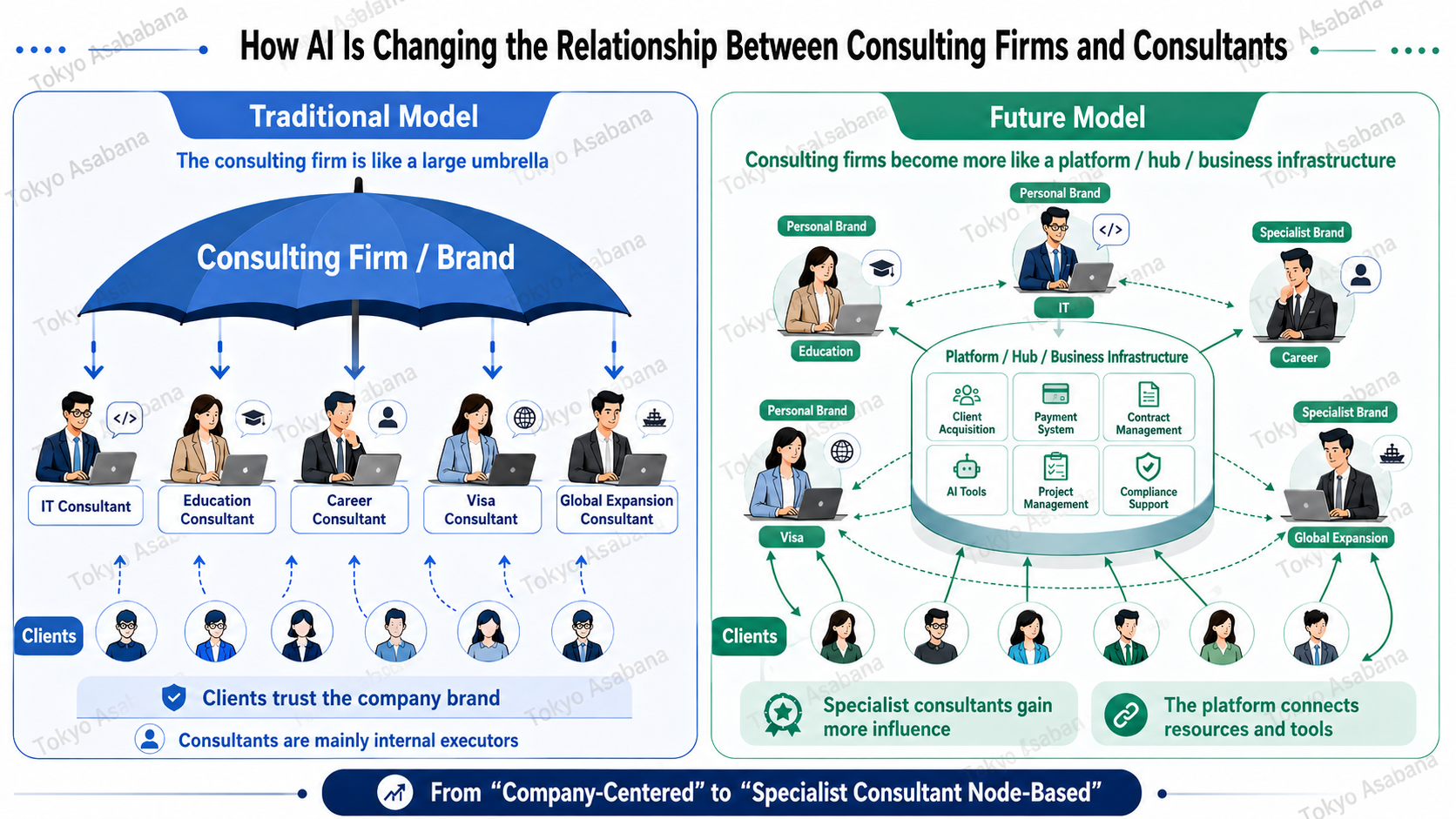
As AI continues to develop, the organizational structure of the consulting industry may undergo a significant transformation.
In the past, the core value of a consulting firm lay in “organization.”
A consulting firm hired different types of consultants internally, then used its brand, sales channels, and project management capabilities to take on various client projects.
What clients purchased was often not the service of one specific consultant, but the service of “a consulting firm.”
In this model, the consulting firm was like a large umbrella.
Under that umbrella were consultants from different fields, each working with their own laptop and expertise.
Clients trusted the brand of the umbrella, while consultants were more like internal executors within the company.
But AI is beginning to change this structure.
First, AI will greatly reduce the basic workload of professional consultants.
Tasks such as information organization, market research, preliminary analysis, copywriting, proposal frameworks, meeting minutes, and client communication drafts — many of which used to require team collaboration — will increasingly be handled by AI.
This means that an excellent individual consultant can use AI to complete a volume of work that previously required a small team.
The productivity of professional consultants will be amplified.
Second, clients’ criteria for evaluating consulting services will gradually shift from “How big is this company?” to “Does this person truly understand my problem?”
In an environment where information is becoming more transparent and AI tools are becoming more widely available, consulting services that rely only on corporate branding and packaging will find it increasingly difficult to build strong barriers.
What clients truly need may not be a beautiful but generic solution.
They need a professional who can accurately understand their situation, assess risks, design a path forward, and support execution.
Therefore, in the future, the market weight of consulting firms may decline, while the influence of highly specialized consultants will increase.
Consulting firms will not necessarily disappear.
But their role may change.
They may gradually move away from being organizations that “hire consultants and sell services under one unified brand,” and become something closer to a platform, a hub, or business infrastructure.
Future consulting firms may function more like professional service platforms.
They may provide client acquisition channels, credibility, payment systems, contract management, compliance support, project management tools, and AI systems.
However, the people who truly build trust with clients, make professional judgments, and deliver the final service will be specialized consultants in different fields.
In other words, the future consulting ecosystem may no longer be centered on “consulting firms with consultants inside them.”
Instead, professional consultants may become the center, while consulting firms become platforms that connect clients, tools, resources, and projects.
This will create a new trend:
The personal brand of consultants will become increasingly important.
In the past, when a consultant left a major firm, they might lose access to clients, organizational credibility, and project resources.
But in the future, if a consultant has a clear professional positioning, consistent content output, verifiable case experience, and AI-enhanced delivery capabilities, they may still be able to gain client trust even without relying on a large consulting firm.
This is especially true in fields such as career planning, education consulting, overseas development, IT career transition, corporate overseas expansion, visa strategy, and small business DX.
In these specialized areas, clients often need “the person who truly understands the problem,” rather than the name of a large consulting company.
AI will not simply replace consultants.
It is more likely to replace low-value, repetitive, and template-based consulting work.
Consultants who have real experience, sound judgment, strong communication skills, and the ability to understand complex human and business realities may become even stronger because of AI.
AI will become their analysis assistant, research assistant, writing assistant, project assistant, and even a 24-hour knowledge base.
Therefore, the core competitiveness of the future consulting industry may shift from “company scale” to:
Individual professional depth × AI capability × client trust.
For consulting firms, the most important task in the future may no longer be simply increasing headcount.
Instead, it will be about building a platform that can gather and empower excellent professional consultants.
For consultants, the most important task may no longer be remaining only as internal executors within a company.
Instead, they will need to build their own professional labels, methodologies, and personal brands that clients can recognize.
The future consulting industry may increasingly resemble a network made up of professional nodes.
Every strong consultant will be an independent professional touchpoint.
AI will amplify their capabilities.
Platforms will connect clients and resources.
And clients will directly search for the person who best fits their specific problem.
This also means that the consulting industry may gradually move from “large-company centralization” toward “specialized individual nodes.”
The AI era does not mean there will be no consultants.
It means ordinary consultants may be eliminated, while strong consultants will be amplified.
Consulting firms will not lose all value either.
But they must transform from “companies that manage consultants” into “platforms that empower consultants.”
In the future, the truly competitive player may not be the largest consulting firm.
It may be the consulting ecosystem that best connects professionals, AI tools, and real client needs.
Tokyo Asabana|東京朝花
Founder: Serena He
Nationally Certified Career Consultant / MBA
Education & Career Strategy Consultant for International Residents in Japan
hello@tokyoasabana.com
This article was picked up by noteマネー.