
Japan is often seen as a country where international students can support themselves through part-time work while studying.
That is partly true—but part-time work rarely covers everything.
很多人咨询日本留学时,都会问:
“我能不能一边打工,一边支付学费和生活费?”
答案不是简单的“Yes”或者“No”。
我曾经体验过两种不同的模式:先是读书期间兼职,后来又在全职工作的同时完成MBA。
虽然都可以叫作“半工半读”,但实际上,这是两种完全不同的生存模式。
Two Different Models|两种完全不同的半工半读
1. Study First, Work Second|主读副工
第一种,是大多数留学生所理解的半工半读:
学习是主业,兼职用于补充生活费。
Let us consider an international student attending a private university in Tokyo.
以下使用一组示例数据进行估算。实际金额会因学校、专业、住房、工作时数与生活方式而不同。
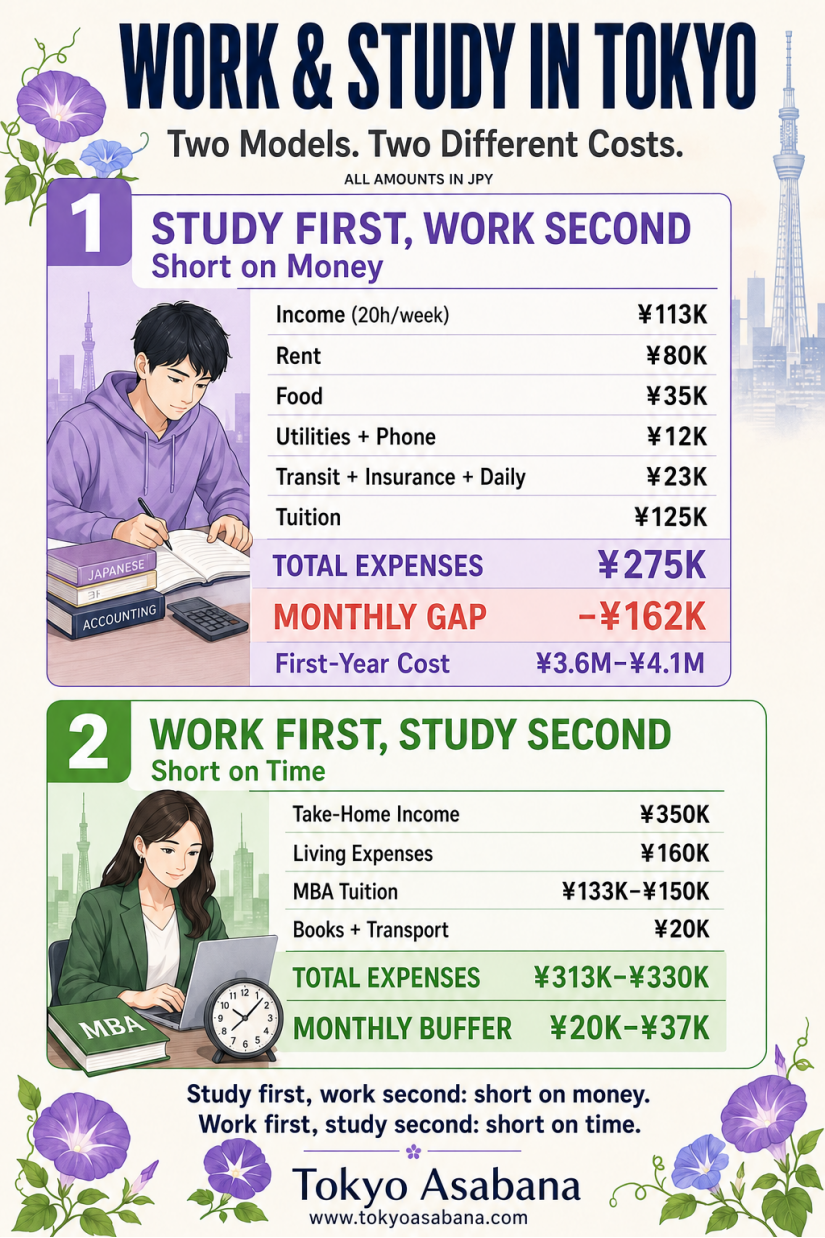
Illustrative monthly income|每月收入估算
- Hourly wage|时薪:¥1,300
- Working time|每周工作时间:20小时
- Monthly part-time income|每月兼职收入:约¥113,000
Illustrative monthly expenses|每月支出估算
- Rent and living expenses|房租及生活费:约¥150,000
- First-year tuition averaged monthly|第一年学费月均:约¥125,000
- Total monthly expenses|每月总支出:约¥275,000
Estimated monthly funding gap|每月资金缺口:约¥162,000
Even if the student works 28 hours per week—the general upper limit for students who have obtained the required permission—the gross monthly income would be approximately ¥158,000.
The funding gap would still be around ¥117,000 per month.
即使按照每周28小时计算,兼职收入仍然很难同时覆盖东京的生活费和私立大学学费。
而且,这还是建立在以下条件之上:
- 每周都能稳定排到足够的班
- 时薪能够达到¥1,300
- 考试期间和学校活动不会影响工作
- 身体状况能够长期承受
- 没有出现搬家、医疗或其他临时支出
Part-time work can support your cash flow, but it should not be treated as a complete education funding plan.
打工可以“补血”,但很难一个人包办学费、房租和全部生活费。
How Much Should You Prepare?|第一年需要准备多少钱?
For a private undergraduate student living in Tokyo, a more realistic first-year budget may include:
- Tuition and admission-related fees
- Rent and daily living expenses
- Initial housing costs
- Insurance, books and transportation
- Emergency savings
- Expenses during periods when part-time work is limited
按照上述模型估算,东京私立大学第一年的整体资金准备,大约需要:
¥3.6 million–¥4.1 million
这不是说每个人一定会花这么多,而是说,准备留学资金时不能只计算“每个月勉强活下去”的费用。
押金、礼金、家具、保险、教材、入学金和突发支出,往往才是最容易被漏掉的部分。
2. Work First, Study Second|主工副读
第二种模式没有那么常见:
全职工作,同时攻读MBA或其他适合在职人士的课程。
I followed this route when completing my MBA in Japan.
However, this model is not simply an extension of the international-student part-time-work route.
It is only possible when your residence status permits full-time employment and when the school program can be combined with your working schedule.
它并不是“拿着留学签证,白天全职上班,晚上顺便读书”。
能否采用这条路线,需要同时确认:
- 在留资格是否允许全职工作
- 学校是否提供夜间、周末或适合在职人士的课程
- 公司是否允许兼顾学习
- 通勤距离与上课时间是否现实
- 自己是否能够长期承担双重压力
An Illustrative Monthly Budget|每月收支示例
- Gross salary|税前工资:约¥450,000
- Take-home income|到手收入:约¥350,000
- Living expenses|生活费:约¥160,000
- MBA tuition averaged monthly|MBA学费月均:约¥133,000–¥150,000
- Books, transportation and study costs|教材、交通及其他学习费用:约¥20,000
Total monthly expenses|每月总支出:约¥313,000–¥330,000
Remaining monthly buffer|每月剩余:约¥20,000–¥37,000
Financially, this model can work.
But the most expensive part is not tuition.
It is time.
老板不会因为你晚上上课,就自动减少白天的工作;
老师也不会因为你白天上班,就自动减少作业。
You may finish work and go directly to class.
You may spend weekends preparing presentations and group assignments.
You may need to complete reports after your colleagues have already gone to sleep.
经济上能够成立,不代表生活上就一定能够持续。
主工副读真正考验的,是时间管理、体力、工作弹性,以及你愿意为学位放弃多少休息和娱乐。
Money or Time?|你真正缺少的是什么?
So, is it possible to work and study in Japan?
Yes—but it is not a magic formula for studying abroad without savings.
两种路线面对的是不同的瓶颈:
主读副工,最缺的是钱。
主工副读,最缺的是时间。
Study-first students need enough savings to survive even when part-time income is lower than expected.
Work-first students need sufficient income, a suitable residence status, a compatible school program and a realistic weekly schedule.
因此,一份真正可持续的计划,不能只回答:
“我能不能去日本?”
它还必须回答:
“我能否把这种生活持续两到四年?”
Before You Decide|决定之前,需要计算什么?
在决定采用哪条路线之前,至少需要确认:
- 学费、入学金及其他学校费用
- 东京或目标城市的实际生活成本
- 可以动用的储蓄
- 家庭是否能够提供紧急支持
- 在留资格与合法工作范围
- 日语或英语能力
- 课程时间与工作时间能否兼容
- 毕业后的职业、创业或长期生活计划
A route that worked for someone else may not work for you.
Their tuition may be lower.
Their employer may be more flexible.
Their family may provide financial support.
Their residence status may also be completely different from yours.
别人的路线可以参考,但你的人生,必须使用自己的计算器。
Tokyo Asabana Support|东京朝花个性化规划
At Tokyo Asabana, I help individuals evaluate education, career, relocation and long-term development options in Japan.
规划可以结合您的:
- Education and professional background|学历与职业经历
- Financial situation|资金与预算
- Language ability|语言能力
- School and program options|学校及项目选择
- Residence status considerations|在留资格相关条件
- Career and business goals|就业、创业与事业目标
- Long-term life plan in Japan|未来在日生活规划
东京朝花不会承诺录取、就业或在留资格审批结果,但可以帮助您判断:一条路线是否现实、需要准备什么,以及它能否与您的长期目标衔接。
Tokyo Asabana
All figures are in JPY and are illustrative planning examples based on Tokyo costs as of September 2026. Actual expenses vary by school, program, housing, employment conditions, tax situation and lifestyle. Students generally need permission before undertaking paid activities outside their residence status. Please confirm current employment and residence-status requirements with Japan’s Immigration Services Agency, your school or a qualified professional.