
For many Singapore companies, international business is already part of the business model.
A company may already serve clients across Southeast Asia, work with international partners, manage regional operations, or have experience entering overseas markets.
Japan, however, can still be difficult to test.
The question is often not whether a Singapore company can operate internationally.
The question is:
How can we test the Japanese market without building a full Japan operation before the opportunity has been validated?
Who are the right potential customers or partners?
Does an existing regional value proposition work in Japan?
Should the product, website, or sales materials be localized?
Who should be contacted inside a Japanese company?
How should outreach and follow-up be handled?
Is a distributor, local partner, direct-sales approach, or another model more appropriate?
And most importantly:
Do you need to establish a Japanese entity or hire a local team before you can begin learning from the market?
For many companies, the answer is no.
A more practical approach is to start small: understand the market, adapt the positioning, identify relevant organizations, conduct targeted outreach, collect actual market feedback, and then decide whether deeper investment is justified.
Tokyo Asabana provides flexible Japan-side market entry and business development support for overseas companies, including Singapore businesses exploring opportunities in Japan.
1. Singapore Companies Are International — but Japan Is Still a Distinct Market
Singapore is a natural base for regional and international business.
Many Singapore companies are already accustomed to working across borders, serving international clients, managing multicultural teams, and operating in multiple markets.
That experience is valuable.
But entering Japan is not simply an extension of entering another Asian market.
A company may already have a strong product, proven business model, established regional customers, and successful experience in Southeast Asia.
It may still have limited visibility into:
- how Japanese companies evaluate overseas vendors;
- which customer segments are realistic targets;
- which departments should be approached;
- how decisions are made inside Japanese organizations;
- what information Japanese stakeholders expect;
- whether the existing value proposition needs adjustment;
- how business materials should be localized;
- and how communication and follow-up should be handled locally.
The challenge is therefore not necessarily a lack of international experience.
It is the gap between an internationally successful business and the specific realities of the Japanese market.
2. Japan Market Entry Is More Than Translation
A common assumption is that localization begins with translating a website, presentation, or sales material into Japanese.
Translation can be important.
But Japan market entry involves a broader question:
Does the existing proposition make sense to Japanese customers and partners?
A Singapore company may say:
“We already serve customers across Asia.”
“We have strong technology.”
“We have an established regional network.”
“Our solution has already succeeded in other markets.”
Those are useful credentials.
But a Japanese prospect may still ask:
Why is this relevant to our organization?
How would implementation work in Japan?
Who provides local support?
Who will coordinate communication?
Does the solution fit Japanese business practices?
What happens after the first meeting?
The overseas track record may be strong while the Japan-side proposition remains unclear.
This is why localization should not be treated only as a language task.
It is also about making an existing business understandable, relevant, and practical in the Japanese context.
3. You Do Not Need to Build a Japan Team Before Testing Japan
Companies sometimes treat international expansion as an all-or-nothing decision.
For Japan, the choice may appear to be:
Establish a Japanese entity, hire local employees, and invest seriously
or
Wait until the company is ready to make that investment.
There is another option.
Before establishing a permanent Japan operation, a company can conduct a smaller market test.
For example:
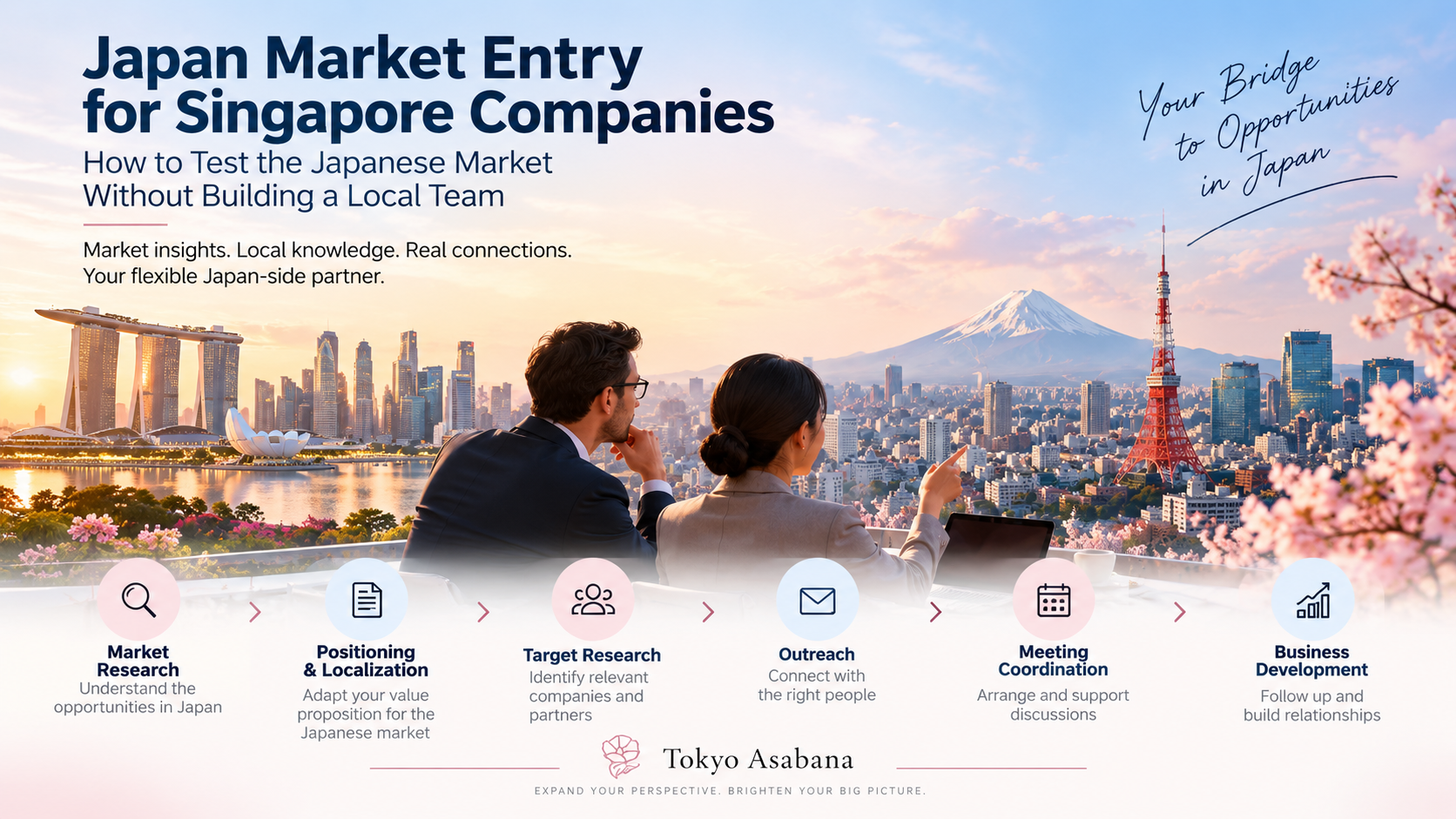
Market Research → Positioning → Localization → Target Research → Outreach → Meetings → Feedback
The purpose is to generate information before making a larger commitment.
Instead of asking:
“Could Japan potentially be a good market for us?”
a company can begin answering more practical questions:
- Which Japanese customer segments appear relevant?
- Which organizations should we approach?
- Which positioning generates interest?
- What questions or objections appear repeatedly?
- Does the existing pricing or business model require adjustment?
- Do potential customers expect Japan-side support?
- Is a distributor, partner, representative, or direct-sales model more appropriate?
- Is there enough evidence to justify further investment?
Early-stage market entry does not need to promise immediate sales.
Its first purpose can be much simpler:
Reduce uncertainty before committing substantial resources.
4. A Practical Japan Market Test for Singapore Companies
A lightweight Japan market-entry project can be structured in stages.
Stage 1 — Understand the Opportunity
First, clarify what the company actually wants to achieve in Japan.
Possible objectives may include:
- finding Japanese B2B customers;
- identifying distributors or commercial partners;
- introducing a SaaS, AI, or digital solution;
- exploring opportunities for technology services;
- identifying potential corporate users;
- developing education or institutional partnerships;
- exploring Japan as an additional market for an existing regional service;
- or simply determining whether Japan deserves further investment.
Different objectives require different targets, positioning, research, and outreach.
Stage 2 — Adapt the Positioning
A proposition that works in Singapore or Southeast Asia may need to be presented differently in Japan.
Depending on the project, this may include:
- reviewing the value proposition;
- identifying which parts of the company’s regional track record are most relevant;
- adapting terminology;
- simplifying or reorganizing sales materials;
- preparing Japanese-language introductions;
- clarifying the business model;
- identifying information gaps;
- and explaining how Japan-side implementation or support would work.
The goal is not to make a Singapore company “look Japanese.”
The goal is to make the proposition easy for Japanese stakeholders to understand and evaluate.
Stage 3 — Identify Relevant Targets
Instead of immediately contacting hundreds of organizations, a company can first identify a smaller number of relevant targets.
Depending on the business, these may include:
- corporate customers;
- technology partners;
- distributors;
- wholesalers;
- professional-service firms;
- educational institutions;
- HR and recruitment companies;
- industry organizations;
- or other strategic partners.
Target research should consider not only the organization itself, but also which department or business function is most relevant.
Stage 4 — Begin Targeted Outreach
Once the target and positioning are clearer, outreach can begin.
The objective is not simply to send as many messages as possible.
It is to generate useful market interaction.
Responses — including negative responses — can provide valuable information.
If several Japanese companies raise the same concern, that is market feedback.
If one customer segment responds while another consistently shows little interest, that is market feedback.
If prospects like the product but hesitate because there is no Japan-side support, that is also market feedback.
Early-stage business development can therefore function as both:
business development and market research.
Stage 5 — Decide Whether to Scale
After an initial test, the company has more information for its next decision.
It may decide to:
- continue targeted outreach;
- deepen relationships with specific prospects;
- change the positioning;
- identify a distributor or local partner;
- increase localization;
- conduct further market research;
- build a structured Japan sales pipeline;
- develop a longer-term Japan-side business development function;
- establish a local presence;
- or postpone expansion until the timing is more appropriate.
The important point is that the next decision is based on actual market interaction rather than assumptions.
5. How Tokyo Asabana Can Support Singapore Companies
Tokyo Asabana works as a flexible Japan-side partner for overseas companies that want to explore Japan without immediately building their own local team.
Depending on the agreed project scope, support may include:
Japan Market Research
Researching relevant industries, customer segments, companies, institutions, competitors, market characteristics, and potential entry paths.
Business Localization
Reviewing and adapting company introductions, proposals, service descriptions, outreach messages, and other business materials for the Japanese market.
Target Research
Identifying relevant Japanese companies, institutions, potential partners, departments, and business contacts.
Japan-side Outreach
Supporting targeted communication with Japanese organizations based on an agreed scope and positioning.
Meeting Coordination
Helping coordinate communication and meetings between Singapore companies and Japanese organizations.
Business Development Support
Supporting early-stage relationship building, follow-up, market feedback collection, partner development, and Japan-side coordination.
Multilingual Cross-border Communication
Supporting cross-border business communication in English, Japanese and Chinese, helping international companies communicate more effectively with relevant stakeholders in Japan and across Asia.
Education and Institutional Outreach
For education, EdTech, career, international mobility, and related organizations, Tokyo Asabana can also support outreach to relevant Japanese educational institutions and organizations.
Coordination with Relevant Specialists
Where a project involves regulated matters such as legal, immigration, tax, food regulation, licensing, or other professional services, Tokyo Asabana can coordinate with relevant specialists rather than providing regulated professional advice directly.
6. Who This Service Is For
This approach may be particularly suitable for:
- Singapore SaaS companies exploring Japanese corporate customers;
- AI and technology companies considering Japan as an additional international market;
- IT and digital-service companies without an established Japan sales team;
- professional-service and consulting firms whose clients require Japan-side support;
- EdTech, HRTech, and international education companies exploring Japanese organizations or partners;
- international mobility companies looking to add Japan to their existing services;
- consumer or B2B companies exploring potential Japanese distributors, partners, or channels;
- and Singapore companies that already operate internationally but do not yet have their own Japan-side capability.
Tokyo Asabana is particularly suited to companies that already have a real product, service, track record, or customer base and now need support understanding how that existing value can be introduced into Japan.
7. What Tokyo Asabana Does Not Promise
Market entry is not the same as guaranteed sales.
No Japan-side partner can responsibly guarantee that a particular Japanese company will purchase a product, that a specific number of customers will be acquired, or that a particular partnership will be established.
Tokyo Asabana therefore does not position market-entry support as a promise of sales results.
Instead, the objective is to help overseas companies:
- reduce information gaps;
- improve Japan-side positioning;
- identify more relevant organizations;
- communicate with the Japanese market;
- conduct structured market tests;
- collect useful feedback;
- and make better-informed expansion decisions.
For a company genuinely considering Japan, reducing uncertainty before making a larger investment can itself have substantial value.
8. Start Small. Learn from Japan. Then Scale.
Entering Japan does not have to begin with a subsidiary, permanent office, or full local sales team.
It can begin with a much simpler question:
Is there a real opportunity for our business in Japan?
Then test it.
Research the market.
Adapt the proposition.
Identify the right organizations.
Start conversations.
Collect feedback.
Decide what the evidence justifies.
For many Singapore companies, this can be a practical way to approach Japan.
You do not need to build a Japan team before you test the Japanese market.
Tokyo Asabana can serve as a flexible Japan-side partner during that early stage — helping bridge the gap between a Singapore business and the people, organizations, and opportunities it wants to reach in Japan.
For Singapore Companies Exploring Japan
If your company already has an established product or service and is considering the Japanese market, Tokyo Asabana can support an initial discussion, market-entry assessment, or customized Japan-side project.
Services can be structured according to the actual scope of the project, from initial consultation to research, localization, target identification, outreach, meeting coordination, and ongoing business development support.
Tokyo Asabana
Start small. Test the market. Learn from Japan. Then scale.