
For a Singapore company considering Japan, one of the first practical questions is simple:
How much does it actually cost to test the Japanese market?
The answer depends on what you mean by “entering Japan.”
Establishing a Japanese entity, hiring employees, opening an office, building a local sales team, and launching a full commercial operation can require substantial time and investment.
But an early-stage Japan market test is different.
If your company already has a proven product, service, customer base, or international track record, you may not need to build a complete Japan operation before learning whether the market is worth pursuing.
Instead, you can begin with a smaller question:
Can we gather enough real evidence from Japan to decide whether deeper investment makes sense?
For many Singapore companies, this can be a more practical starting point.
1. “Entering Japan” Can Mean Very Different Things
There is no single cost for Japan market entry because companies enter the market in different ways.
One company may simply want to understand:
- whether Japanese customers have a need for its product;
- who its likely competitors are;
- which industries or customer segments should be targeted;
- and whether its existing positioning works in Japan.
Another may already be ready to:
- identify potential customers;
- find distributors or commercial partners;
- localize business materials;
- conduct B2B outreach;
- arrange meetings;
- or begin developing a Japan-side pipeline.
A more advanced company may be considering:
- hiring local employees;
- establishing a Japanese entity;
- signing distribution agreements;
- building a permanent sales function;
- or making a long-term investment in Japan.
These are completely different levels of market entry.
So before asking:
“How much does Japan market entry cost?”
it is more useful to ask:
“What do we need to learn or accomplish at this stage?”
2. Start with the Smallest Useful Test
For many Singapore companies, the first step does not need to be a major investment.
A practical early-stage test might include:
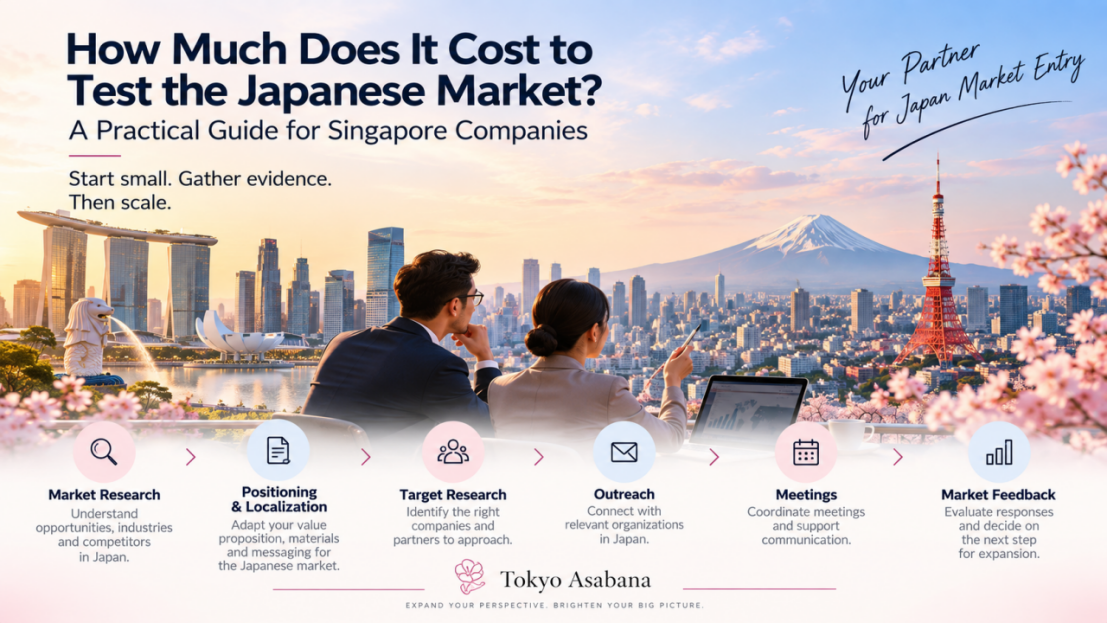
Market Research → Positioning & Localization → Target Research → Outreach → Meetings → Market Feedback
Each stage answers a different question.
Market Research
What does the Japanese market look like?
Who are the competitors?
Which industries, companies, or customer groups appear relevant?
Positioning & Localization
Does your existing Singapore or regional proposition make sense to Japanese customers?
What information needs to be adapted?
Which parts of your international track record matter most in Japan?
Target Research
Which Japanese companies, organizations, distributors, institutions, or partners should you actually approach?
Who inside those organizations is relevant?
Outreach
Will relevant Japanese organizations respond to the proposition?
What questions, objections, or concerns appear?
Meetings
Can initial interest develop into meaningful business discussions?
What additional information do Japanese stakeholders require?
Market Feedback
After real market interaction, what have you learned?
Should you continue?
Change the positioning?
Target another segment?
Find a local partner?
Invest more?
Or pause?
This is why a market test can be valuable even before it produces sales.
Its purpose is to replace assumptions with evidence.
3. The Cost Depends on the Scope
A Japan market test can be very small or relatively extensive.
For example, a company that only needs an initial discussion about its Japan strategy may require very little work.
A company requesting:
- detailed market research;
- competitor analysis;
- localization;
- a customized target list;
- decision-maker research;
- B2B outreach;
- follow-up;
- meeting coordination;
- and ongoing business development
is asking for a substantially larger project.
Tokyo Asabana therefore does not treat all Japan market-entry projects as identical packages.
The appropriate scope depends on:
- the product or service;
- industry;
- current stage of expansion;
- target customer;
- existing Japan resources;
- amount of research required;
- number of organizations to be approached;
- expected project duration;
- and the level of Japan-side execution required.
4. A Low-Cost Starting Point: Preliminary Discussion
For companies that are still determining what kind of Japan support they need, Tokyo Asabana offers a preliminary discussion.
30-Minute Preliminary Discussion — JPY 4,400
This is designed for companies that want to explain their current situation and determine whether there is a realistic fit with Tokyo Asabana’s services.
Typical topics may include:
- your current business;
- why you are considering Japan;
- your product or service;
- target customers or partners;
- existing Japan resources;
- current market-entry stage;
- expected timeline;
- and the type of Japan-side support you may require.
The preliminary discussion is not a market research or strategy project.
The JPY 4,400 fee covers the discussion itself.
It does not include customized market research, target-company research, competitor analysis, written strategy, outreach, or other project deliverables.
If further work is appropriate, the next scope can then be defined separately.
5. From Preliminary Discussion to a Japan Market Test
A company does not need to jump directly from a 30-minute conversation to a large market-entry project.
The process can develop gradually.
For example:
Preliminary Discussion
↓
Consultation / Research
↓
Small Market Test
↓
Targeted Business Development
↓
Partnership Development
↓
Longer-term Japan-side Support
↓
Local Presence, if justified
The purpose of this structure is simple:
Investment should increase as evidence increases.
A company that has not yet tested Japan may not need the same level of commitment as a company that already has active prospects, partners, or customers in the market.
6. What Might a Japan Market Test Include?
Depending on the agreed scope, Tokyo Asabana can support areas such as:
Market Research
Understanding the Japanese market, relevant industries, competitors, potential customer segments, and market characteristics.
Positioning and Business Localization
Reviewing how an existing product or service should be explained to Japanese stakeholders.
This may include adapting:
- company introductions;
- service descriptions;
- sales messages;
- presentations;
- outreach messages;
- and other business materials.
Target Research
Identifying relevant:
- Japanese companies;
- potential customers;
- distributors;
- business partners;
- institutions;
- departments;
- and other organizations.
B2B Outreach
Contacting selected Japanese organizations according to an agreed target profile and business proposition.
Meeting Coordination
Supporting communication and coordination when relevant Japanese organizations show interest.
Multilingual Cross-border Communication
Supporting cross-border business communication in English, Japanese and Chinese, helping overseas companies communicate effectively with relevant stakeholders in Japan.
Market Feedback
Organizing what has been learned through research, outreach, responses, meetings, and other market interactions.
Business Development Support
Where appropriate, continuing follow-up, relationship development, partner communication, and other Japan-side commercial activities.
7. Why Test Before Building a Local Team?
Singapore companies often have significant international experience.
But experience in Southeast Asia or other overseas markets does not automatically answer Japan-specific questions.
Before hiring employees or establishing a permanent operation, a company may want evidence about:
- actual Japanese customer interest;
- realistic target segments;
- local pricing expectations;
- competitive positioning;
- business communication;
- localization requirements;
- sales cycles;
- channel structure;
- and whether Japan-side support is necessary.
A relatively small market test may reveal that the opportunity is stronger than expected.
It may also reveal that the positioning needs to change.
Or it may show that Japan should not yet be a priority.
All three outcomes are useful.
The purpose of testing is not to prove that Japan is a good market.
The purpose is to generate enough information to make a better business decision.
8. What Tokyo Asabana Does — and Does Not — Provide
Tokyo Asabana provides flexible Japan-side support in areas such as:
- market research;
- business localization;
- target research;
- B2B outreach;
- meeting coordination;
- partner development;
- cross-border communication in English, Japanese and Chinese;
- and business development support.
Tokyo Asabana does not guarantee:
- sales;
- a particular number of customers;
- successful partnerships;
- investment results;
- or specific commercial outcomes.
Where a project involves regulated matters such as legal advice, taxation, immigration, licensing, food regulation, or other specialist areas, the relevant work should be handled by appropriately qualified professionals.
Tokyo Asabana can support coordination with relevant specialists where required.
9. So, How Much Should a Singapore Company Budget?
There is no responsible single answer without knowing the scope.
A preliminary conversation may begin at:
JPY 4,400 / 30 minutes
A customized research, market-testing, outreach, or business-development project requires a separate scope and quotation.
The more useful budgeting principle is therefore:
Do not begin by asking how much it costs to “enter Japan.”
Begin by defining the smallest useful piece of evidence you need from Japan.
Then decide what level of research, localization, outreach, and Japan-side execution is necessary to obtain it.
This keeps the first investment proportionate to the level of uncertainty.
10. Start Small. Gather Evidence. Then Scale.
Japan market entry does not need to begin with a large commitment.
For a Singapore company, the first investment can simply be enough to answer:
Who should we target?
Does our proposition work?
Will Japanese organizations talk to us?
What does the market tell us?
What should we do next?
Once those questions begin to produce real answers, the company can make a more informed decision about larger investments.
Start small. Gather evidence. Then scale.
That is often a more practical way to test the Japanese market.
For Singapore Companies Exploring Japan
If your company already has an established product, service, customer base, or international track record and is considering Japan, Tokyo Asabana can support an initial discussion or customized Japan market-entry project, with cross-border communication available in English, Japanese and Chinese.
30-Minute Preliminary Discussion
JPY 4,400
For larger projects, the scope and quotation can be determined based on your actual Japan-market objectives.
Tokyo Asabana
Market insights. Local knowledge. Real connections.
Your flexible Japan-side partner.