
Entering the Japanese market is an important business decision for overseas companies. However, successful expansion requires more than identifying Japan as an attractive destination.
Companies need to understand whether their services are suitable for local customers, whether commercial opportunities can be validated, and how to develop business relationships in Japan.
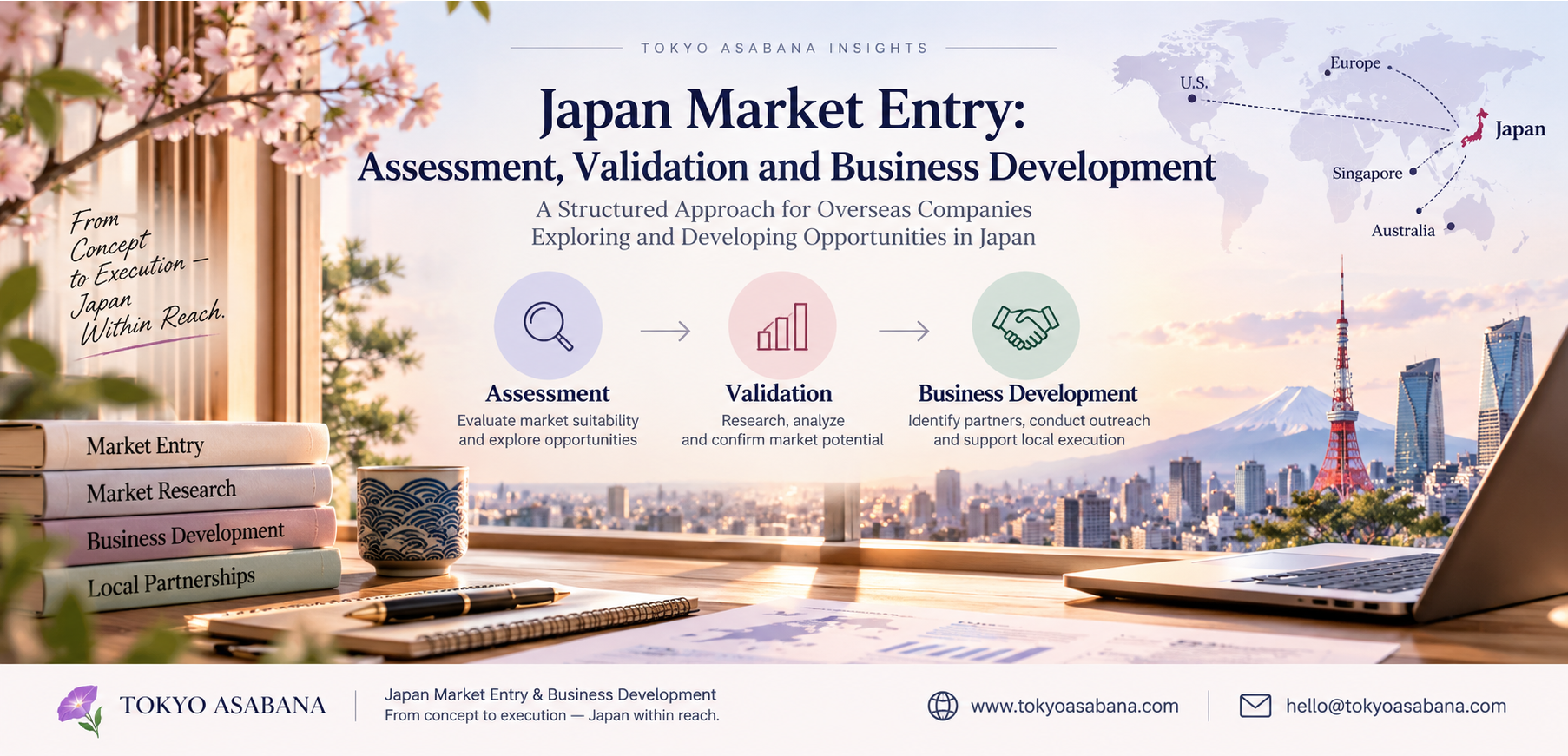
Japan market entry is not a single activity. It is a process that moves from assessment to validation and, when appropriate, business development.
At Tokyo Asabana, we organize our Japan market entry support around these three stages.
1. Stage One: Japan Market Entry Assessment
The first question is not how to enter Japan, but whether entering Japan makes commercial sense.
Overseas companies often begin with a general interest in the Japanese market.
They may have an established business overseas, a competitive service offering, or experience expanding into other countries.
However, these advantages do not automatically translate into demand in Japan.
An initial market entry assessment helps companies examine fundamental questions:
- What business objectives does the company hope to achieve in Japan?
- Which Japanese customer segments might benefit from its services?
- How does the company’s existing business model fit local market conditions?
- What language, cultural, regulatory, or operational barriers may exist?
- What resources would be required to pursue the opportunity?
For example, a U.S.-based education company exploring Japan may need to consider how its services relate to Japanese educational pathways and customer expectations.
An Australian international services provider may face different questions involving local partnerships, customer acquisition, and service delivery.
A Singapore-based technology or professional services company may need to evaluate its competitive positioning and the practical requirements of approaching Japanese corporate customers.
These examples illustrate an important principle:
Different industries, services, and countries of origin require different market entry assessments.
There is no universal Japan market entry strategy.
What Does an Initial Assessment Deliver?
An initial assessment provides a structured discussion of the company’s objectives, potential opportunities, key challenges, and possible next steps.
It helps decision-makers determine whether further investment in market research or business development is justified.
It is not a substitute for comprehensive market research, nor does it guarantee that a commercially viable opportunity exists.
Its value lies in helping companies make an informed initial decision.
2. Stage Two: Market Validation and Research
Once a company identifies a potentially attractive opportunity, the next step is to examine whether its assumptions are supported by the market.
Market interest and validated business demand are not the same thing.
A service may appear relevant to Japanese customers, but important questions may remain unanswered.
For example:
- Is the proposed target customer segment sufficiently defined?
- What alternatives are already available in Japan?
- How do local customers compare service providers?
- Is the overseas company’s pricing commercially realistic?
- Which sales channels or partnership models may be appropriate?
- What would make the company’s offering different from existing competitors?
Market validation can involve secondary research, competitor analysis, customer segment evaluation, business model review, and other agreed research activities.
Depending on the project, it may also involve preliminary discussions with relevant market participants, subject to a separately agreed scope.
Why Validation Matters
Consider an overseas IT services company interested in Japanese corporate customers.
The company may have strong technical capabilities and an established delivery team.
However, Japanese clients may evaluate potential suppliers based on factors beyond technical expertise, including communication arrangements, project management, information security requirements, contractual responsibilities, and long-term support.
Similarly, an international education provider may need to understand how Japanese families evaluate overseas programs, how decisions are made, and whether the service addresses a sufficiently specific need.
A professional services company may need to identify which industries or business sizes are most likely to consider an overseas provider.
These questions cannot always be answered through general market statistics alone.
Market validation helps transform an attractive business idea into a more realistic commercial hypothesis.
It can also reveal that a company should refine its offering, narrow its target market, or postpone expansion.
That is a valuable outcome in itself.
3. Stage Three: Japan-side Business Development
When a company has a sufficiently clear market proposition and is ready to invest in execution, it may proceed to active business development.
This is where market entry moves beyond analysis.
Business development in Japan requires sustained communication, relationship building, and practical coordination.
Potential activities may include:
- Identifying relevant Japanese companies, institutions, or potential business partners.
- Developing target lists based on agreed criteria.
- Preparing localized business communication materials.
- Conducting initial business outreach.
- Coordinating introductions and meetings.
- Supporting multilingual business communication.
- Managing follow-up activities and project coordination.
The exact activities depend on the company’s objectives, resources, and agreed project scope.
Why Local Execution Matters
An overseas company may have an excellent service but limited capacity to communicate with Japanese organizations.
Differences in business language, decision-making processes, organizational structures, and commercial expectations can create practical challenges.
For example, an Australian company exploring Japan-related international services may require local partner coordination.
A Singapore-based company considering Japanese corporate clients may need a more targeted approach to business outreach and relationship development.
An overseas education company may need to determine which types of institutions or commercial partners are relevant before beginning outreach.
In each situation, the execution strategy should reflect the company’s actual business model.
Simply sending large numbers of emails is not equivalent to building a sustainable market presence.
Effective business development requires appropriate targeting, clear value propositions, consistent follow-up, and realistic expectations.
4. Why These Three Stages Should Be Separated
One common challenge in international expansion is attempting to combine assessment, research, and execution into a single undefined project.
A company may ask for an initial opinion about Japan but also expect competitor research, introductions, partner identification, and business development recommendations.
These activities require different levels of work.
Separating them creates greater clarity for both the overseas company and its Japan-side service provider.
| Stage | Main Objective | Typical Output |
| Assessment | Understand initial market suitability | Preliminary evaluation and recommendations |
| Validation | Examine market assumptions and opportunities | Research findings and strategic considerations |
| Business Development | Pursue defined commercial opportunities | Agreed outreach, coordination, and implementation activities |
Not every company needs all three stages.
Some companies may only require an initial assessment before deciding not to proceed.
Others may already have conducted substantial research and need practical Japan-side support.
Established companies with a clear target market may be ready to begin business development immediately.
The appropriate starting point depends on the company’s existing knowledge, commercial readiness, and objectives.
5. Why Japan Market Entry Requires a Realistic Budget
International market development requires professional resources.
Even before a company secures its first Japanese customer, meaningful work may be necessary.
This can include researching potential markets, identifying organizations, adapting communication materials, conducting outreach, and coordinating follow-up activities.
Some overseas businesses initially prefer commission-only arrangements, under which a local partner receives compensation only after a sale.
Such arrangements may be suitable for certain referral relationships.
However, occasional referrals and active market development are fundamentally different services.
Active business development requires time and effort regardless of whether an eventual commercial transaction occurs.
For this reason, Tokyo Asabana provides structured research, outreach, and business development support on a fee-based basis.
Occasional referral arrangements may be considered separately where appropriate.
A market entry budget is not a guarantee of sales. It is an investment in professional work designed to evaluate and pursue commercial opportunities.
Clear project scopes, deliverables, and expectations help companies manage that investment responsibly.
6. Different Companies Need Different Japan Strategies
Through business discussions with overseas organizations across markets such as the United States, Australia, and Singapore, one point becomes especially clear:
A company’s country of origin does not determine its Japan strategy. Its business model, target customers, resources, and objectives matter far more.
Two education companies from the same country may require completely different approaches.
An education business serving individual families has different commercial needs from a company developing institutional partnerships.
Similarly, an IT company offering outsourced software development requires a different strategy from a business selling a specialized technology product.
A professional services company seeking occasional referrals may not need the same level of Japan-side support as a company planning systematic customer acquisition.
This is why Tokyo Asabana does not treat Japan market entry as a standardized package with identical activities for every client.
Instead, we begin by clarifying the business objective and identifying the most appropriate level of support.
7. From Market Understanding to Practical Execution
Japan can offer meaningful opportunities for overseas companies, but successful international expansion depends on preparation, commercial judgment, and effective execution.
A company should not invest in extensive business development simply because Japan appears attractive.
Nor should it assume that a promising market assessment automatically guarantees future sales.
The three-stage approach provides a practical framework:
Assessment: Is Japan a suitable market for this business?
Validation: Are the proposed opportunities commercially realistic?
Business Development: How can the company pursue those opportunities in practice?
These stages help businesses allocate resources more deliberately and understand what each engagement is intended to achieve.
How Tokyo Asabana Supports Overseas Companies
Tokyo Asabana is a Tokyo-based business advisory and coordination service supporting overseas companies exploring or developing opportunities in Japan.
Our work covers Japan market entry advisory, market validation, business development, partnership coordination, and multilingual business communication.
We work across different business sectors and support communication in Chinese, Japanese, and English.
Our engagement models include:
Corporate Pre-Consultation: An initial paid discussion to clarify business objectives and potential directions.
Corporate Advisory: Structured consultation and strategic recommendations.
Market Validation & Research: Research projects based on an agreed scope.
Japan-side Business Development: Targeted outreach, partner coordination, and practical implementation support.
Each service is arranged according to the client’s needs. Detailed research and active business development are quoted separately.
Tokyo Asabana does not guarantee customer acquisition, partnerships, or sales results.
Our objective is to help overseas companies make informed decisions and pursue Japan-related business opportunities through clearly defined professional services.
From concept to execution — Japan within reach.
Tokyo Asabana | Japan Market Entry & Business Development
Website: https://www.tokyoasabana.com
Services & Transparent Pricing: https://tokyoasabana.stores.jp/
Email: hello@tokyoasabana.com
Related Reading
Tokyo Asabana Insights|Japan Market Entry for Small Companies: A Practical 90-Day Plan
Tokyo Asabana Insights|From Market Research to Business Development in Japan