
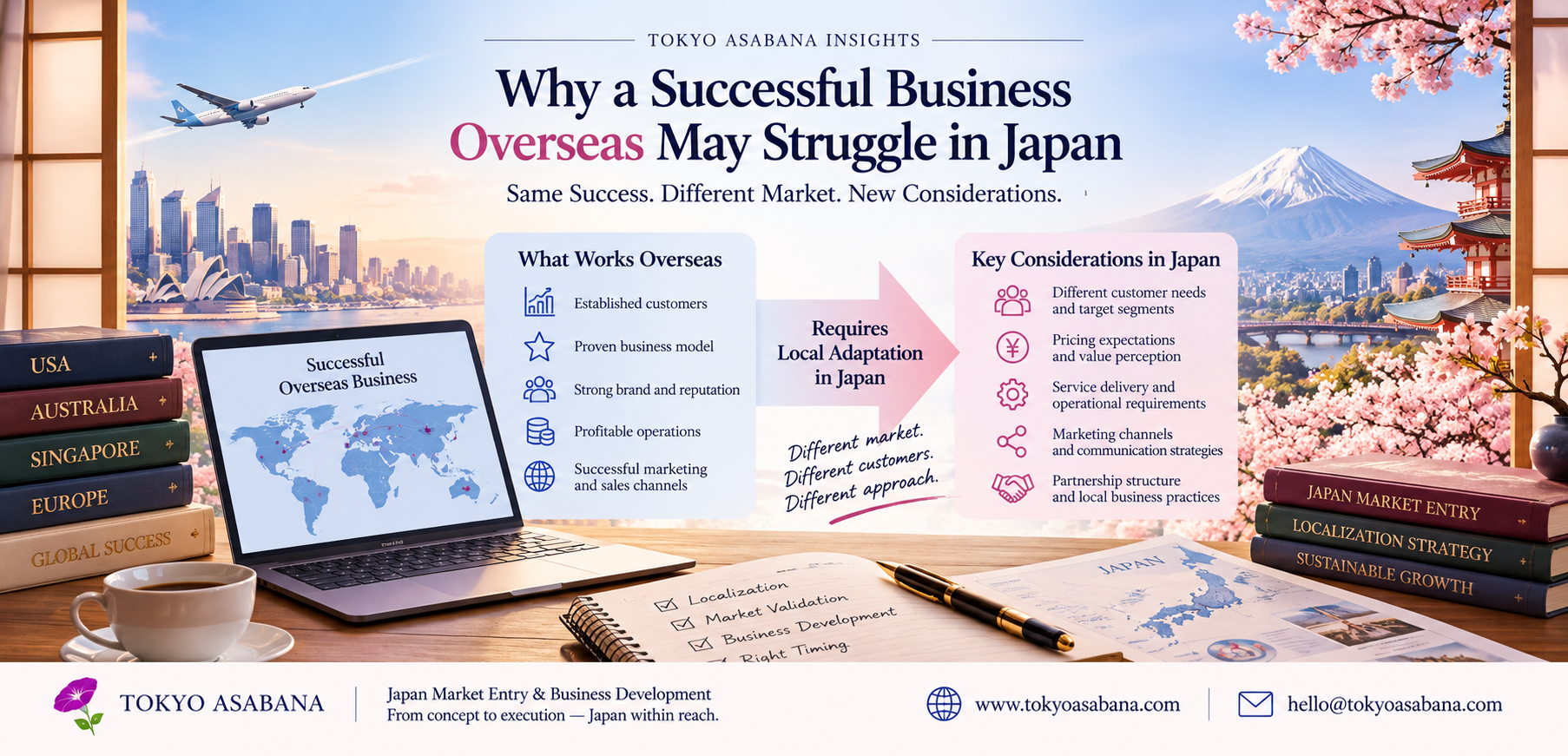
A company may have a successful business in the United States, Australia, Singapore, or another international market.
It may have an established customer base, a strong reputation, experienced employees, and a profitable business model.
Naturally, Japan may appear to be an attractive next step.
However, one of the most important lessons in international business expansion is that success in one market does not automatically translate into success in another.
A service that sells well overseas may struggle to attract Japanese customers.
A pricing model that works in one country may not match local purchasing expectations.
A successful marketing strategy may generate little interest in Japan.
And a business model that depends on particular partnerships or sales channels may be difficult to reproduce.
This does not necessarily mean the company has a poor product or service.
It may mean that its existing business model has not yet been sufficiently adapted to the Japanese market.
Understanding this distinction is essential before investing heavily in Japan market entry.
1. A Successful Product Does Not Always Solve the Same Problem in Japan
One of the first questions overseas companies should ask is:
Does our service solve a meaningful problem for Japanese customers?
A product may be highly successful in its home market because it addresses a specific customer need.
However, the same need may be less common, less urgent, or already addressed differently in Japan.
For example, an overseas education company may provide services designed around the educational system, admission requirements, and career pathways of its home country.
Those services may be valuable to certain Japanese families, but their relevance will depend on the families’ educational goals and circumstances.
Similarly, an overseas IT company may offer solutions that address common operational problems in its domestic market.
Japanese businesses may face similar problems, but they may already use different systems, processes, or service providers.
A professional services company may offer a successful advisory model overseas, yet Japanese customers may have different expectations regarding the scope of advice, implementation support, and ongoing relationships.
The important question is not simply whether the service is good.
It is whether the service addresses a sufficiently important need in the target Japanese customer segment.
Product quality and local market suitability are two different questions.
2. The Target Customer May Be Different
Overseas companies sometimes assume that their ideal customers in Japan will resemble their existing customers abroad.
This assumption can lead to ineffective marketing and business development.
For example, a service purchased directly by individual consumers in one country may be purchased through institutions or corporate arrangements in another.
An overseas education provider may primarily serve individual families in its home market.
In Japan, however, certain services may be more relevant to specific groups of families, educational institutions, or organizations supporting international education.
An IT services company may successfully serve small businesses overseas but discover that its Japanese opportunities are concentrated in a different customer segment.
A professional services firm may find that its most relevant Japanese clients are not the same types of organizations it typically serves elsewhere.
These are possibilities to investigate, not assumptions to accept without validation.
Before beginning outreach, overseas companies should consider:
- Who experiences the problem the service is designed to solve?
- Who makes the purchasing decision?
- Who controls the budget?
- Who influences the selection of service providers?
- Which customer segments have a realistic reason to purchase?
The end user, the decision-maker, and the paying customer are not always the same person or organization.
Understanding these roles can significantly change a market entry strategy.
3. Pricing Must Be Evaluated Against Local Value
Pricing is another area where successful overseas companies may encounter difficulties.
A company may have a well-established price structure in its home market.
However, directly converting that price into Japanese yen does not establish whether it is commercially appropriate for Japan.
The relevant questions include:
- What alternatives are available to Japanese customers?
- How do customers evaluate the value of the service?
- What outcomes or benefits justify the price?
- Is the service purchased as a one-time project, subscription, or ongoing engagement?
- What additional costs are involved in delivering the service in Japan?
A premium-priced service can succeed in Japan if the target customers recognize sufficient value.
Conversely, a relatively inexpensive service may struggle if customers do not understand why they need it.
This is particularly relevant to professional services, international education, software solutions, and specialized B2B offerings.
Localization does not automatically mean lowering prices. It means understanding how customers evaluate value in the local market.
A company may need to adjust its package structure, payment terms, service scope, or value proposition rather than simply offer a discount.
4. The Delivery Model May Not Transfer Easily
A company may attract interest from Japanese customers but still encounter problems delivering its services.
This is because commercial success depends on more than generating demand.
Customers also need confidence that the company can fulfill its commitments.
For example, an overseas IT services provider may need to clarify project management responsibilities, technical communication, support arrangements, and information security expectations.
An education company may need to explain how consultations, applications, documentation, and customer support will be handled across borders.
A professional services firm may need to define which activities can be delivered remotely and which require coordination with qualified local specialists.
In some sectors, regulatory requirements or professional licensing may also affect what services can legally be provided and by whom.
These issues should be evaluated before promising services to Japanese customers.
A business model is not ready for Japan simply because customers might be interested. The company must also be capable of delivering the service reliably.
This may require changes to internal processes, customer communication, contractual arrangements, or local partnerships.
5. Successful Overseas Marketing May Not Work in Japan
An overseas company may have an effective marketing strategy in its home market.
It may generate customers through social media, online advertising, referrals, direct outreach, or established industry relationships.
However, the same channels may not perform equally well in Japan.
Different customer segments may rely on different sources of information when evaluating unfamiliar providers.
The language of the marketing materials is only one consideration.
Companies must also examine whether their messaging addresses the priorities of Japanese customers.
A marketing campaign emphasizing international recognition may be persuasive in one market but insufficient in another.
A message focused on low prices may fail to communicate the service quality or reliability expected by the intended customers.
Similarly, a company may receive website visits or inquiries without attracting commercially qualified prospects.
Marketing visibility does not automatically mean market demand.
Before investing heavily in promotion, overseas companies should identify the customer segments they want to reach and understand how those customers make purchasing decisions.
6. Local Partnerships Are Not a Substitute for a Viable Business Model
Some overseas companies assume that finding a Japanese partner will solve their market entry challenges.
A local partner may provide valuable support with communication, introductions, distribution, or business coordination.
However, the existence of a partnership does not automatically create customer demand.
Both parties need a clear commercial reason to cooperate.
For example, a Japanese company may be willing to discuss an overseas service without having a specific customer requirement.
An institution may express general interest in international cooperation without having the budget or internal resources to implement a project.
A potential partner may also have different expectations regarding pricing, responsibilities, exclusivity, or commercial risk.
Before pursuing a partnership, overseas companies should clarify:
- What value does each party contribute?
- Which customers or opportunities would the partnership address?
- Who is responsible for sales and service delivery?
- How would costs, responsibilities, and commercial benefits be allocated?
- What would make the relationship sustainable?
A business partnership should support a commercially viable proposition, not replace the need to establish one.
7. Japan Market Entry Is Not Simply a Translation Project
Many companies begin localization by translating their website, brochures, or presentations into Japanese.
This can be useful, especially when communicating with Japanese customers and organizations.
However, translation alone cannot resolve fundamental differences in customer needs, pricing, service delivery, or business processes.
A Japanese-language website may describe a service accurately while failing to explain why the service is relevant to Japanese customers.
A translated overseas sales presentation may still rely on assumptions that do not apply to the target market.
A business may also need to adjust its service packages, communication processes, or customer support arrangements.
This is why localization should be understood as a commercial activity rather than only a linguistic one.
True business localization means adapting the offering, positioning, and delivery model to the needs of the target market.
The objective is not to make an overseas business appear Japanese.
It is to make its value understandable, relevant, and deliverable in Japan.
8. Different Products May Require Different Japan Strategies
A company with multiple products or service lines should not automatically apply one Japan market entry strategy to its entire business.
Even when products share the same brand, they may serve different customers, address different needs, and require different sales channels.
For example, an international education company may offer individual advisory services, institutional programs, and research-related opportunities.
Each service may have a different potential customer base in Japan.
An IT company may provide software development, technology consulting, and a proprietary digital product.
These services may require different positioning, pricing, and business development approaches.
A professional services company may offer both individual consultations and long-term corporate projects.
The target customers and purchasing processes may be entirely different.
A company can have a strong overall business while only some of its products are commercially suitable for Japan.
This is not necessarily a weakness.
It may provide an opportunity to prioritize the services with the clearest potential before investing in broader expansion.
9. Why Market Assessment Should Come Before Large-Scale Execution
Overseas companies sometimes move directly from identifying Japan as an attractive market to investing in advertising, outreach, or local partnerships.
However, without an initial assessment, these activities may be based on assumptions that have not been tested.
A more structured approach can help companies allocate resources more effectively.
At Tokyo Asabana, we organize Japan market entry support around three stages.
Stage 1 — Japan Market Entry Assessment
Evaluate the company’s objectives, business model, service suitability, potential target customers, and initial market challenges.
The purpose is to identify whether further exploration is justified and which services or customer segments may deserve priority.
Stage 2 — Market Validation & Research
Examine market assumptions through more detailed research into competitors, customer segments, pricing, commercial positioning, and possible business channels.
The purpose is to determine whether the proposed opportunity has a sufficiently realistic commercial basis.
Stage 3 — Japan-side Business Development
Support practical activities such as target identification, localized business communication, outreach, follow-up, and potential partner coordination.
The purpose is to pursue defined opportunities through an agreed scope of professional work.
Not every company needs all three stages.
Some businesses may discover during assessment that they should adjust their offering or postpone expansion.
Others may already have a suitable business model and require practical Japan-side execution support.
The appropriate starting point depends on the company’s readiness, objectives, and available resources.
10. Sometimes the Right Decision Is Not to Enter Japan Yet
One of the most important responsibilities of a market entry advisor is to distinguish between an attractive market and an appropriate business opportunity.
Japan may be a desirable destination for international expansion.
However, a company may not yet have the necessary market understanding, operational capacity, or commercial resources.
Its existing services may require substantial adaptation.
Its target customers may be too narrowly defined.
Or the potential commercial return may not justify the required investment at the current stage.
In such situations, recommending further preparation or a narrower market approach can be more valuable than encouraging immediate expansion.
Professional market entry advice should help companies make better business decisions, including the decision not to proceed.
An assessment that identifies important limitations is not a failed engagement.
It can help a company avoid unnecessary spending and focus on opportunities that better match its capabilities.
Conclusion: Success Abroad Is a Starting Point, Not a Guarantee
A successful overseas business has already demonstrated that it can create value for customers in at least one market.
That experience can be an important advantage when considering Japan.
However, entering Japan requires companies to examine whether their existing assumptions remain valid.
Customer needs may differ.
Pricing expectations may change.
Sales channels and partnership structures may need adjustment.
Service delivery may require additional resources.
And different products within the same company may have very different commercial prospects.
The goal of Japan market entry is not to reproduce an overseas business model unchanged. It is to determine how that business can create sustainable value in Japan.
This requires realistic assessment, appropriate validation, and practical business development when the company is ready.
How Tokyo Asabana Supports Overseas Companies
Tokyo Asabana provides Japan market entry advisory, market validation, business development, and local coordination services for overseas organizations.
Our cross-industry approach supports companies exploring opportunities in education, IT, professional services, and other business sectors.
We help businesses evaluate market suitability, identify potential customer segments, consider localization requirements, and develop practical Japan-related business strategies.
Our services are available in Chinese, Japanese, and English.
Engagement options include paid corporate consultations, market research projects, Japan-side business development, and partnership coordination.
Each engagement is arranged according to the client’s objectives and an agreed scope of work.
Detailed research and active business development are fee-based. Tokyo Asabana does not guarantee customer acquisition, partnerships, or sales results.
From concept to execution — Japan within reach.
Tokyo Asabana | Japan Market Entry & Business Development
Website: https://www.tokyoasabana.com
Services & Transparent Pricing: https://tokyoasabana.stores.jp/
Email: hello@tokyoasabana.com
Related Reading
Tokyo Asabana Insights|Why Customer Engagement Drops After Entering the Japanese Market
Tokyo Asabana Insights|Why Japan Market Entry Requires More Than Market Research