
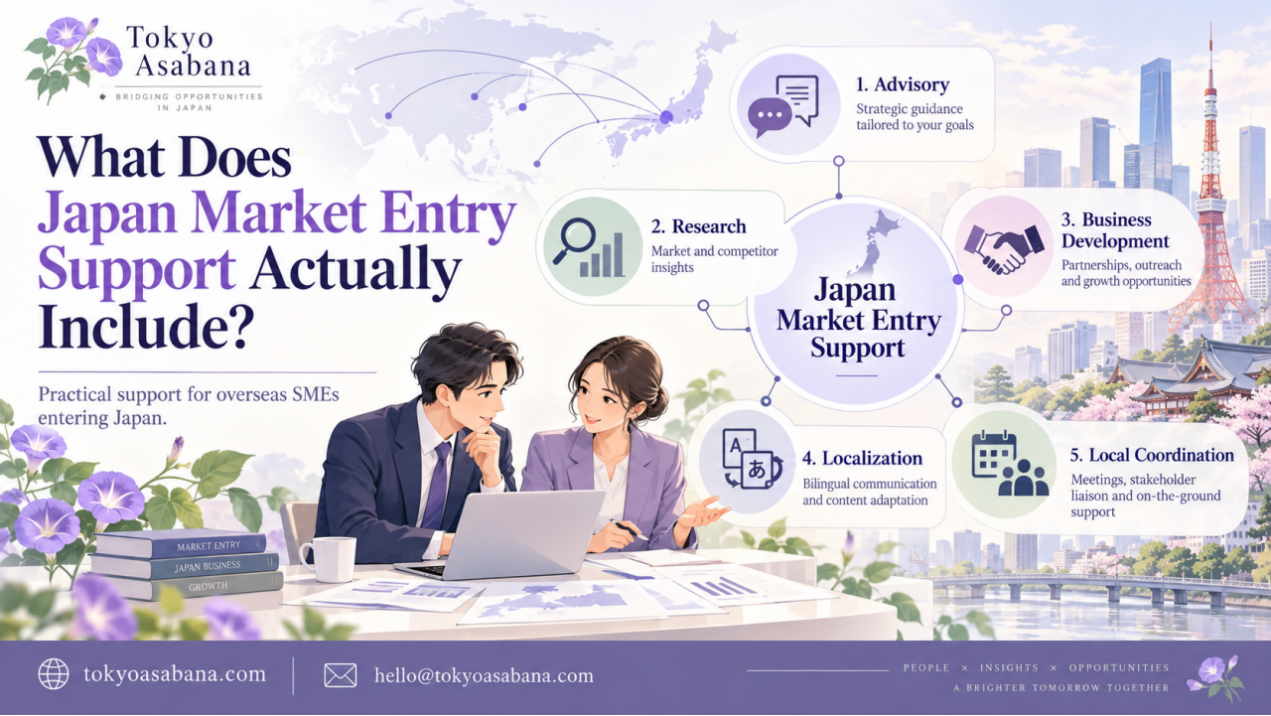
Entering the Japanese market can create new business opportunities for overseas companies. However, many small and medium-sized enterprises (SMEs) face a practical question:
What does Japan market entry support actually include?
Does it mean market research? Finding Japanese customers? Translating business materials? Arranging meetings? Establishing a local company?
The answer depends on the service provider and the company’s objectives.
Japan market entry support is not a single standardized service. It can involve several different activities, from initial business advisory to local execution.
For overseas SMEs, understanding these differences is essential before choosing a service provider or committing to a market entry budget.
1. Market Entry Advisory: Understanding What to Do First
Before investing in Japan, overseas companies often need to clarify whether their existing products or services are suitable for the market.
Market entry advisory helps businesses examine their assumptions and identify practical next steps.
Typical topics include:
- Potential customer segments in Japan
- Market opportunities and competitive conditions
- Differences between Japan and existing markets
- Business positioning and localization requirements
- Potential entry channels and partnership models
- Initial priorities, risks, and resource requirements
For example, an overseas education company may be interested in attracting Japanese students but may not understand how Japanese families evaluate international education services.
An initial advisory session could help the company identify important questions, suitable customer segments, and potential approaches before launching a larger project.
The purpose of advisory is to support informed business decisions, not to guarantee market success.
For smaller companies, a focused consultation can be a practical starting point.
2. Market Research: Turning Assumptions Into Business Information
Market research is another important component of Japan market entry support.
Overseas companies may already know that Japan has a large economy and attractive industries.
However, general economic information is rarely sufficient for making specific business decisions.
Companies may need more targeted research, such as:
- Competitor identification and positioning
- Customer segment analysis
- Industry-specific market information
- Pricing and service comparisons
- Potential business partner identification
- Relevant business practices and market barriers
For example, an overseas IT company considering Japan may need to understand which industries are most relevant to its services and how comparable providers approach Japanese customers.
A research project should therefore begin with clearly defined questions and deliverables.
Research can help reduce uncertainty, but it cannot establish customer demand or commercial viability on its own.
Understanding the market is different from successfully developing business in that market.
3. Business Development Support: Moving Beyond Market Research
After identifying potential opportunities, companies may need support with business development.
This is where market knowledge begins to turn into actual commercial activity.
Depending on the project, Japan-side business development support may involve:
- Identifying potential customers or business partners
- Preparing target company lists
- Researching relevant decision-makers
- Developing localized outreach approaches
- Supporting initial business communications
- Coordinating introductory meetings
- Following up on agreed business discussions
However, business development support should not be confused with guaranteed customer acquisition.
A local consultant or coordinator can assist with identifying and approaching relevant organizations, but cannot guarantee that those organizations will respond, agree to meetings, or purchase services.
The outcome depends on multiple factors, including market demand, the company’s offering, pricing, positioning, and customer decision-making processes.
For overseas SMEs, it is important to distinguish between paying for agreed business development activities and paying exclusively for successful sales referrals.
Developing a new market requires work before a customer is acquired.
This is why a commission-only model may not be suitable for projects involving substantial research, localization, prospect identification, and outreach.
4. Localization and Bilingual Business Communication
Localization is often associated with translation, but the two are not identical.
Translation converts information from one language into another.
Localization considers whether that information is suitable for the intended audience and business environment.
For companies entering Japan, relevant support may include:
- Japanese-language business communication
- Reviewing translated service descriptions
- Adapting presentations and proposals
- Preparing bilingual meeting materials
- Supporting cross-cultural business discussions
- Clarifying business terminology and expectations
For example, an English-language company presentation may contain expressions that are natural in the company’s home market but too general for Japanese corporate buyers.
Japanese clients may want clearer explanations of scope, implementation, responsibilities, and commercial conditions.
Similarly, arranging an introductory meeting is only one step. Both sides must understand what is being proposed and what should happen next.
Effective bilingual coordination is not simply about speaking two languages. It is about helping both sides communicate clearly.
Where specialist legal, tax, immigration, or other regulated advice is needed, appropriately qualified professionals should be involved.
5. Local Coordination: Connecting Overseas Companies With Japan
Many overseas SMEs are not ready to establish a Japanese subsidiary or employ local staff.
However, they may still need someone in Japan to coordinate specific business activities.
Local coordination can include:
- Communicating with Japanese organizations
- Arranging business meetings
- Supporting venue inquiries and scheduling
- Liaising with local stakeholders
- Coordinating bilingual information
- Supporting selected project activities in Japan
For example, an overseas organization planning a business seminar in Tokyo may need assistance communicating with venue operators, preparing bilingual materials, or coordinating with participating organizations.
A university-related event may involve additional procedures, eligibility requirements, and institutional approvals.
In these cases, Japan-side coordination can help organize communication and clarify requirements.
However, a coordinator cannot guarantee venue availability, university approval, or another organization’s participation.
Local coordination should be defined through an agreed project scope, rather than assumed to include unlimited administrative or operational support.
6. Japan Market Entry Consultants, Agencies, and Distributors Are Different
One source of confusion is that different service providers may all describe themselves as offering Japan market entry support.
Their responsibilities can be very different.
| Service Provider | Typical Role |
| Market Entry Consultant | Provides research, analysis, advice, and planning support |
| Business Development Support Provider | Assists with prospect research, outreach, and business communication |
| Distributor | Purchases or distributes products through commercial channels, depending on the agreement |
| Sales Agent | Promotes or sells products under an agreed commercial arrangement |
| Local Coordinator | Supports communication, meetings, stakeholder liaison, and project coordination |
| Legal or Accounting Specialist | Provides relevant professional services within their licensed or qualified scope |
These roles sometimes overlap, but they should not be treated as interchangeable.
For example, a market entry consultant may help an overseas company identify potential distributors, but that does not mean the consultant is acting as the company’s distributor.
Similarly, a business development support provider may help coordinate introductory meetings without assuming responsibility for closing sales.
Before engaging a provider, companies should confirm the exact deliverables, responsibilities, limitations, and commercial terms.
7. What Does Japan Market Entry Support Cost?
There is no universal price for Japan market entry support.
Costs depend on the type of assistance, project complexity, duration, language requirements, and expected deliverables.
A short advisory consultation is different from a multi-month market research and business development project.
Companies should distinguish between several types of fees:
Advisory fees: Payment for professional consultations and business analysis.
Research fees: Payment for defined research questions, reports, or target company lists.
Business development fees: Payment for prospect identification, outreach preparation, communication, and other agreed activities.
Coordination fees: Payment for specific meeting, stakeholder, venue, or project coordination work.
Specialist fees: Additional charges for legal, accounting, interpretation, or other professional services where required.
For overseas SMEs, transparent pricing and clearly defined scope are especially important.
A low initial fee does not necessarily mean that all subsequent services are included.
Similarly, an initial consultation should not automatically commit the company to a large service package.
The best approach is to understand what is included, what is excluded, and which activities require separate quotations.
8. How Should Overseas SMEs Choose the Right Level of Support?
Not every company needs the same market entry services.
The appropriate starting point depends on its current position.
Scenario A: The company is only considering Japan.
An initial advisory consultation may help clarify market assumptions, opportunities, and priorities.
Scenario B: The company understands the opportunity but needs specific information.
A targeted research project may be appropriate.
Scenario C: The company has identified its target customers but cannot reach them effectively.
Business development and bilingual communication support may be useful.
Scenario D: The company has an upcoming meeting, seminar, or local project.
Japan-side coordination may be the immediate priority.
Scenario E: The company requires legal, tax, licensing, or company establishment assistance.
Qualified specialists may be needed, potentially alongside commercial advisory or coordination support.
The key is to match the service to the business problem.
Overseas companies should not purchase a large market entry package simply because they are interested in Japan.
They should first identify the specific support required at their current stage.
9. How Tokyo Asabana Supports Overseas Companies
Tokyo Asabana provides Japan-side business advisory, research, communication, and coordination support for overseas companies exploring or developing business opportunities in Japan.
Our services are designed to help international businesses, including SMEs, address practical questions and operational challenges without assuming that every company needs a large market entry project.
Depending on the agreed scope, support may include:
- Japan market entry advisory
- Business research and competitor analysis
- Potential customer or partner identification
- Business development and outreach support
- Bilingual business communication
- Meeting and stakeholder coordination
- Selected local project support in Tokyo and Japan
Companies can begin with a paid corporate consultation to discuss their objectives and identify suitable next steps.
Tokyo Asabana’s standard corporate consultation options include:
- 30-minute preliminary consultation: JPY 4,400
- 60-minute corporate advisory consultation: JPY 44,000
The preliminary consultation fee can be credited toward a further paid consultation for the same agreed scope within 14 calendar days, subject to the applicable terms.
Research, outreach, coordination, interpretation, and other project-based activities are not automatically included in the initial consultation and can be quoted separately.
Tokyo Asabana does not guarantee customer acquisition, successful partnerships, or commercial outcomes.
Where regulated professional services are required, coordination with appropriately qualified specialists may be arranged as relevant.
Our approach emphasizes transparent pricing, defined responsibilities, and practical business support.
Conclusion: Start With the Support You Actually Need
Japan market entry support can include many different services, but not every overseas business needs all of them.
Some companies need initial strategic advice.
Others need market research, prospective partner identification, business communication, or local coordination.
For overseas SMEs, the most effective approach is often to identify the immediate business problem before committing to a larger investment.
Japan market entry support should solve a defined business problem—not simply add another expensive service package.
Understanding the differences between advisory, research, business development, localization, and coordination can help overseas companies make better decisions about entering and expanding in Japan.
Looking for Japan Market Entry Support?
Tokyo Asabana provides paid business advisory and Japan-side coordination services for overseas companies.
Whether you are evaluating the Japanese market, researching potential business partners, or planning specific activities in Japan, you can begin with a corporate consultation to discuss your priorities.
Website: https://www.tokyoasabana.com
Services & Transparent Pricing: https://tokyoasabana.stores.jp/
Email: hello@tokyoasabana.com
Related Reading
Tokyo Asabana Insights|How to Choose a Japan Market Entry Partner
Tokyo Asabana Insights|Japan Market Entry Cost: What Should Overseas SMEs Budget For?