
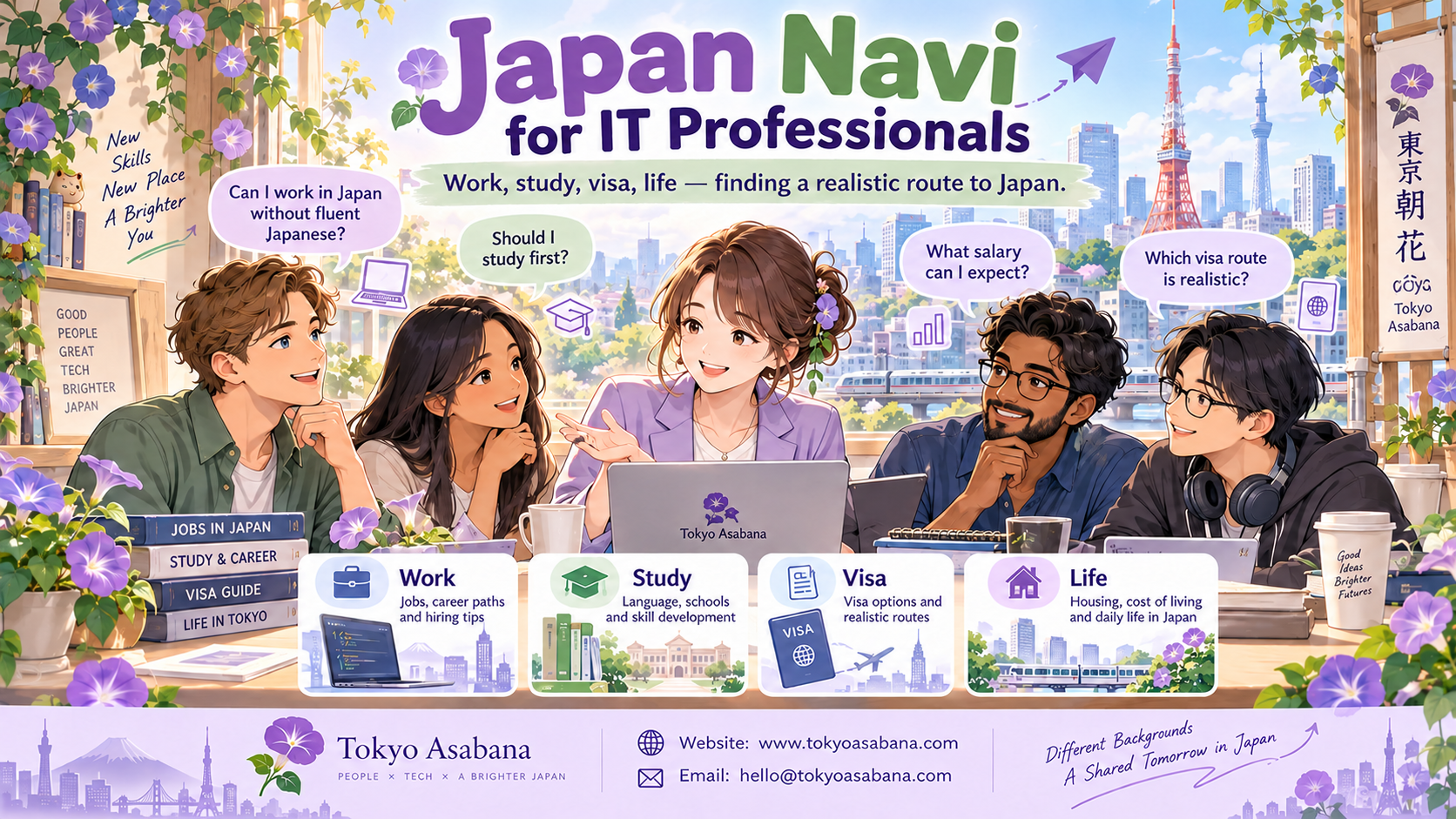
Considering an IT career in Japan? Your best route may depend on much more than your technical skills.
Japan attracts IT professionals from around the world. Some are looking for international career opportunities, while others are interested in Japan’s safety, lifestyle, education system, or long-term living environment.
However, moving to Japan as an IT professional is not always straightforward.
At Tokyo Asabana, I have provided consultations to overseas IT professionals from different regions, including Europe, the United States, India, and Southeast Asia.
Despite their different nationalities, qualifications, and career backgrounds, many face surprisingly similar questions:
- Can I find an IT job in Japan without fluent Japanese?
- Should I study Japanese first or apply directly for jobs?
- Will I need to accept a lower salary?
- Which technical skills are valued by Japanese employers?
- What kind of visa or residence status might be appropriate?
- Can my spouse and children move to Japan with me?
- How much money will I need to live comfortably in Tokyo?
- Is Japan a realistic destination for my long-term career?
Behind these practical questions lies an even more important one:
Does moving to Japan actually make sense for my personal and professional situation?
This is where individualized career and relocation guidance can make a difference.
1. Japan Is Not One Single IT Job Market
One common misunderstanding is that Japan has one unified IT employment market.
In reality, career opportunities can differ significantly depending on the employer, industry, job function, and candidate’s background.
For example, an experienced cloud engineer with international project experience may have very different opportunities from a junior software developer seeking their first position overseas.
Likewise, an English-speaking engineer targeting a multinational technology company may require a different career strategy from someone interested in a traditional Japanese corporation.
Some international companies operate primarily in English, while many Japanese companies require substantial Japanese communication skills.
The expectations surrounding recruitment, salaries, language proficiency, and workplace culture can vary considerably.
The question is not simply whether Japan needs IT professionals. It is whether your particular skills, experience, and career expectations match realistic opportunities in Japan.
2. Should You Find a Job First or Study in Japan?
For many overseas IT professionals, this is one of the most important decisions.
There are several possible approaches.
Route A: Apply for IT Jobs Directly
Experienced professionals with relevant technical expertise may consider applying to Japanese employers from overseas.
This approach can help candidates avoid unnecessary educational expenses and potentially continue their careers without a lengthy interruption.
However, opportunities depend on technical experience, communication ability, employer requirements, and recruitment conditions.
Route B: Study Japanese Before Entering the Job Market
Some professionals choose to improve their Japanese language skills before seeking employment.
Japanese proficiency can broaden the range of potential employers, particularly companies where internal communication is conducted primarily in Japanese.
However, attending language school involves tuition fees, living expenses, and time away from full-time employment.
Language school should be evaluated as an investment, not treated as an automatic requirement for working in Japan.
Route C: Pursue Further Education in Japan
For certain candidates, studying at a Japanese university or graduate school may provide useful academic qualifications, local experience, and connections.
This approach may be appropriate for professionals considering research, specialized technical fields, or a significant career transition.
However, additional education is not necessarily the most efficient route for someone who already has strong professional experience.
At Tokyo Asabana, the objective is to help clients understand the advantages, costs, limitations, and feasibility of different pathways before making a decision.
3. Japanese Language Skills: Do You Really Need N2?
Another frequently asked question concerns Japanese proficiency.
Some overseas candidates believe that passing JLPT N2 is a universal requirement for employment in Japan.
Others assume that IT professionals can easily find English-speaking positions without Japanese skills.
Neither assumption applies universally.
The importance of Japanese depends on factors such as:
- Whether the employer is Japanese or foreign-affiliated
- The language used by the engineering team
- Whether the position involves communication with Japanese clients
- The candidate’s technical specialization and seniority
- The responsibilities and expectations of the position
For example, an English-speaking software engineer working in an international development team may face different language requirements from an IT consultant working directly with Japanese corporate clients.
Japanese language proficiency can expand employment opportunities, but its value should be considered alongside professional experience and career goals.
Rather than telling every candidate to obtain N2 first, I prefer to understand which roles they are targeting and what language proficiency those roles actually require.
4. Salary Expectations: Will Moving to Japan Mean Earning Less?
Salary is another major concern, particularly for experienced professionals from high-income economies.
Japan may offer attractive opportunities in certain technical fields, but salary levels can differ substantially from those in the United States and some other international technology markets.
Even within Japan, compensation varies according to employer, specialization, seniority, language ability, and employment conditions.
A candidate should consider more than the advertised annual salary.
Other relevant factors include:
- Expected take-home income after taxes and social insurance
- Housing and transportation expenses
- Family living costs
- Career progression and future salary growth
- Employment stability and working conditions
- Exchange-rate exposure and international financial commitments
For some professionals, moving to Japan may involve accepting lower compensation in exchange for other personal or lifestyle benefits.
For others, the financial trade-off may simply be too large.
The right decision depends on what you want from your career and life—not just whether you can obtain a job offer.
5. Visa Feasibility and Family Relocation
Employment opportunities and immigration feasibility need to be considered together.
Japan has several residence-status categories that may be relevant to overseas professionals, depending on their qualifications, activities, employment arrangements, and other circumstances.
For IT professionals, possible routes may include employment-based residence statuses such as Engineer/Specialist in Humanities/International Services, or other categories where eligibility requirements are met.
However, a technical background alone does not guarantee immigration eligibility.
Family relocation introduces additional considerations.
Candidates may need to examine whether their spouse and children qualify for dependent residence status, how schooling works, and what financial resources would be needed to support the household.
These questions should be addressed before committing to a major international move.
Tokyo Asabana provides general career and relocation planning support and, where appropriate, can coordinate with qualified licensed specialists for matters requiring professional immigration or legal services.
Tokyo Asabana does not guarantee visa approval or independently provide regulated immigration representation.
6. Daily Life in Japan: What Happens After You Arrive?
Finding a job is only one part of a successful international relocation.
For someone moving from overseas, everyday life in Japan may involve unfamiliar systems and expectations.
Examples include:
- Finding accommodation and understanding rental requirements
- Calculating monthly living expenses
- Understanding health insurance, pension, and taxation basics
- Choosing suitable areas to live
- Planning education for children
- Understanding workplace and daily communication
- Considering long-term residence and lifestyle goals
The situation may be particularly complicated for professionals relocating with their families.
A salary that appears attractive for a single professional may be insufficient for a household with children, depending on housing choices, education costs, and lifestyle expectations.
This is why career decisions and life planning should not be treated as entirely separate subjects.
7. Why One-Size-Fits-All Advice Often Fails
Overseas IT professionals frequently encounter simplified recommendations online:
“Learn N2 before applying.”
“Just apply to international companies.”
“Go to Japanese language school first.”
“Japan needs engineers, so finding a job will be easy.”
“Move to Japan first and figure everything out later.”
Each recommendation may work for certain people.
However, none should be applied universally.
Consider two candidates.
Candidate A: A senior IT professional with over ten years of cloud infrastructure experience, strong English skills, and a family.
Candidate B: A recent computer science graduate with limited professional experience who wants to begin a career in Japan.
Their employment prospects, language priorities, financial requirements, educational options, and relocation strategies could be entirely different.
Applying the same advice to both would overlook important differences.
The purpose of an individualized consultation is to understand these differences before recommending a direction.
8. How Tokyo Asabana Supports Overseas IT Professionals
Tokyo Asabana offers paid, individualized Japan career and life-planning consultations.
As a Japan Nationally Qualified Career Consultant with previous experience in IT recruitment, I approach these discussions from both career-development and labor-market perspectives.
My experience supporting overseas professionals also provides practical insight into the questions that arise when individuals consider working, studying, or building a life in Japan.
Depending on the client’s situation, a consultation may cover the following areas.
Career and Employment Direction
Assessing how the client’s technical experience, qualifications, language abilities, and target roles relate to potential career pathways in Japan.
Job Search Strategy
Discussing possible employer categories, recruitment approaches, application preparation, and challenges that international candidates may encounter.
Japanese Language and Education Planning
Evaluating whether further language study or academic education would be useful, taking into account time, budget, career objectives, and existing experience.
General Visa Route Considerations
Identifying possible immigration-related questions and issues that may need verification by appropriate licensed professionals.
Salary and Living Cost Considerations
Discussing compensation expectations, household budgeting, and the financial implications of relocating to Japan.
Family and Long-Term Life Planning
Considering how employment decisions interact with family needs, education, lifestyle preferences, and long-term personal goals.
Consultations are tailored to the client’s priorities. Not every topic needs to be covered in every session.
Tokyo Asabana is an independent advisory service, not a job-placement guarantee or a substitute for licensed legal and immigration professionals.
9. Who Is This Service For?
Japan Navi for IT Professionals may be particularly relevant to:
- Experienced software engineers considering relocation to Japan
- Cloud, infrastructure, cybersecurity, AI, and data professionals exploring Japanese employment opportunities
- IT professionals evaluating whether Japanese language study is worth the investment
- International technology workers comparing Japan with other career destinations
- Professionals planning to relocate with spouses or children
- IT graduates considering further study or employment in Japan
- Overseas professionals who have received conflicting information and want an individualized assessment
This service is particularly useful for people who want to evaluate their options before making costly or difficult-to-reverse decisions.
It is not designed to promise a job offer, guarantee immigration approval, or provide a universal relocation formula.
Instead, it helps clients make better-informed choices based on their actual circumstances.
10. Start With a Realistic Plan, Not an Assumption
Japan can offer meaningful opportunities for overseas IT professionals.
However, a successful transition depends on the relationship between professional qualifications, language skills, employer expectations, financial considerations, immigration eligibility, and personal priorities.
Sometimes the best decision is to apply for jobs immediately.
Sometimes additional preparation is worthwhile.
And sometimes remaining in one’s current country or exploring another market may be the more suitable choice.
A good consultation should not simply encourage someone to move to Japan. It should help them determine whether moving to Japan is the right decision—and, if so, how to approach it realistically.
At Tokyo Asabana, my goal is to help overseas IT professionals understand their options, identify potential obstacles, and develop practical career and life-planning strategies.
Because the most useful question is not:
“How can I move to Japan as quickly as possible?”
It is:
“What is the most realistic and sustainable Japan pathway for me?”
Book a Japan Navi Consultation
Considering your next career move to Japan?
Tokyo Asabana offers personalized, paid consultations for international professionals seeking guidance on Japanese employment, education, relocation, and long-term career planning.
Website: https://www.tokyoasabana.com
Services & Transparent Pricing: https://tokyoasabana.stores.jp/
Email: hello@tokyoasabana.com
Tokyo Asabana — Independent Career, Business & Life Planning Guidance in Japan.
Related Reading
Asabana Insight | Why Japanese Recruiters Don’t Respond to You
Asabana Insight| Can you find a job in Japan if you only speak English?