
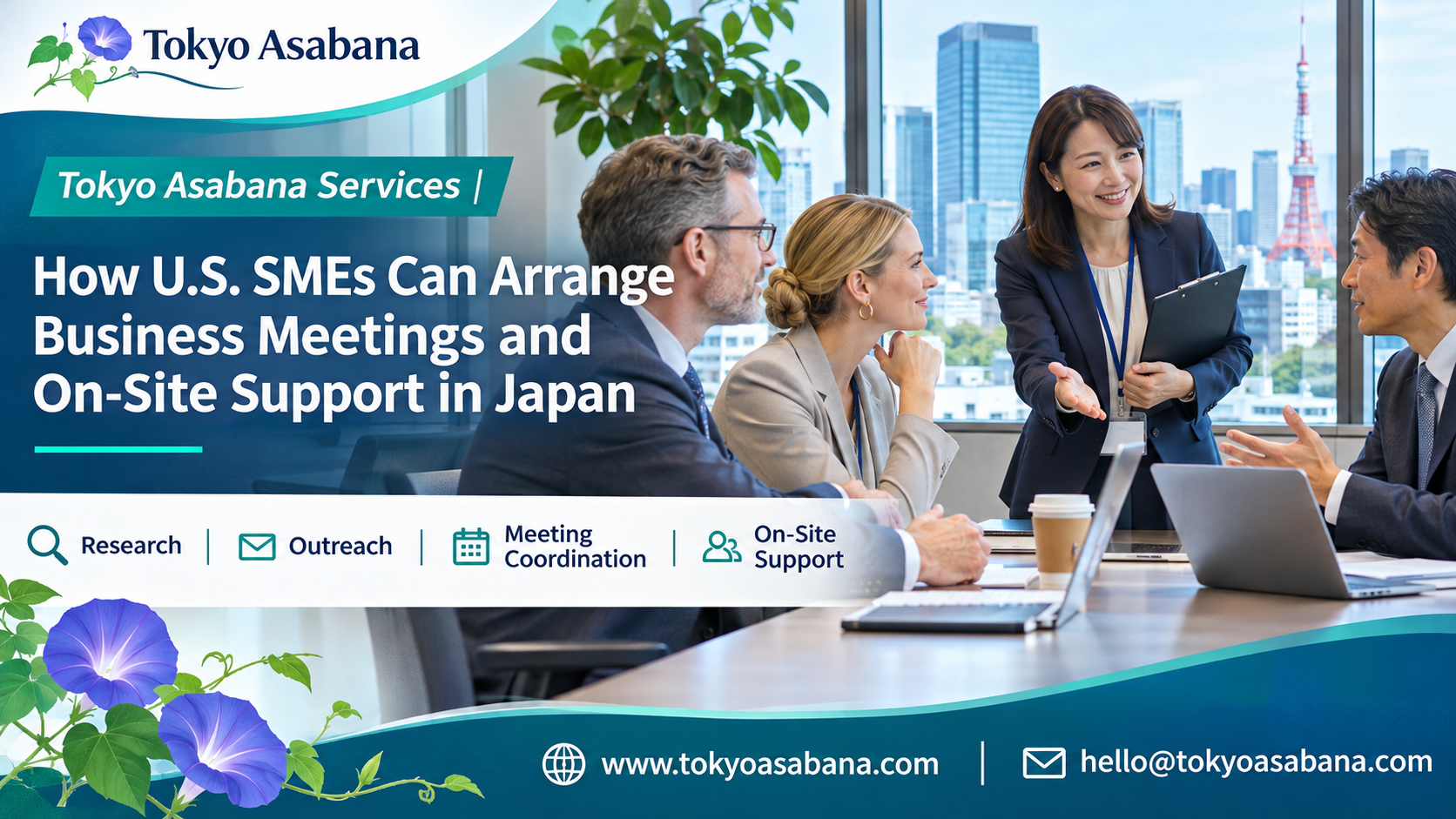
Practical Japan-Side Business Support for Small and Mid-Sized American Companies Without a Local Office
Introduction: Your U.S. Company Wants to Do Business in Japan. But Who Will Handle Things Locally?
Imagine a small American company exploring new business opportunities in Japan.
The company may be a manufacturer looking for Japanese suppliers, a technology provider seeking potential customers, or an education business exploring local partnerships.
Its products and services are already established in the United States.
Management believes there may be commercial opportunities in Japan.
However, the company does not have a Japanese office.
It has no employees based in Tokyo.
And nobody on the team speaks Japanese fluently enough to manage ongoing business communication.
The CEO or business development manager begins researching Japanese companies online.
Potential partners are identified.
Introductory emails are sent.
But responses are limited.
Some Japanese companies do not reply. Others request additional information, and arranging meetings across languages and time zones becomes increasingly complicated.
Eventually, the American company faces a practical question:
Do we really need to hire employees or establish an office in Japan just to explore potential business opportunities?
Not necessarily.
For many U.S. small and mid-sized enterprises (SMEs), a more flexible option is to engage an independent Japan-side business support provider.
Depending on the project, local support may include company research, Japanese-language outreach, business meeting coordination, on-site accompaniment, and follow-up communication.
You do not necessarily need a permanent Japan team to arrange your first business meetings in Japan.
This article explains how American SMEs can organize business activities in Japan without immediately establishing local operations — and how Tokyo Asabana can support the process.
1. Why Business Development in Japan Can Be Challenging for U.S. SMEs
Large American multinational corporations may have established Japanese subsidiaries, dedicated sales teams, and extensive international business networks.
Smaller U.S. companies often operate differently.
A manufacturing company with 40 employees may have excellent products and technical expertise but limited international business development resources.
A U.S. software company may have a successful domestic sales process but no established Japanese customer relationships.
An education provider may be interested in Japanese schools or institutional partnerships but lack the local contacts needed to begin discussions.
These companies can face several practical challenges.
Finding the Right Japanese Organizations
Online searches may generate long lists of potential customers, suppliers, or partners.
However, identifying relevant organizations requires more than finding companies in the correct industry.
The American business needs to understand whether each organization is a suitable commercial target.
Establishing Initial Communication
Some Japanese SMEs primarily operate in Japanese and may have limited resources dedicated to overseas inquiries.
An English-language introduction may not always reach the appropriate person or provide enough information to evaluate the opportunity.
Arranging Business Meetings
Even when a potential partner expresses interest, arranging a meeting requires additional work.
Dates, locations, participants, objectives, and communication arrangements must be confirmed.
Coordinating Local Visits
Japanese companies may be located outside central Tokyo.
Business travel can involve regional transportation, factory access requirements, and scheduling considerations.
Maintaining Communication After Meetings
Initial discussions are only the beginning.
Companies may need to exchange information, clarify questions, and coordinate further discussions after American executives return home.
For a smaller U.S. company, these activities can consume significant management time even before a commercial relationship has been established.
2. What Can a Japan-Side Business Support Provider Actually Do?
A Japan-side business support provider can assist with practical local activities based on the overseas company’s objectives.
The appropriate responsibilities depend on the project.
Below are six areas in which Tokyo Asabana may support American SMEs.
Service 1: Japanese Company Research and Preliminary Screening
Before contacting potential partners, overseas companies need to identify relevant Japanese organizations.
For example, a U.S. manufacturing company may be looking for Japanese companies with particular production capabilities.
A software developer may want to identify potential business customers or implementation partners.
An education provider may be researching Japanese institutions or corporate training opportunities.
Tokyo Asabana can assist with:
- Identifying potentially relevant Japanese companies
- Reviewing publicly available business information
- Organizing company profiles and contact information
- Conducting preliminary research based on agreed criteria
- Identifying questions requiring further investigation
- Preparing a practical target-company shortlist
The objective is to move from a broad collection of company names to a more focused list of potential business opportunities.
Research findings do not constitute technical certification, financial due diligence, or confirmation that a target company is willing to cooperate.
Service 2: Japanese-Language Business Outreach
Finding a Japanese company online is one thing.
Getting a meaningful business response is another.
American SMEs may have strong products or attractive commercial proposals but struggle to communicate their relevance to potential Japanese partners.
Tokyo Asabana can help prepare and coordinate appropriate business inquiries in Japanese.
Depending on the agreed scope, this may include:
- Preparing Japanese-language introductory messages
- Explaining the overseas company’s business background
- Presenting approved commercial objectives
- Contacting appropriate business channels
- Following up on previous inquiries
- Recording responses and outstanding questions
- Coordinating next steps when mutual interest exists
A well-prepared message should explain not only what the American company wants but also why the proposed discussion may be relevant to the Japanese recipient.
However, responses depend on the third party’s interests, availability, policies, and commercial priorities.
Tokyo Asabana can provide professional outreach and follow-up, but no service provider can guarantee that a Japanese company will respond or accept a meeting.
Service 3: Business Meeting Coordination in Japan
Once a potential partner expresses interest, the next challenge is turning that communication into a confirmed business meeting.
A meeting generally requires agreement on several details:
- Purpose and agenda
- Date and time
- Meeting location or online platform
- Participating representatives
- Business materials
- Language and communication requirements
- Expected next steps
For overseas SMEs, managing these arrangements from the United States can become time-consuming.
Tokyo Asabana can assist with scheduling and coordination between the American company and relevant Japanese organizations.
This may include online discussions, introductory business meetings, partnership discussions, and other agreed commercial engagements.
A confirmed business meeting should have a clear objective, appropriate participants, and mutually agreed arrangements.
A list of prospective companies or unanswered inquiries should not be presented as confirmed appointments.
Service 4: On-Site Business Visit Accompaniment
For American executives visiting Japan, local support can be particularly valuable.
A U.S. company may have already arranged meetings with Japanese businesses but still need someone to assist with communication and practical arrangements on the ground.
Tokyo Asabana offers optional on-site business visit accompaniment.
Depending on the agreed project scope, support may include:
- Accompanying overseas clients to Japanese business meetings
- Participating in company and supplier visits
- Assisting with business communication during meetings
- Supporting introductions and meeting logistics
- Coordinating local schedules and practical arrangements
- Helping organize meeting notes and follow-up items
- Supporting communication between visiting executives and Japanese representatives
These services are not limited to manufacturing.
Manufacturing Companies
An American procurement team may require assistance coordinating meetings with potential Japanese manufacturing partners.
Technology Companies
A U.S. technology provider may want to meet local customers, implementation partners, or other relevant businesses.
Education Companies
An American education provider may wish to discuss potential cooperation with Japanese educational institutions or business partners.
Professional Service Companies
A U.S. consulting or professional services firm may need local assistance arranging partnership discussions or introductory meetings.
Tokyo Asabana’s on-site support is designed for business activities across industries, not only factory visits.
Specialized engineering evaluations, formal supplier audits, legal advice, and other professional assessments remain the responsibility of appropriately qualified specialists.
Service 5: Trilingual Business Communication
Language can be an important practical consideration when American companies work with Japanese organizations.
Some overseas companies may need assistance communicating with Japanese partners before, during, and after meetings.
Tokyo Asabana provides business communication support in:
English | Japanese | Chinese
This multilingual capability can be useful for international companies operating across different markets.
For example, a U.S. company may work with Japanese business partners while coordinating with Chinese-speaking stakeholders elsewhere in Asia.
Depending on the project, trilingual support can help organize business correspondence, meeting communication, and agreed follow-up activities.
Language support should be matched to the subject matter and the participants’ requirements.
Where certified, highly specialized, or regulated interpretation services are necessary, appropriately qualified professionals should be engaged.
Service 6: Post-Meeting Follow-Up and Local Coordination
A productive meeting is not the end of business development.
After returning to the United States, executives may need additional information from their Japanese counterparts.
Potential follow-up activities include:
- Confirming meeting summaries
- Requesting additional business information
- Coordinating subsequent appointments
- Following up on commercial questions
- Clarifying outstanding action items
- Maintaining agreed communication between organizations
- Organizing next-stage business discussions
Without consistent follow-up, promising conversations may lose momentum.
Tokyo Asabana can provide agreed Japan-side follow-up coordination to help overseas companies maintain communication after their visits.
The goal is to turn business meetings into organized next steps — without promising particular commercial outcomes.
3. A Practical Example: A U.S. SME Planning Its First Japan Business Visit
Consider a hypothetical U.S. manufacturing company with approximately 50 employees.
The company wants to explore relationships with Japanese manufacturers.
Its CEO and procurement manager are considering a business trip to Japan.
However, the company has no Japanese office or local employees.
Without Japan-Side Support
The American team conducts online research, identifies potential suppliers, and sends introductory inquiries.
The CEO attempts to coordinate meetings across time zones while managing other business responsibilities.
Some inquiries receive no response.
Others require additional information.
The company begins arranging travel despite uncertainty about which meetings will take place.
With a Defined Japan-Side Support Project
The company may instead commission selected activities before departure.
Step 1 — Preliminary Research
Identify and review Japanese companies relevant to the buyer’s stated requirements.
Step 2 — Business Outreach
Prepare appropriate inquiries and contact potential partners through agreed channels.
Step 3 — Meeting Coordination
Where Japanese organizations accept meeting requests, confirm dates, participants, and agendas.
Step 4 — Visit Preparation
Review the schedule, meeting locations, and practical travel arrangements.
Step 5 — On-Site Accompaniment
Arrange agreed local support for relevant business visits.
Step 6 — Follow-Up
Coordinate appropriate post-meeting communication.
The company may then have a clearer basis for deciding whether to travel and what the visit should accomplish.
This does not guarantee supplier responses or successful partnerships.
However, it provides a structured approach to managing the activities required for business visits.
This is an illustrative scenario, not a description of a particular Tokyo Asabana client engagement.
4. Do U.S. SMEs Need to Establish a Japanese Subsidiary First?
Not every overseas company needs to establish a Japanese subsidiary before conducting preliminary market research or arranging business meetings.
Depending on the business model and applicable requirements, certain activities can be carried out through cross-border commercial arrangements or independent local service providers.
For early-stage market exploration, American SMEs may initially need only:
- Market research
- Customer or partner identification
- Preliminary business outreach
- Business meeting arrangements
- Local coordination
- On-site business visit support
A permanent office or full-time employee may become appropriate when ongoing sales, service delivery, operational responsibilities, or regulatory requirements justify a more substantial local presence.
Some activities and industries do require specific legal structures, registrations, or licenses, so companies should seek qualified advice where necessary.
The key is to determine what the business actually needs before committing to a permanent operating structure.
5. How Much Japan-Side Support Does Your Company Actually Need?
Not every American SME requires a large project.
Different companies have different priorities.
| Business Situation | Potential Support |
| We don’t know which Japanese companies to approach. | Company research and preliminary screening |
| We identified companies but cannot establish communication. | Japanese-language outreach and follow-up |
| Japanese partners are interested, but meetings need arranging. | Business meeting coordination |
| Our executives are visiting Japan. | Visit planning and on-site accompaniment |
| We need help communicating after meetings. | Post-meeting coordination |
| We need to understand Japan before investing further. | Market entry assessment and advisory |
For example, if a U.S. company already has confirmed meetings, it may not need to purchase an extensive supplier research project.
It may only require local visit coordination and on-site accompaniment.
Similarly, a business that is not ready to travel may benefit more from preliminary market research and outreach.
The right project should match the actual business problem.
6. Why Outsourcing Can Be Useful for Smaller American Companies
For a U.S. SME exploring Japan, outsourcing selected local tasks can offer practical advantages.
Flexible Scope
Companies can commission specific services according to their requirements rather than immediately creating permanent positions.
Local Communication
Japanese-language outreach and coordination can help address communication challenges.
Management Efficiency
Senior American executives can focus on commercial strategy and decision-making while agreed coordination activities are handled locally.
Access to Local Meetings
On-site assistance can support practical execution when executives travel to Japan.
Defined Deliverables
A properly scoped project can establish responsibilities, activities, fees, and expected outputs before work begins.
Outsourcing is not necessarily the right solution for every company.
Some businesses require dedicated local employees, specialized industry personnel, or permanent operations.
However, independent Japan-side business support can be a useful option when a full local team would be premature.
For many smaller American companies, the first step is not necessarily hiring in Japan. It is understanding which local activities actually need to be done.
7. Why Work With Tokyo Asabana?
Tokyo Asabana is an independent Japan-side business support and consulting service based in Tokyo.
We help overseas businesses explore opportunities in the Japanese market through research, business development, multilingual communication, and practical local coordination.
Our work spans multiple industries, including:
- Manufacturing and industrial businesses
- Information technology and digital services
- Education and professional development
- International business and professional services
Tokyo Asabana has provided paid Japan-related business advisory services to U.S. companies, including businesses in the education and manufacturing sectors.
These engagements have involved assessing Japan market opportunities, reviewing business requirements, and discussing potential Japan-side support options.
Our service approach emphasizes:
Practical Business Support
Research, communication, coordination, and agreed local implementation activities.
Trilingual Communication
Business support in Chinese, Japanese, and English.
Flexible Engagement
Services matched to the company’s requirements rather than a mandatory long-term package.
Transparent Pricing
Published consultation fees and separately scoped project quotations.
On-Site Availability
Optional accompaniment for business meetings, company visits, and other professional engagements in Japan.
Our services are designed to help overseas businesses handle practical Japan-side work without immediately committing to a permanent local team.
8. Start With a Paid Corporate Consultation
If your U.S. company is considering meetings, partner development, supplier research, or a business visit in Japan, a consultation can help clarify your needs.
Corporate Pre-Consultation — Online, 30 Minutes
JPY 4,400
An introductory paid consultation to discuss your company’s Japan-related objectives, immediate challenges, and possible support requirements.
Corporate Advisory Consultation — Online, 60 Minutes
JPY 44,000
A more detailed advisory discussion covering market entry, business development, partner research, outreach planning, and Japan-side coordination.
The preliminary consultation fee may be credited toward a qualifying subsequent corporate service within 14 calendar days, subject to applicable terms.
Separately Scoped Business Support
Research, outreach, meeting coordination, on-site accompaniment, and follow-up projects are quoted according to the agreed scope.
Project responsibilities, deliverables, schedules, and fees are confirmed before engagement.
Tokyo Asabana does not guarantee third-party responses, meeting acceptance, supplier suitability, commercial agreements, or revenue.
Conclusion: You Don’t Need a Full Japan Team to Start Building Business Relationships
For American SMEs, Japan can offer valuable opportunities across manufacturing, technology, education, and other industries.
However, exploring these opportunities often requires practical local communication and coordination.
Identifying Japanese companies is only the beginning.
Meaningful business development also requires appropriate outreach, meeting arrangements, realistic travel planning, and follow-up.
A company without a Japanese office can still explore selected opportunities through a carefully scoped local support project, where legally and operationally appropriate.
For some businesses, preliminary research may be enough to determine the next step.
Others may need help arranging business meetings or accompanying executives during visits to Japan.
Tokyo Asabana provides flexible Japan-side business services designed around these practical needs.
You don’t need to build a full Japan team just to arrange your first business meetings in Japan.
Your Japan Team — Before You Build a Japan Team.
Need Business Meeting or On-Site Support in Japan?
Whether your U.S. company is looking for Japanese suppliers, potential customers, business partners, or local meeting coordination, Tokyo Asabana can help you evaluate your requirements and arrange appropriate Japan-side support.
Start with a paid corporate consultation to discuss your objectives and possible next steps.
Website: https://www.tokyoasabana.com
Services & Transparent Pricing: https://tokyoasabana.stores.jp/
Email: hello@tokyoasabana.com
Related Reading
Tokyo Asabana Insights|The Hidden Costs of an Unproductive Business Visit to Japan
Tokyo Asabana B2B Case Study|A U.S. Manufacturing Company Seeking Business Opportunities in Japan