
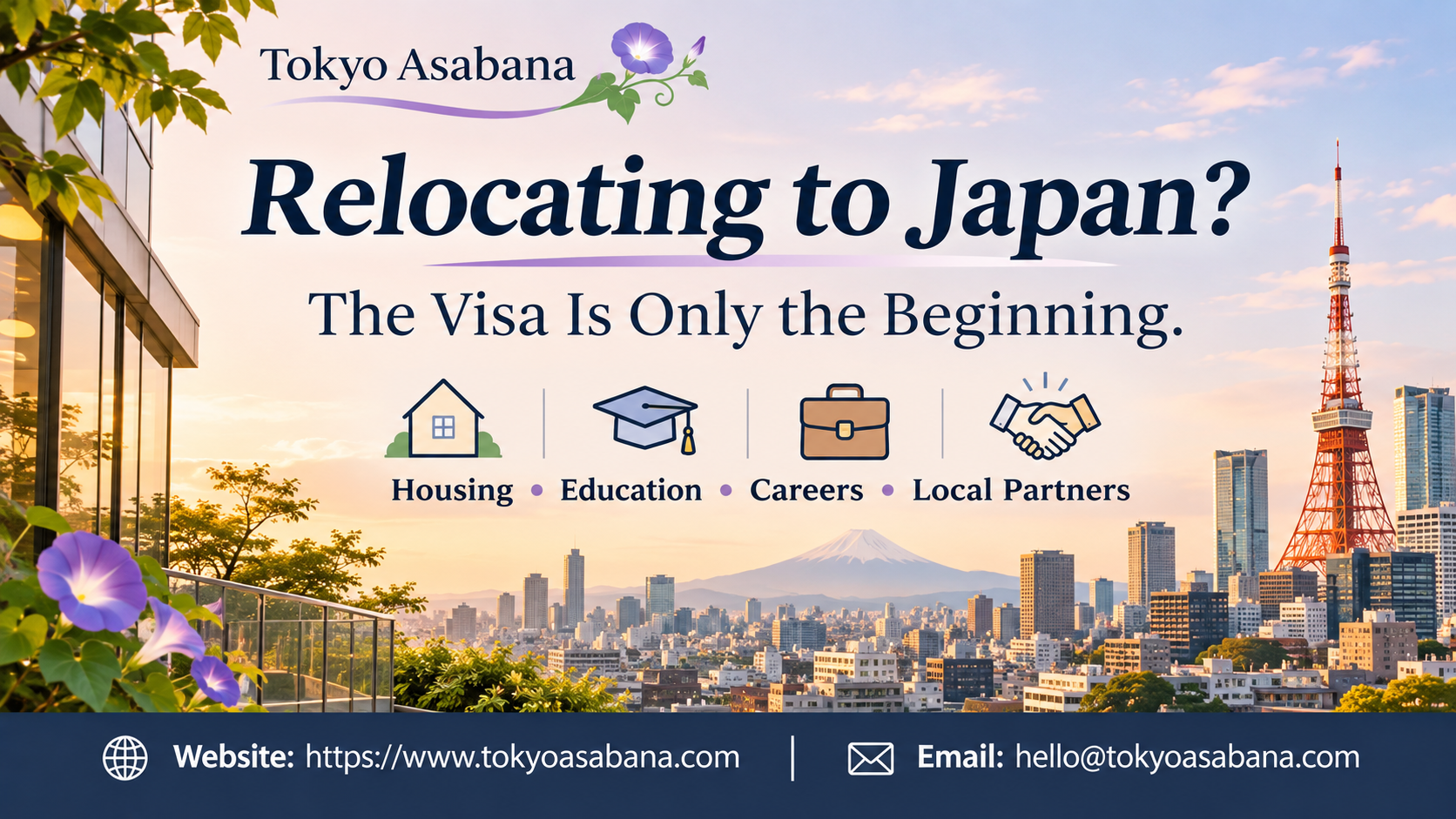
Japan Relocation, Corporate Mobility & Local Partnership Support
A visa gets you into Japan. A reliable local network helps you actually build a life — or a business — here.
Recently, Tokyo Asabana has been receiving a growing variety of inquiries from overseas individuals, families, and corporate organizations exploring opportunities in Japan.
Some want to move to Tokyo with their children.
Some are considering Japanese schools, universities, or career opportunities.
Others are international businesses looking for accommodation providers, local service partners, or practical coordination for their employees and executives.
And some overseas companies are looking beyond relocation itself. They want to establish a business presence, identify local partners, or explore Japan before investing in a permanent team.
At first glance, these appear to be completely different requests.
But they share one fundamental challenge: entering Japan is not the same as functioning effectively in Japan.
The real difficulty often begins after the decision to relocate has already been made.
1. The Hidden Complexity of Moving to Japan
When people think about relocation, they usually start with immigration.
What visa do I need?
How long can I stay?
Can my family accompany me?
These are important questions, and immigration matters should be handled by appropriately qualified professionals.
But obtaining the right residence status is only one part of the process.
Imagine a professional relocating from the United States to Tokyo with a spouse and two children.
The employer may have already arranged the transfer.
The employee may have a confirmed position and a suitable immigration pathway.
Yet the family still needs to answer several practical questions.
Where should they live?
Can they find suitable accommodation near an international school?
How does the Japanese school system differ from the American or British systems?
Can the accompanying spouse continue working?
Will the family need Japanese-language support?
Who can coordinate with landlords, schools, service providers, and other local organizations?
A successful international assignment depends not only on the employee’s professional performance, but also on whether the family can establish a stable life.
When that part is overlooked, even a promising international opportunity can become unnecessarily stressful.
2. Housing: Finding an Address Is Not the Same as Finding a Solution
Housing is one of the first practical challenges.
For an individual moving to Japan, the right solution may be a conventional rental apartment.
For an international executive arriving for a temporary assignment, a furnished monthly apartment or serviced residence may be more appropriate.
For a corporate visitor staying 30–60 nights, an extended-stay hotel or other short-term accommodation may be worth considering.
The appropriate choice depends on the assignment, budget, location, length of stay, and the client’s requirements.
However, housing searches in Japan are not simply about identifying properties online.
The process may involve Japanese-language inquiries, availability confirmation, contract conditions, furnishing requirements, payment arrangements, and coordination with local operators.
A property that appears suitable on a website may not be available under the required conditions.
An overseas company might also discover that the housing provider primarily communicates in Japanese.
This is where local relationships become valuable.
International companies do not always need to build their own housing supplier network from scratch.
They may benefit from working with Japan-based partners who already understand the local market and can coordinate with appropriate service providers.
Tokyo Asabana maintains relationships with Japanese real estate partners and can also support the identification and coordination of additional local providers according to specific business requirements.
Property transactions and regulated real estate services remain the responsibility of appropriately licensed providers.
Our role is to help international clients navigate the business and communication challenges around local coordination.
3. Children’s Education Can Determine the Entire Relocation Plan
For families with children, school selection can influence almost every other relocation decision.
A family may initially choose Tokyo because of employment.
But once they investigate schooling, their preferred residential location may change completely.
Japan offers several educational pathways, including Japanese public and private schools, international schools, and programs following different international curricula.
Families may need to consider IB, American, British, or other educational systems.
They may also need to understand language expectations, admissions procedures, school calendars, tuition, and future university pathways.
The right answer depends on the child’s age, educational history, language proficiency, and long-term goals.
For example, a family planning to remain in Japan permanently may evaluate schooling differently from a family expecting to relocate again after three years.
And a teenager preparing for university entrance faces different decisions from a child entering elementary school.
School selection should not be treated as an isolated administrative task. It is part of the family’s long-term relocation strategy.
Tokyo Asabana supports international families with education and career pathway discussions and can coordinate with appropriate educational specialists when more specific institutional assistance is required.
4. What About the Accompanying Spouse’s Career?
This is another issue that can easily be overlooked.
An international assignment is often organized around one employee.
But the accompanying spouse may also have an established career, professional qualifications, and personal ambitions.
Relocation may affect that person’s employment opportunities, professional identity, income, and future career development.
Can their existing professional experience transfer to Japan?
Will Japanese-language proficiency be necessary?
What career opportunities may be realistic?
Would further education or professional training help?
And what employment permissions apply to their residence status?
These questions require both career planning and, where necessary, specialist immigration advice.
As a nationally qualified Career Consultant in Japan, with a background in international recruitment and IT consulting, I understand how Japanese employment practices and overseas professional backgrounds can intersect.
Career support is not only about helping someone find their next job.
It is also about helping professionals understand their available options and make informed decisions.
For international mobility providers, spouse career support can be a valuable part of the overall relocation experience.
5. Corporate Relocation Is Also a Supplier Network Challenge
Now consider the same situation from an employer’s perspective.
A US, UK, or Australian company needs to relocate an employee to Japan.
Its HR or Global Mobility team may already have internal processes for international assignments.
But the company still needs reliable local execution.
The required services may include housing, educational guidance, local orientation, professional services, and ongoing coordination.
Rather than establishing individual relationships with numerous Japanese vendors, the organization may work through an international relocation management company.
That company, in turn, may need dependable Japan-based service providers.
This creates opportunities for specialized local partners.
A Japan-side coordination partner can potentially contribute through:
- Identifying and approaching suitable local service providers.
- Coordinating communication between overseas companies and Japanese partners.
- Supporting bilingual or multilingual business discussions.
- Helping clarify service requirements and practical delivery arrangements.
- Assisting with project-based coordination and follow-up.
Importantly, the local partner does not necessarily need to perform every specialized service directly.
The value may lie in connecting the right parties, reducing communication friction, and supporting reliable execution.
For professional services involving legal, tax, immigration, or other regulated matters, appropriately qualified specialists should remain responsible for the relevant advice and procedures.
6. The Challenge Is Even Bigger When a Company Enters Japan
The relocation challenge becomes more complex when a company is exploring Japanese market entry.
Imagine an overseas business considering a small operation in Tokyo.
It may need an office or flexible workspace.
It may need accounting, legal, immigration, or administrative support.
It may need to identify business partners, distributors, suppliers, or local corporate customers.
It may also need someone who can communicate effectively with Japanese organizations before a permanent team exists.
These requirements are interconnected.
A company may not yet know whether it needs a full office, local employees, or simply a temporary business presence.
It may be more sensible to begin with a limited market validation project.
That is why I often encourage overseas businesses to start small.
Before committing to a large Japanese operation, first understand what local support is actually required.
Tokyo Asabana maintains relationships with Japan-based service providers across real estate, education, office solutions, and professional services.
Where appropriate, we can coordinate with existing partners or help identify additional providers for a specific client requirement.
Active partner sourcing, business outreach, and coordination are structured as paid professional services, with scope and fees agreed upon in advance.
The objective is not to create unnecessary layers of intermediaries.
It is to help overseas organizations access relevant local capabilities without immediately building every function internally.
7. Why Multilingual Coordination Matters
There is one issue that connects nearly all these challenges: communication.
International organizations often operate in English.
Japanese real estate companies, local service providers, schools, and professional organizations may primarily operate in Japanese.
Individual clients may be more comfortable communicating in Chinese or another language.
Even when everyone speaks some English, differences in business expectations can create misunderstandings.
For example, an overseas client may expect a quick preliminary estimate.
A Japanese provider may prefer to clarify requirements internally before issuing a response.
One side interprets the delay as a lack of interest.
The other believes it is following an appropriate business process.
Neither side necessarily has bad intentions.
They may simply be working with different communication expectations.
Effective coordination requires more than translation.
It requires understanding the business context, clarifying responsibilities, and helping both parties communicate productively.
Tokyo Asabana works in English, Japanese, and Chinese, combining multilingual communication with practical knowledge of Japanese business and professional environments.
8. Why a Local Network Matters More Than a Long List of Contacts
Having hundreds of business cards is not the same as having an effective local network.
What matters is whether the right partner can be identified for the right situation.
A family relocating with children may need education specialists.
A global mobility company may need corporate housing providers.
An overseas manufacturer may need Japanese suppliers and business meeting coordination.
A growing international company may need flexible office solutions and professional advisers.
Each project requires a different combination of local resources.
That is why I see Japan-side support as a coordination capability rather than one fixed service package.
Sometimes the appropriate partner is already available within an existing network.
Sometimes a new provider needs to be identified and approached.
And sometimes the most useful first step is simply to clarify the client’s requirements before any outreach begins.
The goal is not to promise that one company can do everything. The goal is to build the right team around each client’s actual needs.
9. Your Japan Team — Before You Build a Japan Team
Tokyo Asabana’s approach is built around a simple idea:
“Your Japan Team — Before You Build a Japan Team.”
For an individual, this may mean understanding education, employment, and practical relocation options before making a major life decision.
For a family, it may mean connecting housing, schooling, and career planning into a more coherent relocation strategy.
For a global mobility provider, it may mean accessing a Japan-based professional who can help coordinate suitable local partners.
For an overseas company, it may mean testing the Japanese market and developing business relationships without immediately establishing a full local team.
These are different situations, but the underlying principle is the same.
Start by understanding the actual need.
Identify the right expertise.
Define responsibilities and commercial arrangements clearly.
Then move forward in manageable stages.
10. Japan Relocation Is Not Just a Move. It Is a Long-Term Transition.
Japan can offer attractive opportunities for international professionals, families, and businesses.
But successful relocation requires more than administrative preparation.
It requires housing solutions that fit the assignment.
Education planning that fits the family.
Career decisions that fit the individual.
And local business relationships that fit the company’s objectives.
The same applies to international organizations already supporting clients worldwide.
Even an established global company may occasionally need additional local expertise for a particular Japanese project.
A reliable Japan-side professional network can help bridge the gap between international expectations and local execution.
As Tokyo Asabana continues working with international individual and corporate clients, I look forward to developing practical partnerships with global mobility providers, education organizations, relocation specialists, and overseas businesses exploring Japan.
Whether your needs involve an individual family or a corporate project, the most productive starting point is a clearly defined objective and a realistic scope of support.
You don’t always need to build an entire Japan team to take your first meaningful step in Japan.
Sometimes, you need the right local connections — and someone who knows how to bring them together.
Tokyo Asabana | Japan Market Entry, Local Partnerships, Education & Career Advisory
Website: https://www.tokyoasabana.com
Services & Transparent Pricing: https://tokyoasabana.stores.jp/
Email: hello@tokyoasabana.com
Related Reading
Tokyo Asabana Services|Japan On-Site Business Support & Executive Accompaniment
Tokyo Asabana Insights|Local Agent Representation in Japan: What Can an Overseas SME Outsource?