
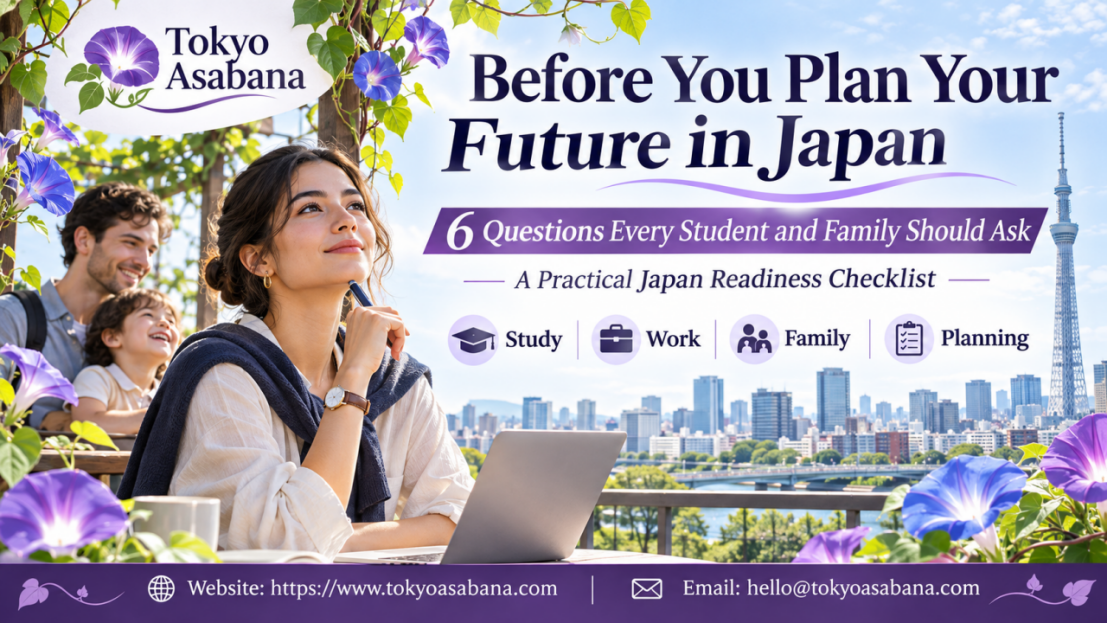
A Practical Japan Readiness Checklist for International Students, Professionals, and Families
Japan attracts people from around the world for many reasons: education, employment, career development, safety, and the possibility of building a long-term future.
But recently, through my work at Tokyo Asabana, I’ve noticed a recurring challenge.
Many people know they want to come to Japan.
Far fewer have a clear understanding of what they need to prepare before making that decision.
Some students believe part-time employment will cover their tuition. Some professionals assume that English-speaking jobs are widely available. Some parents begin researching international schools without first considering the family’s residence arrangements.
These assumptions can become expensive.
That’s why I recommend answering the following six questions before paying an agency, applying to a school, or making major financial commitments.
1. What Is Your Real Goal in Japan?
The first question sounds simple, but it determines almost everything that follows.
Are you planning to:
- Study at a Japanese language school or university?
- Pursue a master’s degree or MBA?
- Find professional employment in Japan?
- Relocate with your spouse and children?
- Explore Japan before making a long-term decision?
Studying in Japan and working in Japan are not interchangeable pathways.
For example, entering a Japanese language school does not guarantee employment afterward.
Similarly, having professional experience overseas does not automatically mean that a Japanese employer will offer you a job.
Your education, financial resources, Japanese ability, and career history should influence the route you choose.
Before contacting a consultant, write down your primary goal in one sentence.
If you cannot clearly explain why Japan fits your plans, more research may be useful before purchasing individualized advice.
2. Do You Have a Realistic Financial Plan?
This is one of the most important questions, especially for students considering part-time employment.
Japan allows eligible international students to work part-time after obtaining the necessary permission.
For students under the standard rules, the general limit is 28 hours per week during the academic term, with different arrangements during designated long school holidays.
However, permission to work does not mean employment is guaranteed, or that part-time earnings will cover all expenses.
According to Japan’s official Study in Japan website, data from the 2023 survey of privately financed international students shows:
JPY 105,000 per month: Average living expenses, excluding tuition and research costs.
JPY 81,000 per month: Average earnings from part-time work among students working part-time.
These figures are national averages, not a personal budget or income guarantee. Costs in Tokyo can be higher, and tuition must be considered separately.
For further perspective, official guidance lists approximate first-year academic fees of JPY 820,000 for national undergraduate universities and JPY 1,300,000 for private undergraduate universities outside certain higher-cost fields.
A realistic budget should also account for housing deposits, transportation, insurance, school materials, airfare, and emergency savings.
My advice: Never build a study-abroad plan that only works if you immediately find a part-time job.
Scholarships may help, but they should not be treated as guaranteed funding before an award is confirmed.
3. Are Your Education and Language Skills Suitable?
Different Japanese education and career pathways require different qualifications.
For university applicants, important questions include whether your previous education meets the institution’s admissions requirements, whether you need the Examination for Japanese University Admission for International Students (EJU), and whether the program is taught in Japanese or English.
Some English-taught university and graduate programs do not require Japanese proficiency for admission.
However, Japanese remains valuable for everyday life, internships, and employment opportunities.
For working professionals, employers may consider your academic background, previous experience, technical capabilities, and ability to communicate in Japanese.
Before requesting individualized guidance, prepare a basic summary of your highest qualification, work experience, Japanese and English proficiency, and intended study or career field.
The goal is not to be perfectly prepared. It is to understand your current starting point.
4. Who Is Moving to Japan — and What About Children?
An individual student’s plan is very different from a family’s relocation plan.
If you are considering moving with children, you need to think about education and residence arrangements together.
Important considerations include the children’s ages, current curriculum, language ability, desired school system, parental residence arrangements, and long-term plans.
Japan offers public, private, and international schooling options, but admission requirements and availability differ significantly.
Not every international school accepts every applicant, and school admission does not automatically establish a parent’s right to reside in Japan.
Some families need to plan the parents’ employment or other lawful residence arrangements before finalizing their children’s education.
For families, the correct sequence of decisions can be just as important as the choice of school.
Tokyo Asabana can help families evaluate education pathways and coordinate with relevant specialists when necessary.
Immigration and other regulated legal matters should be addressed by appropriately qualified professionals.
5. What Is Your Timeline?
Japan-related plans often require more preparation than people initially expect.
University admissions, language examinations, school application deadlines, document preparation, financial arrangements, and immigration procedures each have their own timelines.
A student hoping to enter university in the next academic year may need to start preparing well in advance.
A professional with limited Japanese proficiency may need a longer period of language study and career development before actively applying for jobs.
Parents considering international schools may also face application windows, assessment requirements, and limited places.
I usually encourage prospective clients to identify three dates:
Your ideal arrival date.
The deadline for your next major application or decision.
The earliest date by which your finances, qualifications, and documents could realistically be ready.
If these dates are far apart, that’s useful information.
It may mean your current priority is preparation rather than relocation.
6. Are You Ready for Professional Consultation?
Not everyone needs to hire a consultant immediately.
If you are still exploring Japan generally, free public resources may be sufficient for now.
However, professional consultation becomes more valuable when you have a specific decision to make, several competing options, or a complicated personal situation.
Before approaching Tokyo Asabana, I recommend having the following information ready:
Your goal: What are you hoping to achieve in Japan?
Your background: Education, work history, and language ability.
Your family situation: Who is planning to relocate, including children’s ages where relevant?
Your timeline: When do you hope to start?
Your financial preparation: Your realistic budget and funding sources.
Your decision: What specific question would you like professional guidance to help you answer?
For minors, a parent or legal guardian should be involved in the consultation process.
You don’t need to have everything solved. That’s what professional advice can help you work through.
But being honest about your starting point makes the consultation far more productive.
What About Schools and Education Partners Overseas?
Schools, educators, and international education organizations sometimes contact Tokyo Asabana because their students are interested in Japan.
I welcome these conversations when there is a clearly identified need.
However, I recommend that overseas partners conduct a basic readiness check before referring students or families.
A genuine interest in Japan is a starting point, not proof that someone is financially or academically ready to proceed.
One well-prepared student with a realistic plan is more valuable than dozens of referrals built on unrealistic expectations.
Organizations seeking Japan-side education support, career workshops, school-related coordination, or partnership development can also discuss specific paid projects with Tokyo Asabana.
How Tokyo Asabana Can Help
Tokyo Asabana provides personalized professional advisory services covering:
Education planning: Japanese universities, graduate schools, MBA programs, and selected school pathways.
Career development: Japanese employment-market insights, career strategy, CV preparation, and interview guidance.
Japanese language planning: JLPT preparation and realistic language-learning goals.
Family relocation planning: Education considerations, long-term planning, and coordination with relevant Japan-based specialists.
Corporate and institutional support: Japan-side research, partnership development, educational project coordination, and professional advisory services.
I am Serena, Founder of Tokyo Asabana, a Nationally Certified Career Consultant in Japan, an MBA graduate of Meiji University, and a former international recruitment and IT consulting professional.
My approach is straightforward:
I don’t want clients to make expensive decisions based on unrealistic expectations about Japan.
I want them to understand their options, their constraints, and their next practical steps.
Ready to Take the Next Step?
Tokyo Asabana offers personalized online consultations for individuals and families considering their future in Japan.
Initial Online Consultation: 30 minutes | JPY 4,400
Booking is simple. Please complete the following two steps in order.
Step 1 — Complete Your Payment
Please pay the consultation fee of JPY 4,400 through our secure PayPal payment link:
Pay JPY 4,400 via PayPal|PayPalで4,400円を支払う|通过PayPal支付4,400日元
Please copy and paste the payment link into your browser if you have difficulty opening it.
Step 2 — Complete the Consultation Inquiry Form
After completing your payment, please fill out our consultation inquiry form using the button below.
Provide your contact details, background, consultation topic, and questions so we can prepare for your session.
Please use the same name and email address as your PayPal payment whenever possible.
What Happens Next?
Once your payment and inquiry form have been received, I will contact you within 2 Japanese business day to arrange your online consultation, usually via Google Meet.
Corporate and institutional clients are welcome to enquire about paid advisory services and project-based support. Corporate consultations use a separate booking and payment process.
Additional services are quoted and agreed upon before work begins.
Please note that Tokyo Asabana does not guarantee school admissions, employment, scholarships, or immigration outcomes.
If you are not ready for a paid consultation yet, you’re welcome to continue reading our free articles and official resources.
Your Japan journey shouldn’t begin with a promise. It should begin with a realistic plan.
Official resources for further reading
Study in Japan — Living Costs and Expenses
Study in Japan — Academic Fees
Study in Japan — Part-Time Work
Study in Japan — Immigration and Student Visas
Website: https://www.tokyoasabana.com
Services & Transparent Pricing: https://tokyoasabana.stores.jp/
Email: hello@tokyoasabana.com
Related Reading