For a US company considering Japan, one of the first practical questions is simple:
How much does it actually cost to test the Japanese market?
The answer depends heavily on what “entering Japan” means.
Establishing a Japanese entity, hiring employees, renting an office, building a local sales organization, and launching a full marketing campaign can require substantial investment.
But if your first objective is simply to determine whether Japan deserves further exploration, you may not need to start with any of those things.
For many small and mid-sized overseas companies, a more practical approach is:
Start with a preliminary discussion. Clarify the objective. Define the questions. Then decide what level of market testing makes sense.
1. Testing Japan Is Different from Entering Japan at Full Scale
Companies sometimes approach international expansion as if there were only two choices:
Enter Japan seriously — or don’t enter at all.
In reality, market entry can happen in stages.
A full-scale Japan operation might eventually involve:
- establishing a Japanese entity;
- hiring local employees;
- accounting and administrative support;
- legal and tax services;
- office or workspace costs;
- Japanese-language marketing;
- local sales staff;
- advertising;
- exhibitions and industry events;
- distributors or channel partners;
- and ongoing business development.
Those investments may make sense once Japan becomes strategically important.
They are much harder to justify when the company still does not know whether the Japanese market is relevant to its business.
A market test has a different objective.
It asks:
Before we build a Japan operation, what do we actually need to learn from the market?
2. What Can a Japan Market Test Include?
A useful market test should be designed around the company’s actual objectives rather than a standard package.
Depending on the business, this may involve several stages.
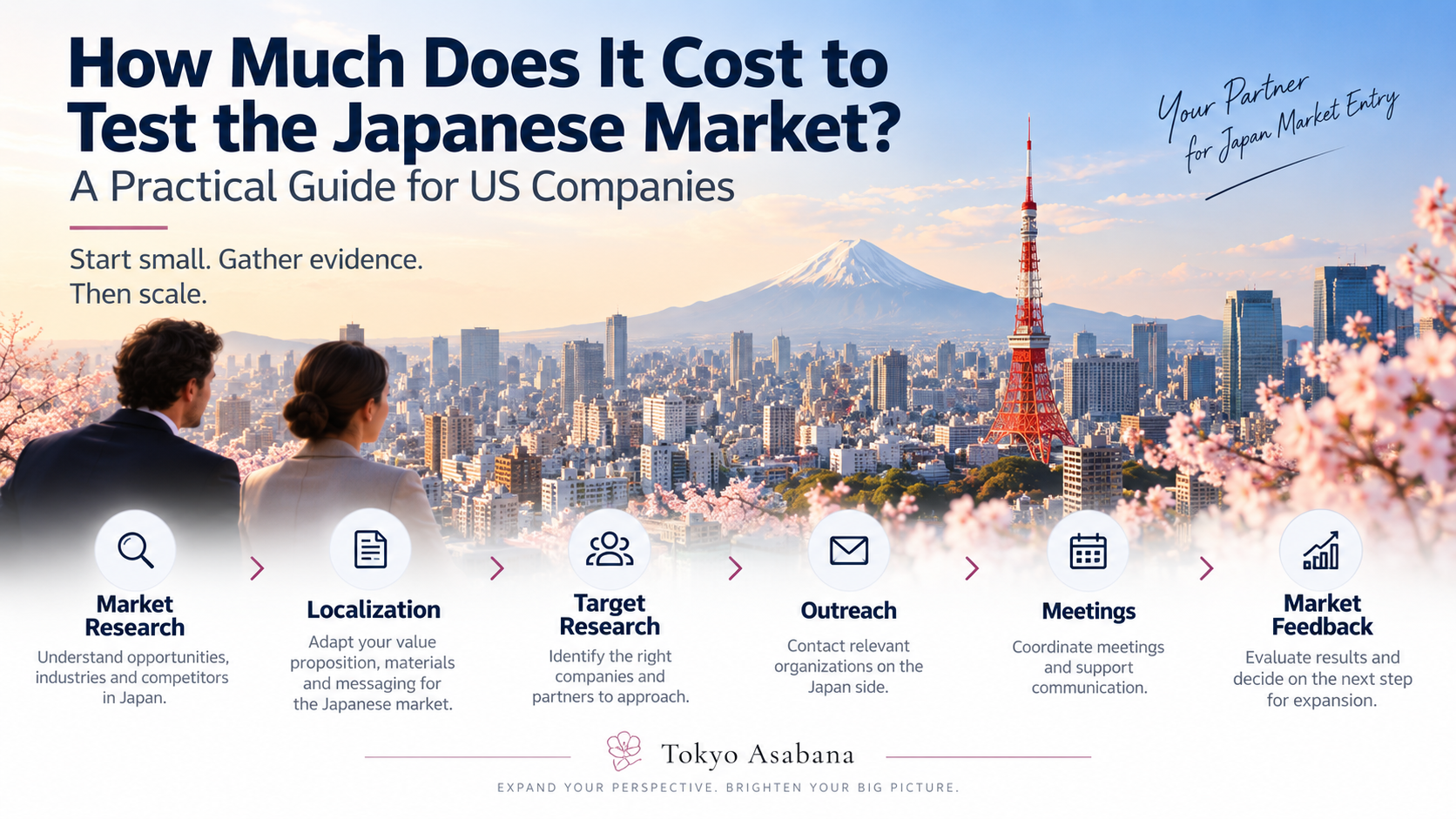
Stage 1 — Market Research
Research may examine:
- relevant industries;
- potential customer segments;
- competitors and existing alternatives;
- possible partners;
- distribution structures;
- Japanese business practices relevant to the product or service;
- and potential barriers to market entry.
The objective is to identify where further investigation or testing may be worthwhile.
Stage 2 — Japan-side Positioning
A successful US value proposition does not automatically become a successful Japanese one.
This is not simply a language issue.
Depending on the project, a company may need to consider:
- how its value proposition is presented;
- which aspects of its overseas track record are relevant;
- what information Japanese stakeholders may require;
- how implementation and local support would work;
- and whether business materials need localization.
Localization is not just translation. It is making a proposition understandable and relevant in the local business context.
Stage 3 — Target Research
Another important question is:
Who should we actually approach?
Depending on the business, potential targets may include:
- corporate customers;
- distributors;
- technology partners;
- educational institutions;
- HR or recruitment companies;
- industry organizations;
- professional-service firms;
- or other strategic partners.
Research may also need to identify the relevant department or business function within an organization.
Stage 4 — Outreach
Research can tell a company what the market looks like.
Outreach can begin generating actual market feedback.
Responses may reveal questions about:
- pricing;
- localization;
- implementation;
- local support;
- security;
- compliance;
- partnership structures;
- or timing.
Even limited market interaction can provide information that desk research alone cannot.
Stage 5 — Meetings and Market Feedback
Where relevant organizations show interest, further work may include:
- meeting coordination;
- communication support;
- follow-up;
- clarification of requirements;
- and collection of recurring feedback.
This information can help a company decide whether deeper investment in Japan is justified.
3. You Do Not Need to Start with a Large Project
There is no single correct budget for testing Japan.
A company at the very beginning of its Japan exploration has very different needs from a company that is already ready for research, localization, outreach, and business development.
That is why Tokyo Asabana provides a low-commitment starting point for corporate clients.
30-Minute Preliminary Discussion — JPY 4,400
Companies considering Japan can begin with a 30-minute preliminary discussion for JPY 4,400.
The purpose of this session is to:
- understand your company’s objectives;
- clarify the main Japan-related questions you would like to address;
- confirm whether Tokyo Asabana’s services are relevant to your needs;
- and discuss a possible next step or service format.
This preliminary discussion is designed to help both sides determine the appropriate scope before proceeding further.
It is not a research or advisory engagement and does not include detailed analysis, strategic recommendations, written reports, solutions, or answers requiring additional research.
If more extensive consultation or execution is required, an appropriate service can be discussed separately.
For the same corporate client and the same confirmed matter, if a qualifying service is purchased within 14 calendar days after the preliminary discussion, JPY 4,400 may be credited once toward that service.
4. What Can Happen After the Preliminary Discussion?
The next step depends on the company’s needs.
Some companies may only need to clarify what type of support would be appropriate.
Others may require professional consultation, research, or practical Japan-side execution.
Possible next steps include:
Professional Consultation
For questions requiring more substantial discussion, analysis, or professional input, a separate consultation can be arranged.
Market Research and Entry Planning
A project may include:
- target-segment research;
- competitor research;
- potential partner research;
- localization review;
- or market-entry planning.
Practical Market Testing
For companies ready to interact with the Japanese market, the scope may combine:
Research → Localization → Target Research → Outreach → Meetings → Feedback
Ongoing Japan-side Business Development
Where appropriate, support may expand to:
- continued target research;
- B2B outreach;
- partnership development;
- meeting coordination;
- follow-up;
- localization;
- institutional outreach;
- events;
- and other Japan-side business development activities.
The scope and pricing of further services are determined according to the actual work required.
5. The Cheapest Approach Is Not Always the Lowest-Cost Approach
A company may try to minimize costs by handling everything remotely.
That can work.
But there can also be hidden costs:
time spent approaching the wrong companies, contacting the wrong departments, using ineffective positioning, or investing in activities before the core market-entry questions have been clarified.
At the other extreme, immediately hiring a full-time Japan employee can be expensive when the company has not yet determined:
- which segments to prioritize;
- what type of local support is required;
- what market-entry model is appropriate;
- or whether deeper investment is justified.
The objective is therefore not simply:
“How can we enter Japan as cheaply as possible?”
A more useful question is:
“What do we need to clarify before deciding how much to invest?”
6. How Tokyo Asabana Can Support US Companies
Tokyo Asabana supports overseas companies at different stages of Japan market development.
Depending on the agreed scope, services may include:
- Japan market research;
- business localization;
- target company and partner research;
- B2B outreach;
- meeting coordination;
- Japan-side business development;
- institutional and education-sector outreach;
- follow-up and local coordination;
- and coordination with licensed specialists where regulated professional services are required.
Companies do not need to begin with a large engagement.
If your company is still exploring Japan, you can start with a:
30-Minute Preliminary Discussion — JPY 4,400
The purpose is to understand the business objective, clarify the matter to be addressed, confirm mutual fit, and discuss an appropriate next step.
If your company subsequently requires consultation, research, localization, outreach, or other Japan-side execution, the relevant service and scope can then be discussed separately.
7. What Should a Market Test Ultimately Tell You?
Early-stage market development should not be evaluated only by immediate customer acquisition.
Depending on the scope of the project, useful findings may include:
- which customer segments appear relevant;
- which messages generate interest;
- which concerns repeatedly appear;
- whether localization is required;
- whether potential customers expect local support;
- which organizations should be approached next;
- and whether the company should invest further.
Sometimes the most useful outcome is discovering that the original approach should be changed before more money is spent.
That is part of the purpose of testing.
8. When Does It Make Sense to Invest More?
Deeper investment may become appropriate when the company begins to see meaningful signals from the Japanese market.
For example:
- recurring interest from a particular segment;
- concrete discussions with potential partners or customers;
- demand for stronger local support;
- or enough Japan-related activity to justify a more permanent presence.
A company’s path may gradually develop from:
Preliminary Discussion → Consultation / Research → Market Test → Business Development → Partnerships → Local Presence
The appropriate path will differ from company to company.
Start by Defining the Right Question
Testing Japan does not have to begin with a Japanese subsidiary, a permanent office, a full local sales team, or a large consulting project.
Sometimes the first step is much simpler:
Clarify what you actually need to know.
Tokyo Asabana offers a 30-minute preliminary discussion for JPY 4,400 for corporate clients considering business development, partnerships, market entry, or project development in Japan.
This provides a structured starting point for confirming the matter, understanding the company’s objective, and determining an appropriate next step.
It does not include detailed research, analysis, strategic recommendations, or project execution.
Those services can be arranged separately where required.
Start with the right questions. Define the scope. Then decide how far to go.
中文摘要|测试日本市场,可以先从预沟通开始
对于准备开发日本市场的美国及其他海外企业来说,并不需要在一开始就成立日本法人、招聘本地团队,或者直接购买大型市场开发项目。
如果企业目前还处于初步探索阶段,可以先预约东京朝花的:
法人30分钟预沟通|JPY 4,400
预沟通主要用于:
- 了解企业在日本市场的目标;
- 明确目前希望解决的核心课题;
- 确认东京朝花的服务是否与企业需求匹配;
- 讨论可能适合的下一步服务形式。
预沟通并非正式咨询服务。
其中不包含详细分析、战略建议、解决方案、书面报告、项目执行,也不包含需要进一步调查后才能回答的问题。
如果企业之后需要正式咨询、市场调研、本地化、目标企业调查、B2B外联、商务会议协调或持续的日本端BD支持,可以根据实际需求进一步确定服务范围。
对于同一法人、同一已确认课题,在预沟通结束后14个自然日内购买符合条件的后续服务时,JPY 4,400可抵扣一次。
因此,企业无需在一开始就决定是否进行大规模投入。
可以先明确:
我们到底想在日本解决什么问题?
再决定下一步需要的是咨询、调查,还是实际市场开发。
Start with the right questions. Define the scope. Then decide how far to go.
Tokyo Asabana|拓宽你的视野,点亮你的全局