Japan is one of the world’s largest and most established markets.
For overseas companies considering Japan, however, one practical question often comes first:
How much does it actually cost to test the Japanese market?
The answer depends on what you mean by “entering Japan.”
If market entry means establishing a Japanese company, hiring employees, renting an office, building a local sales team, and launching a full-scale operation, the initial investment can be substantial.
But companies do not necessarily need to begin there.
For many overseas businesses, a more practical first step is to conduct a small, structured market test before making a larger commitment.
The objective is not to build the entire Japan operation immediately.
It is to answer a simpler question:
Is there enough evidence in the Japanese market to justify further investment?
1. There Is No Single “Japan Market Entry Cost”
The cost of entering Japan varies significantly depending on the company, industry, objectives, and stage of expansion.
A company may simply want to understand the market.
Another may want to identify potential customers or distributors.
Another may already have a proven international product and want to begin approaching Japanese companies.
Others may be ready to establish a permanent local operation.
These are very different projects.
For this reason, it is more useful to think about Japan market entry in stages rather than as one large investment.
A typical progression might look like:
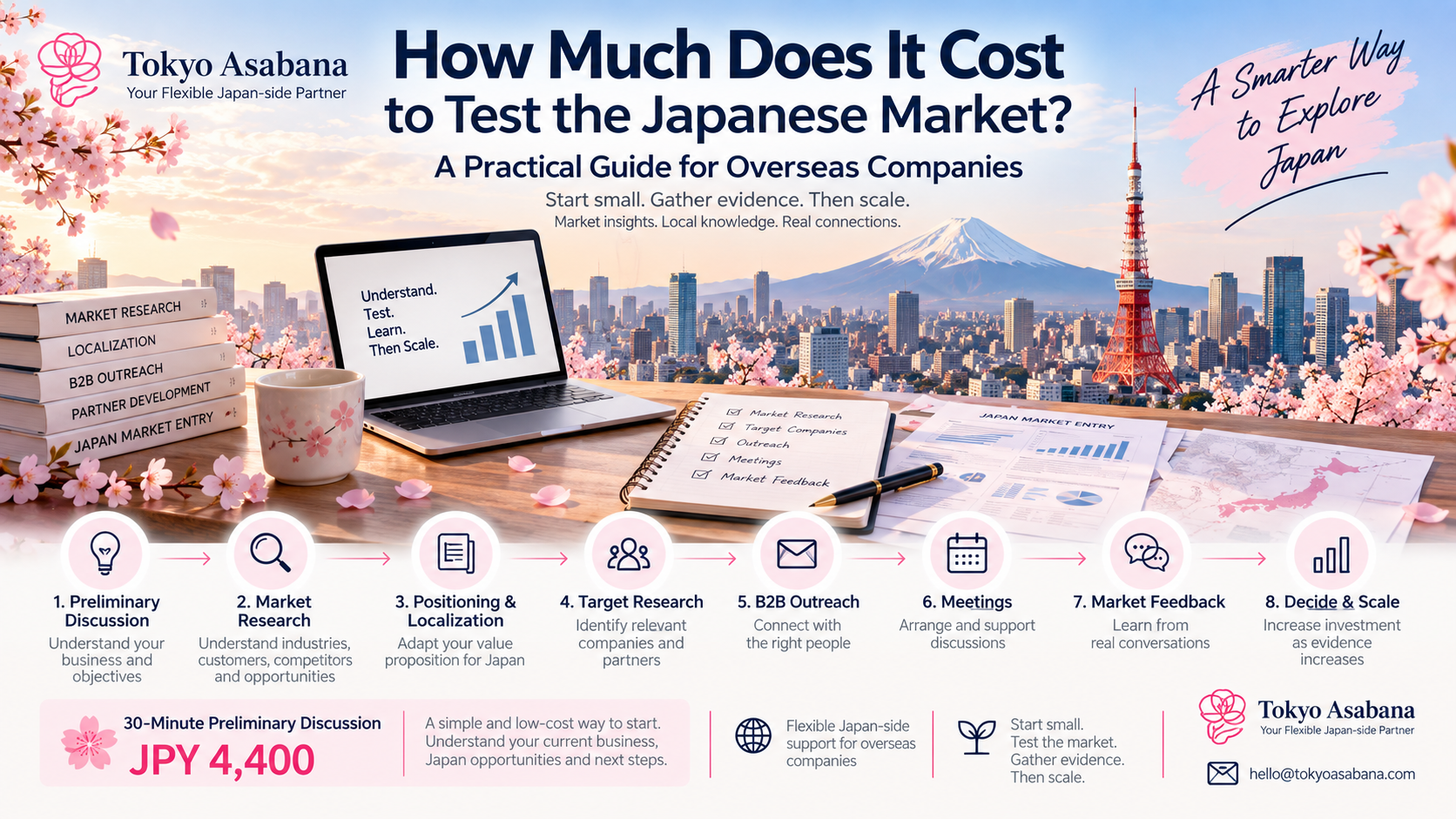
Preliminary Discussion → Market Research → Positioning & Localization → Target Research → B2B Outreach → Meetings → Market Feedback → Further Investment
Each stage provides information that can help determine whether the next stage is justified.
2. Level 1 — Preliminary Discussion
For a company that is still exploring Japan, the first step may simply be to discuss the business and clarify the opportunity.
Tokyo Asabana offers:
30-Minute Preliminary Discussion — JPY 4,400
This discussion can be used to understand:
- your current business;
- your product or service;
- why you are considering Japan;
- your target customers or partners;
- your current international experience;
- your existing Japan-side resources;
- your expected timeline;
- and what kind of support may be appropriate.
The JPY 4,400 fee covers the discussion itself.
It does not include customized:
- market research;
- competitor analysis;
- target-company lists;
- distributor research;
- written strategy;
- B2B outreach;
- or other project deliverables.
If further work is appropriate, the scope and quotation can be determined separately.
This creates a relatively low-cost starting point before commissioning a larger project.
3. Level 2 — Market Research
Before approaching Japanese companies, an overseas business may need to understand the market itself.
Depending on the project, research may examine:
- relevant industries;
- customer segments;
- competitors;
- potential business models;
- existing market players;
- distribution structures;
- potential partners;
- market characteristics;
- and possible entry routes.
The scope can vary considerably.
A focused research question may require a relatively small project.
A broad study involving multiple industries, competitor groups, customer segments, or regulatory questions may require substantially more work.
For this reason, market research should be scoped according to the actual business question rather than sold as a generic package.
4. Level 3 — Positioning and Localization
Even when a company has succeeded internationally, its existing messaging may not work in Japan without adjustment.
Localization may involve:
- reviewing the company introduction;
- adapting the value proposition;
- preparing Japanese-language business materials;
- adjusting terminology;
- reorganizing presentations;
- improving outreach messages;
- clarifying the business model;
- and determining which parts of the company’s international track record are most relevant to Japanese stakeholders.
This is different from simple translation.
The objective is not merely to convert English into Japanese.
The objective is to make the business proposition understandable and commercially relevant in Japan.
5. Level 4 — Target Company & Partner Research
Once the positioning is clearer, the next question is:
Who should we actually approach?
Depending on the project, potential targets may include:
- Japanese corporate customers;
- distributors;
- wholesalers;
- technology partners;
- professional-service firms;
- educational institutions;
- HR or recruitment companies;
- industry organizations;
- or other strategic partners.
A useful target list should not simply contain company names.
Research may also need to identify:
- why the organization is relevant;
- which business division may be appropriate;
- what kind of partnership or customer relationship may be realistic;
- and, where available, appropriate contact routes.
The cost therefore depends heavily on the number of targets and the depth of research required.
6. Level 5 — B2B Outreach and Market Testing
Research alone cannot answer every question.
At some point, companies need real interaction with the market.
A Japan market test may therefore include targeted outreach to selected Japanese organizations.
The purpose is not simply to send large numbers of emails.
It is to test questions such as:
- Do Japanese companies understand the proposition?
- Which customer segments respond?
- Which positioning attracts interest?
- What objections appear repeatedly?
- Are prospects concerned about local support?
- Is the proposed partnership structure realistic?
- Does the company need a distributor or other Japan-side partner?
- Are there barriers that were not visible during desk research?
This is why early-stage business development can also function as a form of market validation.
A negative response can still provide useful information.
Silence across a carefully selected segment can also be information.
The goal is to turn assumptions into evidence.
7. Level 6 — Meetings, Follow-up and Partner Development
When outreach begins generating interest, the work becomes more relationship-driven.
Depending on the project, Japan-side support may include:
- meeting coordination;
- multilingual communication;
- follow-up;
- clarification between parties;
- partner communication;
- relationship development;
- and ongoing business development support.
This stage can vary significantly in duration.
Some companies may only require support for several initial conversations.
Others may need ongoing Japan-side coordination over a longer period.
For this reason, the appropriate pricing model may depend on the actual scope, workload, and duration of the project.
8. What Determines the Cost of a Japan Market Test?
Several factors can significantly affect the cost.
Scope
Testing one clearly defined customer segment is very different from researching an entire industry.
Number of Target Companies
Researching and approaching 10 carefully selected companies requires a different workload from approaching 100.
Research Depth
Basic target identification and detailed company-level research are different services.
Localization Requirements
A company with strong existing materials may require only limited adaptation.
Another may need substantial restructuring before outreach begins.
Industry Complexity
Some sectors require additional specialist knowledge, regulatory research, or professional input.
Outreach Volume
A small pilot campaign and an ongoing business-development program involve different levels of work.
Follow-up and Coordination
If Japanese companies respond, meetings, follow-up, communication, and relationship development require additional time.
Project Duration
A two-week market test is different from several months of Japan-side business development.
For these reasons, Tokyo Asabana does not apply one fixed price to every Japan market-entry project.
Customized projects are quoted according to the actual scope.
9. A Smaller Budget Should Mean a Smaller Test — Not a Fake Full-scale Project
One common mistake in international expansion is trying to achieve a full market-entry project with a very small budget.
A better approach is to reduce the scope, not the quality of the work.
For example, instead of trying to research an entire Japanese industry, a company might examine one specific customer segment.
Instead of contacting hundreds of companies, it might begin with a carefully selected group.
Instead of immediately building a local sales operation, it might first test whether Japanese prospects respond to the proposition.
In other words:
A smaller budget should buy a smaller experiment.
It should not create unrealistic expectations of full-scale market entry.
10. What Tokyo Asabana Can Support
Depending on the agreed project scope, Tokyo Asabana can support overseas companies with:
- Japan market research;
- competitor and market mapping;
- business positioning and localization;
- target company research;
- partner and distributor research;
- B2B outreach;
- meeting coordination;
- partner development;
- market feedback collection;
- Japan-side business development;
- and cross-border communication in English, Japanese and Chinese.
Tokyo Asabana is particularly suited to companies that already have a real product, service, customer base, or international track record, but do not yet have a mature Japan-side capability.
11. What About Legal, Tax, Regulatory or Other Specialist Matters?
Some Japan market-entry projects involve areas that require specific professional expertise or qualifications.
These may include:
- legal matters;
- tax;
- immigration and visas;
- licensing;
- food regulations;
- import requirements;
- and other regulated or specialist issues.
Tokyo Asabana does not replace qualified professionals in these areas.
Where necessary, we can support coordination with relevant specialists according to the project requirements.
This allows the market-entry project to remain commercially coordinated while specialist matters are handled by the appropriate professionals.
12. Do You Need to Establish a Japanese Company First?
Not necessarily.
For some businesses, establishing a Japanese entity will eventually make sense.
But it does not always need to be the first step.
Before making that investment, a company may first test:
Is there demand?
Who responds?
Which customer segment is most promising?
Does our positioning work?
Do we need a distributor or local partner?
What objections do Japanese companies raise?
What kind of Japan-side support is actually required?
Once those questions become clearer, the company can make a more informed decision about whether to invest further.
13. Start Small. Gather Evidence. Then Scale.
The most important question is not:
“What is the cheapest possible way to enter Japan?”
A better question is:
“What is the smallest useful investment that can give us meaningful evidence about the Japanese market?”
That may begin with a JPY 4,400 preliminary discussion.
The next step might be a focused research project.
Then target identification.
Then outreach.
Then meetings and market feedback.
And only when the evidence supports it does the company need to consider a larger commitment.
The principle is simple:
Investment should increase as evidence increases.
Japan market entry does not always need to begin with a large budget.
It can begin with a well-designed experiment.
For Overseas Companies Considering Japan
If your company already has an established product, service, customer base, or international track record and is considering the Japanese market, Tokyo Asabana can support an initial discussion or customized market-entry project.
30-Minute Preliminary Discussion
JPY 4,400
The preliminary discussion covers the initial conversation only.
Customized market research, competitor analysis, localization, target research, outreach, partner development, and Japan-side business development are quoted separately according to the actual project scope.
Tokyo Asabana
Start small. Gather evidence. Then scale.
Market insights. Local knowledge. Real connections.
Your flexible Japan-side partner.
English | 日本語 | 中文