
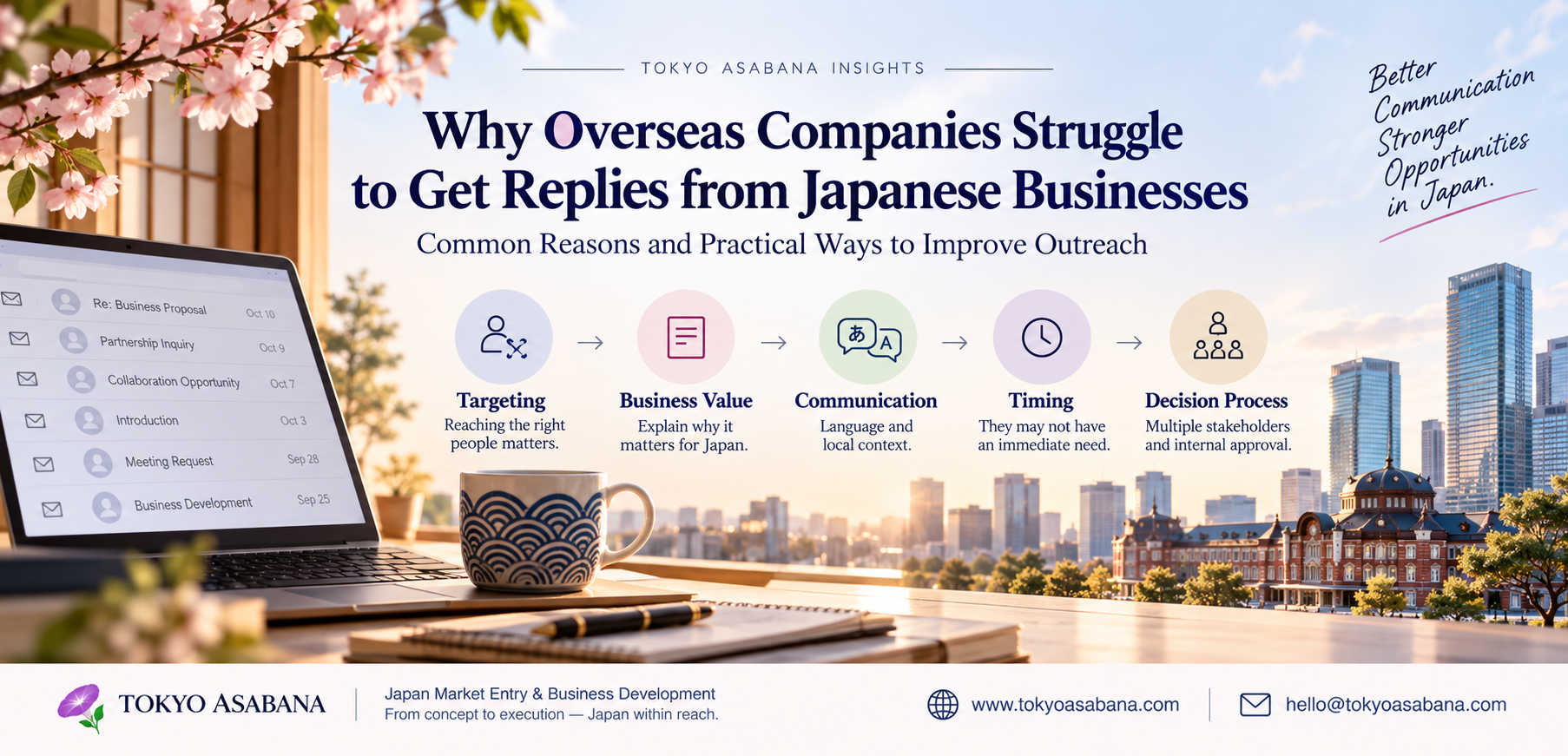
Japan is an attractive market for overseas companies looking to expand internationally. However, many businesses encounter a frustrating challenge at an early stage: they contact Japanese companies but receive few or no replies.
An overseas company may have a strong service offering, an established business in its home market, and a professionally written introduction email.
Yet its outreach still goes unanswered.
Does this mean Japanese companies are not interested in international business?
Not necessarily.
A lack of response does not always indicate a lack of market opportunity. It may indicate a problem with targeting, communication, timing, or the proposed business value.
Understanding these differences is an important part of developing business in Japan.
1. Reaching a Company Is Not the Same as Reaching a Decision-Maker
One of the first challenges in overseas business development is identifying the right contact.
A company may publish a general inquiry email address on its website, but messages sent there may be handled by administrative staff or customer service teams.
The recipient may not have responsibility for international partnerships, business development, or purchasing decisions.
Even when a message reaches the appropriate department, the person receiving it may not have the authority to evaluate a new commercial relationship.
This creates an important distinction:
Finding a company’s email address is not the same as establishing access to its decision-making process.
Before starting outreach, overseas companies should consider which department, business unit, or decision-maker is most relevant to their proposal.
The quality of the target list can matter as much as the number of messages sent.
2. The Business Proposal May Not Explain the Value for Japan
Many overseas companies introduce themselves by describing their achievements.
They may highlight their international experience, successful projects, technical expertise, or established customer base.
These credentials can help establish credibility.
However, Japanese recipients may still have one unanswered question:
Why should our company be interested in this proposal?
A general message about exploring cooperation may not explain what the Japanese organization would gain from the relationship.
For example, an overseas IT services company may offer software development capabilities, but a Japanese potential client needs to understand what specific business problem the company can solve.
An education provider may offer international programs, but a Japanese institution needs to understand how those programs would benefit its students or organizational objectives.
A professional services company may have experience in several international markets, but that experience alone does not establish a compelling reason for a Japanese company to respond.
Effective outreach should explain the proposed value from the recipient’s perspective.
Business development is not simply about presenting what your company can do. It is about explaining why the other party should care.
3. Language and Communication Style Can Create Barriers
English is widely used in international business, but not every Japanese organization has the internal capacity to evaluate overseas proposals in English.
This is particularly relevant when approaching smaller companies, domestic service providers, or departments that do not regularly handle international inquiries.
A message may be understandable in English but still require additional internal explanation or translation.
However, simply translating an email into Japanese does not automatically solve the problem.
Communication should also reflect the recipient’s business context.
Overly broad proposals, unclear requests, unfamiliar terminology, and lengthy introductions can make an inquiry difficult to evaluate.
A more effective approach may include:
- A concise explanation of the overseas company and its services.
- A clear reason for contacting the specific Japanese organization.
- A practical description of the proposed commercial value.
- A realistic and specific next step.
- Appropriate Japanese-language materials when necessary.
Localization should improve business understanding, not merely replace English words with Japanese words.
4. The Recipient May Not Have an Immediate Business Need
A company may be a reasonable potential partner without having an immediate reason to pursue a new relationship.
Its existing suppliers may already meet its needs.
Its management may be focused on other priorities.
Its budget may already be allocated.
Or the organization may simply not be considering international partnerships at that time.
These possibilities are not unique to Japan.
However, overseas companies sometimes interpret silence as a cultural issue when the underlying problem is commercial relevance or timing.
Before investing heavily in outreach, businesses should consider whether their target organizations have a plausible reason to act.
A carefully selected list of relevant companies may produce more meaningful discussions than a large list based only on industry categories.
5. Japanese Business Decisions May Require Internal Coordination
Business decisions can involve multiple stakeholders, particularly when a proposal affects procurement, legal responsibilities, budgets, information security, or ongoing operations.
A person who finds an overseas proposal interesting may still need to consult colleagues or obtain internal approval.
The process can take time, and a positive initial conversation does not necessarily mean that a commercial decision is imminent.
Overseas companies should avoid assuming that an interested contact can independently approve a partnership.
They should also avoid treating every delay as a rejection.
At the same time, internal decision-making processes should not become an excuse for endless follow-up without evidence of genuine interest.
The objective is to understand whether a realistic decision-making process exists, not simply to keep a conversation alive.
6. Follow-Up Matters, but Repetition Is Not a Strategy
Some overseas companies send one introduction email and stop when no response arrives.
Others send repeated messages without changing the substance of their proposal.
Neither approach is necessarily effective.
A professional follow-up can provide useful additional context, clarify the proposed value, or offer a more specific next step.
However, repeating the same general introduction is unlikely to overcome a fundamental mismatch between the proposal and the recipient’s needs.
Follow-up should be purposeful.
For example, an overseas company may clarify the type of Japanese customers it hopes to serve, provide a relevant business example, or explain a more practical cooperation model.
After a reasonable number of attempts, it may be more productive to review the target list and messaging rather than continue contacting the same organizations indefinitely.
Good business development requires both persistence and the judgment to stop pursuing unsuitable opportunities.
7. A Reply Is Not the Same as a Business Opportunity
Receiving a reply is progress, but it is only one step in the business development process.
A Japanese company may respond out of courtesy, curiosity, or a general willingness to exchange information.
A meeting may take place without any intention to purchase a service or establish a commercial relationship.
Similarly, a potential partner may express interest in future cooperation without having a concrete project, budget, or customer requirement.
Overseas companies should distinguish between several stages:
| Stage | What It Actually Means |
| Contact Identified | A potentially relevant organization or individual has been found |
| Outreach Delivered | The business proposal has been sent |
| Reply Received | The recipient has responded |
| Opportunity Qualified | A relevant need, commercial rationale, and possible next step have been identified |
| Business Discussion | Both parties are exploring a potential arrangement |
| Commercial Agreement | Specific terms and commitments have been accepted |
These stages should not be treated as interchangeable.
A high reply rate does not necessarily indicate strong commercial potential.
Likewise, a smaller number of well-qualified conversations may be more valuable than many meetings without a clear business purpose.
The objective of B2B outreach is not simply to generate replies. It is to identify and develop commercially meaningful opportunities.
8. Why Overseas Companies May Need Japan-side Business Development Support
Overseas companies often underestimate the work required between identifying a potential Japanese customer and establishing a productive business conversation.
The process may involve target research, contact identification, localized messaging, outreach, follow-up, meeting coordination, and communication across languages and business practices.
These activities require time and professional resources.
They also require commercial judgment.
Not every organization is a suitable prospect, not every response deserves extensive follow-up, and not every potential partnership justifies further investment.
This is why occasional business introductions and structured market development should be treated as different services.
An occasional referral may arise through an existing relationship.
Active business development involves deliberate work to identify, approach, and develop potential opportunities.
The work involved does not disappear simply because a commercial agreement has not yet been reached.
For overseas companies seeking systematic market development, a clearly defined budget and scope of work are important.
9. How Tokyo Asabana Supports Overseas Companies
Tokyo Asabana provides Japan market entry advisory, business development, and local coordination services for overseas organizations.
Our business discussions with companies from markets including the United States, Australia, and Singapore reflect the diversity of questions overseas businesses face when considering Japan.
Different industries require different approaches.
An education company may need to evaluate relevant customer segments and institutional relationships.
An IT services provider may need to identify suitable Japanese corporate customers and develop a clear commercial proposition.
A professional services company may need to assess potential partnership models and the practical requirements of local business development.
Tokyo Asabana supports companies through three stages:
Stage 1 — Japan Market Entry Assessment
Initial evaluation of business objectives, market suitability, potential customers, and possible business directions.
Stage 2 — Market Validation & Research
Further research into market conditions, customer segments, competitors, positioning, and potential commercial channels.
Stage 3 — Japan-side Business Development
Target identification, localized business communication, outreach, follow-up, partner coordination, and practical implementation support.
Services are arranged according to the company’s objectives and an agreed scope of work.
Detailed research and active business development are fee-based. Tokyo Asabana does not guarantee replies, meetings, partnerships, customers, or sales results.
Conclusion: Better Targeting Before More Outreach
When Japanese businesses do not reply, sending more emails is not always the answer.
The more useful questions may be:
Are we approaching the right organizations?
Are we reaching people who can evaluate our proposal?
Have we explained why our service is commercially relevant?
Is there a realistic reason for the recipient to act?
Do we have the resources to develop opportunities beyond the first conversation?
For overseas companies, answering these questions can improve the quality of market entry decisions and business development efforts.
A successful Japan market entry strategy begins with understanding the market, identifying the right opportunities, and approaching them with a clear business purpose.
Tokyo Asabana helps overseas companies evaluate these questions and pursue Japan-related opportunities through professional advisory and business development services.
From concept to execution — Japan within reach.
Tokyo Asabana | Japan Market Entry & Business Development
Website: https://www.tokyoasabana.com
Services & Transparent Pricing: https://tokyoasabana.stores.jp/
Email: hello@tokyoasabana.com
Related Reading
Tokyo Asabana Insights|From Market Research to Business Development in Japan
Tokyo Asabana Insights|How to Choose a Japan Market Entry Partner