
Japan can be an attractive market for overseas companies looking to expand internationally.
It offers a substantial economy, established industries, and opportunities across sectors such as technology, education, professional services, and manufacturing.
However, entering Japan is not simply a matter of translating a website, launching advertisements, or contacting a few Japanese companies.
For overseas small and medium-sized enterprises (SMEs), the first challenge is often deciding where to begin.
Should you conduct market research? Find a distributor? Contact potential customers? Hire a local representative? Establish a Japanese company?
The right answer depends on your business model, target customers, and existing resources.
Before investing heavily in Japan, overseas companies should identify what they need to validate, which customers they want to reach, and what kind of local support may be necessary.
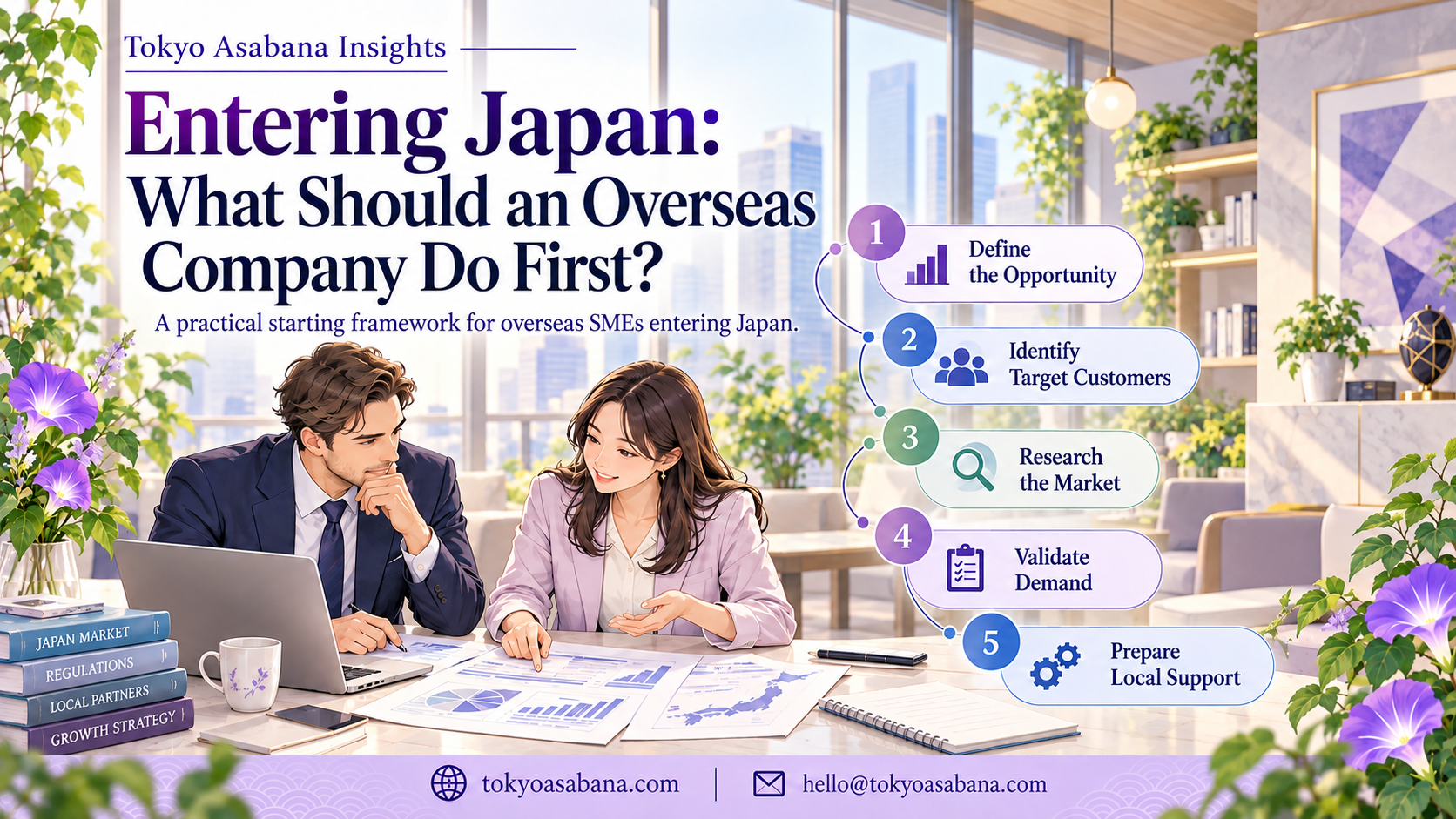
Here is a practical starting framework.
1. Define Why You Want to Enter Japan
Before researching the Japanese market, ask a fundamental question:
Why Japan, and why now?
Some companies consider Japan because of its market size or international reputation.
Others receive inquiries from Japanese customers, discover a potential business partner, or identify a specific opportunity in their industry.
These motivations are not equivalent.
A company responding to existing Japanese customer demand is in a different position from one entering Japan without any confirmed interest.
Start by clarifying:
- What specific business opportunity do we see in Japan?
- Which products or services do we intend to offer?
- Do we already have Japanese customers or business inquiries?
- Why would Japanese customers choose us over existing alternatives?
- What would justify further investment?
A clear commercial objective makes it easier to decide which market entry activities deserve attention.
Entering Japan should be a business decision supported by evidence, not simply an expansion goal.
2. Identify Your Target Customers Before Choosing Your Entry Channel
Japan is not a single, uniform customer market.
Different customer groups may have different purchasing priorities, expectations, budgets, and decision-making processes.
An overseas education company targeting Japanese families faces different challenges from an IT service provider targeting Japanese manufacturers.
Likewise, selling directly to consumers is different from developing partnerships with Japanese businesses.
Before choosing an entry strategy, define your intended customers.
Consider:
- Are you targeting consumers, businesses, institutions, or intermediaries?
- Which industries or customer segments are most relevant?
- Who makes purchasing decisions?
- What problems are customers trying to solve?
- How do customers currently purchase comparable products or services?
- What level of Japanese-language support might they expect?
For B2B companies, identifying the relevant decision-makers is particularly important.
A general company contact address may not reach the person responsible for purchasing, partnerships, or business development.
A market entry strategy becomes more practical when the company knows exactly whom it wants to reach.
3. Research the Competitive Landscape
Overseas companies sometimes assume that a successful product in their home market will automatically have demand in Japan.
However, Japanese customers may already have access to local or international alternatives.
Competitor research can help answer several important questions:
- Which companies currently serve the target market?
- How do they position their products or services?
- What prices and service structures do they offer?
- What languages and support arrangements are available?
- What customer problems remain insufficiently addressed?
- Where could an overseas company offer meaningful differentiation?
For example, an overseas software company may offer technical capabilities that are competitive internationally.
However, Japanese corporate customers may place additional importance on implementation support, documentation, communication, and long-term service arrangements.
Research should therefore go beyond identifying competitor names.
It should examine how comparable businesses communicate value and serve customers.
The goal is not simply to prove that Japan is an attractive market. It is to determine whether your company has a credible reason to compete there.
4. Test Market Demand Before Building a Local Team
One of the most important decisions for overseas SMEs is how much to invest before confirming market demand.
Some companies assume that entering Japan requires immediately establishing a local subsidiary, hiring staff, or opening an office.
That may be necessary for certain activities or business models, but it is not always the first step.
Depending on the nature of the business and applicable requirements, companies may be able to explore the market through limited activities first.
These could include:
- Conducting targeted market research
- Reviewing inquiries from Japanese customers
- Testing localized business messages
- Contacting selected prospective partners
- Holding introductory business discussions
- Evaluating interest in a specific product or service
- Running a limited pilot project where appropriate
For example, an overseas B2B service provider might begin by identifying a small number of relevant Japanese companies and testing whether its proposed offering generates meaningful business conversations.
The objective is not to contact as many organizations as possible.
It is to understand whether the intended customers recognize the problem being addressed and see value in the proposed solution.
Market validation should come before unnecessary fixed costs whenever the business model allows.
5. Decide Whether You Need a Consultant, Distributor, or Local Partner
Not every overseas company needs the same type of Japan-side support.
Different service providers perform different functions.
| Type of Support | Typical Role |
| Market Entry Consultant | Helps clarify market opportunities, positioning, and strategy |
| Market Research Provider | Researches customers, competitors, industries, and market conditions |
| Business Development Support | Assists with prospect identification, outreach, and business communication |
| Distributor | Handles product distribution under an agreed commercial arrangement |
| Sales Agent | Promotes or sells products according to contractual terms |
| Local Coordinator | Supports meetings, stakeholder communication, and selected project activities |
| Legal or Accounting Specialist | Provides services within the relevant professional and regulatory scope |
These roles may overlap, but they should not be treated as interchangeable.
For example, a market entry consultant may help identify possible distributors without becoming a distributor.
Similarly, a local coordinator may assist with business meetings without taking responsibility for closing sales.
Before engaging a partner, clarify:
- What activities will the provider perform?
- What deliverables will be produced?
- What responsibilities remain with our company?
- How will fees be calculated?
- What outcomes are outside the provider’s control?
For overseas SMEs, a limited advisory or coordination arrangement may be more appropriate than a broad commercial commitment during the initial exploration stage.
6. Prepare Your Business Materials for Japanese Customers
Before approaching prospective customers or partners, overseas companies should review their business materials.
An English-language website or presentation may be sufficient for certain international audiences.
However, Japanese customers may require additional information before engaging.
Useful preparation may include:
- A clear explanation of the company’s products or services
- Defined target customers and use cases
- Transparent pricing or an understandable quotation process
- Business presentations adapted to the intended audience
- Relevant company credentials and references
- A clear inquiry and follow-up process
- Japanese-language materials where appropriate
Localization goes beyond literal translation.
For example, phrases such as “innovative solutions” or “global business excellence” may sound professional but provide little concrete information.
Customers often need to know what problem the service solves, how it is delivered, and what responsibilities the provider assumes.
For overseas SMEs with limited budgets, it may be sensible to localize the most commercially important materials first.
Clear communication is often more valuable than producing large amounts of translated content without a defined purpose.
7. Start Business Outreach With a Defined Objective
Once a company understands its target customers and has prepared suitable materials, it can begin exploring commercial relationships.
However, business outreach should not be treated as a numbers-only activity.
Sending hundreds of generic emails does not necessarily lead to meaningful business opportunities.
A more targeted approach might involve:
- Identifying relevant companies or institutions.
- Researching their business activities.
- Determining whether there is a plausible commercial fit.
- Identifying suitable contact points or decision-makers.
- Preparing concise, relevant outreach messages.
- Following up appropriately.
- Recording responses and evaluating what they reveal.
For example, an overseas technology company seeking Japanese corporate customers may benefit from identifying organizations with a specific operational need rather than contacting unrelated businesses.
Responses also need to be interpreted carefully.
A lack of replies does not automatically prove that the market has no demand.
It may reflect unsuitable targeting, unclear positioning, communication barriers, or a lack of trust.
At the same time, interest expressed during an introductory conversation does not guarantee a future purchase.
Business development is a process of testing commercial relevance, not simply collecting contacts or arranging meetings.
8. Understand Regulatory and Operational Requirements Early
Although market validation may be possible before establishing a Japanese entity, overseas companies should not ignore legal and operational requirements.
Depending on the product, service, and business model, relevant matters may include:
- Business licensing and sector-specific regulations
- Import and product requirements
- Tax and accounting obligations
- Contractual arrangements
- Employment and immigration considerations
- Data protection and customer information handling
- Company registration and local operational requirements
These matters vary significantly between industries.
For example, requirements for selling physical products may differ from those for providing cross-border consulting or digital services.
Companies should identify potentially relevant requirements early and consult appropriately qualified professionals where necessary.
Commercial advisory and local coordination can help organize information and communication, but they should not be confused with regulated legal, tax, or immigration advice.
9. Build a Practical First-Stage Japan Market Entry Plan
For overseas SMEs, a practical first-stage plan can be more useful than committing immediately to a comprehensive expansion strategy.
The following framework illustrates how companies might organize their initial work.
| Stage | Main Question | Practical Action |
| Business Objective | Why Japan? | Define the opportunity and intended outcome |
| Customer Identification | Who would buy from us? | Identify target segments and decision-makers |
| Market Research | What alternatives already exist? | Review competitors, positioning, and commercial conditions |
| Demand Validation | Is there credible customer interest? | Conduct focused outreach or appropriate pilot activities |
| Localization | Can customers understand our offering? | Adapt priority business materials and communication |
| Local Support | Which capabilities are missing? | Identify suitable advisory, research, or coordination support |
| Next Investment Decision | Should we expand our commitment? | Review findings, risks, costs, and potential opportunities |
The sequence can vary depending on the industry.
Some activities may take place in parallel, while others may require specialist review before proceeding.
The important principle is to connect each activity to a business decision.
A company should understand what it expects to learn before investing in the next stage.
10. How Tokyo Asabana Supports Overseas Companies Entering Japan
Tokyo Asabana provides Japan-side business advisory, research, communication, and coordination support for overseas companies, including SMEs exploring or developing opportunities in Japan.
Our services are designed to address specific business questions and practical project requirements.
Depending on the agreed scope, support may include:
- Japan market entry advisory
- Customer segment and competitor research
- Potential partner or customer identification
- Business development and outreach support
- Bilingual business communication
- Meeting and stakeholder coordination
- Selected local project support in Japan
Companies can begin with a paid corporate consultation to clarify their objectives and identify appropriate next steps.
Our standard corporate consultation options include:
- 30-minute preliminary corporate consultation: JPY 4,400
- 60-minute corporate advisory consultation: JPY 44,000
The preliminary consultation fee may be credited toward a qualifying further paid consultation for the same agreed scope within 14 calendar days, subject to applicable terms.
Market research, outreach, interpretation, local coordination, and other project-based services are quoted separately according to the agreed scope.
Tokyo Asabana does not guarantee customer acquisition, successful partnerships, or commercial outcomes.
Where regulated professional services are needed, appropriately qualified specialists should be involved.
Our approach emphasizes clear responsibilities, transparent pricing, and practical Japan-side business support.
Conclusion: Start With a Business Question, Not a Large Investment
Entering Japan can offer valuable opportunities, but the first step should not automatically be establishing a company, hiring local employees, or launching a large marketing campaign.
For overseas SMEs, a more practical approach is to begin with clear business questions:
- Who are our potential customers in Japan?
- What problem can we solve for them?
- How do they currently address that problem?
- What evidence would justify further investment?
- Which activities can we manage ourselves?
- Where do we need Japan-side support?
The answers can help determine the appropriate market entry strategy, budget, and level of commitment.
Entering Japan should begin with understanding the opportunity—not simply spending money to establish a presence.
For smaller overseas companies, a focused and evidence-based approach can make the early stages of Japanese market expansion more manageable.
Exploring Business Opportunities in Japan?
Tokyo Asabana provides paid Japan market entry advisory, business research, communication, and local coordination support for overseas companies.
Whether you are evaluating the Japanese market for the first time or preparing your next business development activities, you can begin with a corporate consultation to discuss your priorities.
Website: https://www.tokyoasabana.com
Services & Transparent Pricing: https://tokyoasabana.stores.jp/
Email: hello@tokyoasabana.com
Related Reading
Tokyo Asabana Insights|Japan Market Entry Cost: What Should Overseas SMEs Budget For?
Tokyo Asabana Insights|Japan Market Entry for Small Companies: A Practical 90-Day Plan