
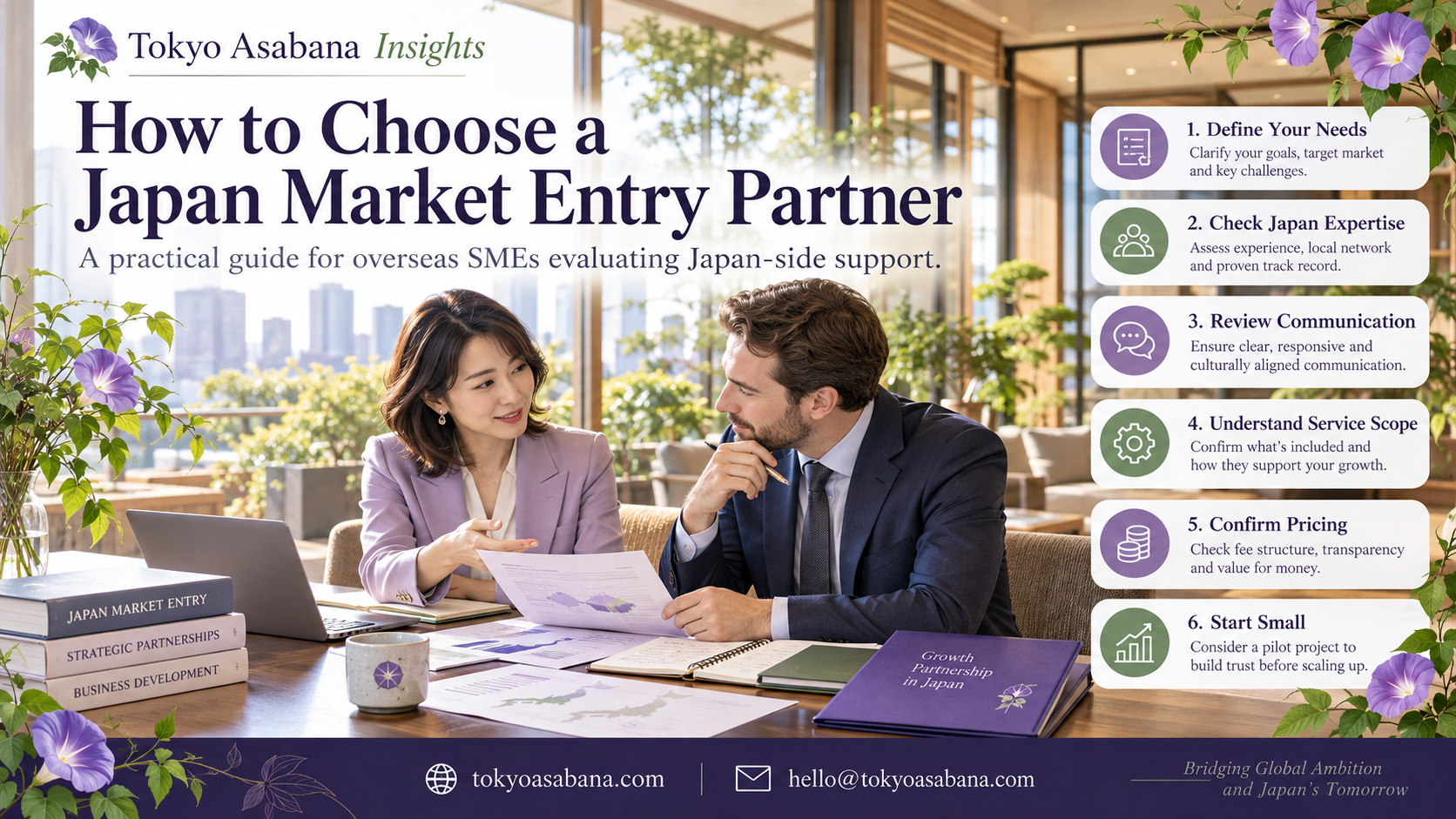
Entering Japan can create significant opportunities for overseas companies, but navigating an unfamiliar business environment often requires local knowledge, communication capabilities, and reliable support.
For small and medium-sized enterprises (SMEs), establishing a Japanese subsidiary or hiring a local team may not be practical during the early stages of market exploration.
This leads to an important question:
How should an overseas company choose the right Japan market entry partner?
Should you work with a consulting firm, business development provider, distributor, local representative, or independent advisor?
More importantly, how can you determine whether a potential partner is capable of delivering what your business actually needs?
Choosing the wrong partner can lead to unnecessary expenses, unclear responsibilities, ineffective outreach, and unrealistic expectations.
For overseas SMEs, the priority should be to identify a partner whose capabilities, commercial model, and responsibilities match their current stage of market entry.
1. Define Your Business Objective Before Searching for a Partner
The first step is not to search for Japan market entry consultants.
It is to clarify what your company wants to achieve.
For example, an overseas business may want to:
- Understand whether its products or services have potential in Japan
- Research Japanese competitors and customer segments
- Identify potential distributors or business partners
- Contact prospective Japanese customers
- Arrange introductory business meetings
- Localize business materials and communications
- Coordinate a seminar, business visit, or local project
- Establish a long-term commercial presence in Japan
These objectives require different capabilities.
A provider experienced in market research may not be responsible for generating sales.
Similarly, a distributor that handles physical products may not be appropriate for an overseas consulting or education business.
The right Japan market entry partner depends on the problem you need to solve, not simply on who offers the broadest list of services.
Before approaching potential providers, prepare a short description of your business, target customers, objectives, and expected support.
This will make initial discussions more focused and productive.
2. Evaluate Relevant Japan Market Experience
Experience in Japan is important, but it should be evaluated carefully.
A service provider may have extensive general business experience without having relevant knowledge of your specific industry or customer segment.
For example, supporting a foreign manufacturer entering Japanese distribution channels is different from helping an overseas education provider reach Japanese families.
Likewise, developing B2B partnerships differs from marketing consumer products.
Useful questions include:
- Which industries has the provider worked with?
- Does the provider understand the intended Japanese customer segment?
- Has the provider supported overseas SMEs?
- What types of projects has it completed?
- Can it explain relevant market challenges?
- Does it understand the differences between advisory, research, and execution?
Relevant experience does not always require having worked with an identical product.
However, the provider should be able to explain how its knowledge and capabilities apply to your specific situation.
A credible partner should demonstrate an understanding of your business problem rather than simply claiming to know the Japanese market.
3. Check Communication and Localization Capabilities
Language ability is important, but effective Japan market entry support requires more than translation.
A potential partner should be able to help bridge differences in commercial communication, expectations, and business practices.
For example, an overseas company may have a persuasive English-language presentation but struggle to communicate its offering clearly to Japanese corporate buyers.
A Japan-side partner may need to assist with:
- Understanding the overseas company’s business model
- Preparing or reviewing Japanese-language materials
- Communicating with Japanese organizations
- Clarifying meeting objectives and commercial expectations
- Explaining questions or concerns raised by local counterparts
- Supporting follow-up communication
The ability to communicate in both English and Japanese can be particularly valuable when the overseas company has no Japanese-speaking employees.
However, bilingual ability alone does not establish commercial expertise.
The provider should also understand the business context of the discussions.
Good market entry communication is not simply about translating words. It is about ensuring both sides understand what is being proposed.
4. Distinguish Advisory From Business Development Execution
One of the most important questions when choosing a Japan market entry partner is whether the provider offers advice, practical execution, or both.
Advisory services may include:
- Market opportunity assessments
- Business positioning
- Competitor analysis
- Customer segment recommendations
- Market entry strategy discussions
Business development execution may include:
- Identifying target companies
- Preparing prospect lists
- Researching relevant decision-makers
- Developing outreach approaches
- Contacting potential customers or partners
- Coordinating introductory discussions
- Supporting agreed follow-up activities
Both can be useful, but they are not interchangeable.
For example, a consultant may advise that a certain industry is attractive without taking responsibility for approaching individual companies.
Conversely, a business development provider may conduct outreach according to an agreed target list without guaranteeing that the target market is commercially viable.
Before signing an agreement, clarify which activities are actually included.
Market entry strategy and market entry execution should be treated as distinct deliverables, even when they are provided by the same organization.
5. Ask How Potential Customers and Partners Will Be Identified
For overseas B2B companies, identifying relevant Japanese organizations is often a central part of market entry.
However, the quality of a target list matters more than its size.
A provider offering hundreds of company names may not necessarily deliver more value than one identifying a smaller number of relevant prospects.
When evaluating a potential partner, ask:
- How will target companies be selected?
- What business criteria will be used?
- Will the research focus on companies with plausible commercial needs?
- How will relevant departments or decision-makers be identified?
- What information will be included in the deliverables?
- What happens if the initial target segment proves unsuitable?
For example, an overseas software development company may benefit from identifying Japanese businesses with specific technical requirements rather than receiving a generic list of large corporations.
A useful prospect list should support a defined business development objective.
It should also reflect realistic limitations regarding access to decision-makers and the availability of contact information.
A long contact list is not the same as a qualified business opportunity.
6. Understand the Partner’s Commercial Model
Japan market entry providers may use different pricing and cooperation models.
Common arrangements include:
Consultation fees
Payment for professional advisory sessions, assessments, or strategy discussions.
Project-based fees
Payment for defined research, outreach, localization, or coordination activities.
Retainer arrangements
Recurring payments for ongoing services within an agreed monthly or periodic scope.
Referral commissions
Payments associated with successful introductions or other contractually defined referral outcomes.
Distribution or agency agreements
Commercial arrangements involving product distribution, sales representation, or related responsibilities.
No single model is appropriate for every situation.
However, overseas SMEs should understand the difference between referring an existing opportunity and developing a new market.
A referral may involve introducing a company to an already identified potential customer.
Market development may require extensive research, target identification, localization, outreach, and follow-up before any commercial opportunity exists.
These activities create costs regardless of whether a sale is eventually completed.
For this reason, commission-only arrangements may be unsuitable for work requiring substantial upfront market development.
A sustainable cooperation model should reflect the actual work, responsibilities, and risks undertaken by each party.
7. Look for Transparent Pricing and Clearly Defined Deliverables
A reliable Japan market entry partner should be able to explain how its services are priced and what clients will receive.
Before committing, overseas SMEs should confirm:
- The exact scope of services
- Fees and payment schedules
- Expected deliverables
- Project duration or consultation time
- Responsibilities of each party
- Additional costs and third-party expenses
- Cancellation or rescheduling conditions
- What is specifically excluded from the agreement
For example, a preliminary consultation may help clarify the company’s needs without including market research or outreach.
Similarly, a market research project may produce a report or prospect list without guaranteeing meetings with those organizations.
A transparent provider should distinguish these services rather than allowing clients to assume that one fee includes unlimited support.
Clear pricing is not simply about displaying a number. It is about explaining what the client is actually purchasing.
Overseas companies should also be cautious about vague promises that are not supported by defined responsibilities or deliverables.
8. Assess Responsiveness and Project Management
A market entry partner may have strong knowledge of Japan but still struggle with project execution.
For overseas companies working across time zones, responsiveness and coordination processes are particularly important.
Useful questions include:
- Who will be the primary contact?
- How will project updates be communicated?
- What information must the overseas client provide?
- How will meetings and follow-up activities be coordinated?
- How will unexpected delays or changes be handled?
- How will project progress be documented?
A provider does not necessarily need to offer around-the-clock communication.
However, expectations should be agreed upon in advance.
For example, an overseas company in North America and a Japan-side advisor may have limited overlapping working hours.
Clear scheduling procedures and communication responsibilities can reduce unnecessary delays.
For project-based work, a defined workflow is often more valuable than informal promises of constant availability.
9. Be Careful With Guaranteed Results and Unclear Authority
Overseas companies should be cautious when evaluating claims about guaranteed market access, customer acquisition, or partnerships.
A Japan-side provider can support research, introductions, business communication, and coordination.
However, it generally cannot control whether an independent Japanese company will respond, agree to a meeting, or enter into a commercial relationship.
Similarly, a local coordinator cannot guarantee approval from a university, government body, venue operator, or other institution.
Companies should also clarify whether the partner has authority to represent them commercially.
Supporting communications does not automatically mean the provider is authorized to negotiate or sign contracts on the client’s behalf.
Before proceeding, consider:
- Are the promised outcomes realistically within the provider’s control?
- Are sales targets being confused with service deliverables?
- Does the provider have clearly defined authority?
- Are confidential information and business data handled appropriately?
- Are regulated professional services being referred to qualified specialists?
Legal, tax, immigration, licensing, and other regulated matters should be handled by appropriately qualified professionals where required.
A credible partner should be clear about both its capabilities and its limitations.
10. Start With a Limited Engagement Before Expanding
For overseas SMEs, selecting a Japan market entry partner does not always require a long-term contract from the beginning.
A smaller initial engagement may help both parties evaluate whether further cooperation is appropriate.
Depending on the circumstances, this could involve:
- A paid initial consultation
- A focused competitor research project
- A limited target company list
- A defined business outreach assignment
- Coordination of a specific meeting or event
- A short exploratory project with agreed deliverables
After the initial engagement, the overseas company can assess:
- Was communication clear?
- Were the agreed deliverables completed?
- Did the work provide useful business information?
- Were project boundaries respected?
- Is there a reasonable basis for additional cooperation?
This approach may help businesses avoid committing to a large project before understanding the provider’s working methods.
A small, well-defined engagement can be a practical way to evaluate a potential long-term Japan-side partner.
11. A Practical Checklist for Evaluating Japan Market Entry Partners
Before choosing a provider, overseas companies can use the following checklist.
| Evaluation Area | Key Question |
| Business Understanding | Does the partner understand our product, customers, and objectives? |
| Japan Market Knowledge | Does the partner have relevant local commercial knowledge? |
| Communication | Can the partner support effective bilingual business communication? |
| Service Scope | Are advisory, research, outreach, and execution clearly distinguished? |
| Deliverables | Do we know exactly what we will receive? |
| Pricing | Are fees, additional charges, and payment terms transparent? |
| Project Management | Are responsibilities, timelines, and communication procedures defined? |
| Commercial Boundaries | Does the partner avoid unrealistic guarantees? |
| Professional Compliance | Are regulated matters handled by appropriately qualified specialists? |
| Scalability | Can cooperation expand according to actual business needs? |
A provider does not necessarily need to score equally well in every category.
The relative importance of each factor depends on the company’s objectives.
For example, a company seeking competitor research may prioritize analytical capability.
Another company preparing a Tokyo business seminar may place greater emphasis on bilingual coordination and local stakeholder communication.
The goal is to identify the best fit for a specific business need.
12. How Tokyo Asabana Supports Overseas Companies
Tokyo Asabana provides Japan-side business advisory, research, communication, and coordination services for overseas companies, including SMEs exploring or developing opportunities in Japan.
Our approach focuses on clearly defined services rather than assuming that every client needs a comprehensive market entry package.
Depending on the agreed project scope, support may include:
- Japan market entry advisory
- Competitor and customer segment research
- Potential partner or customer identification
- Business development and outreach support
- Bilingual business communication
- Meeting and stakeholder coordination
- Selected local project support in Japan
Overseas companies can begin with a paid corporate consultation to discuss their objectives and evaluate suitable next steps.
Our standard corporate consultation options include:
- 30-minute preliminary corporate consultation: JPY 4,400
- 60-minute corporate advisory consultation: JPY 44,000
The preliminary consultation fee may be credited toward a qualifying further paid consultation for the same agreed scope within 14 calendar days, subject to applicable terms.
Additional research, outreach, interpretation, coordination, and project-based services are quoted separately according to the agreed scope.
Tokyo Asabana does not guarantee customer acquisition, successful partnerships, or other commercial outcomes.
Where legal, tax, immigration, licensing, or other regulated professional services are required, appropriately qualified specialists should be involved.
Our approach emphasizes transparent pricing, defined responsibilities, and practical Japan-side business support.
Conclusion: Choose a Partner Based on Fit, Not Promises
The right Japan market entry partner can help an overseas company understand local market conditions, communicate more effectively, and organize specific commercial activities.
However, choosing a provider should not be based solely on company size, broad service claims, or promises of rapid market access.
For overseas SMEs, the most important questions are:
- What business problem do we need to solve?
- What specific capabilities are missing internally?
- What services and deliverables are required?
- How will responsibilities and fees be structured?
- What evidence would justify a larger engagement?
The best Japan market entry partner is not necessarily the largest or the most expensive. It is the one whose capabilities, responsibilities, and commercial model fit your actual business needs.
Starting with a clear objective and a well-defined scope can help overseas companies build more effective and sustainable Japan-side relationships.
Looking for a Japan Market Entry Partner?
Tokyo Asabana supports overseas companies with paid Japan market entry advisory, business research, bilingual communication, and local coordination services.
If your company is evaluating Japan-side support or considering a specific market entry project, you can begin with a corporate consultation to discuss your objectives and available cooperation options.
Website: https://www.tokyoasabana.com
Services & Transparent Pricing: https://tokyoasabana.stores.jp/
Email: hello@tokyoasabana.com
Related Reading
Tokyo Asabana Insights|When Should an Overseas SME Hire a Local Partner in Japan?