
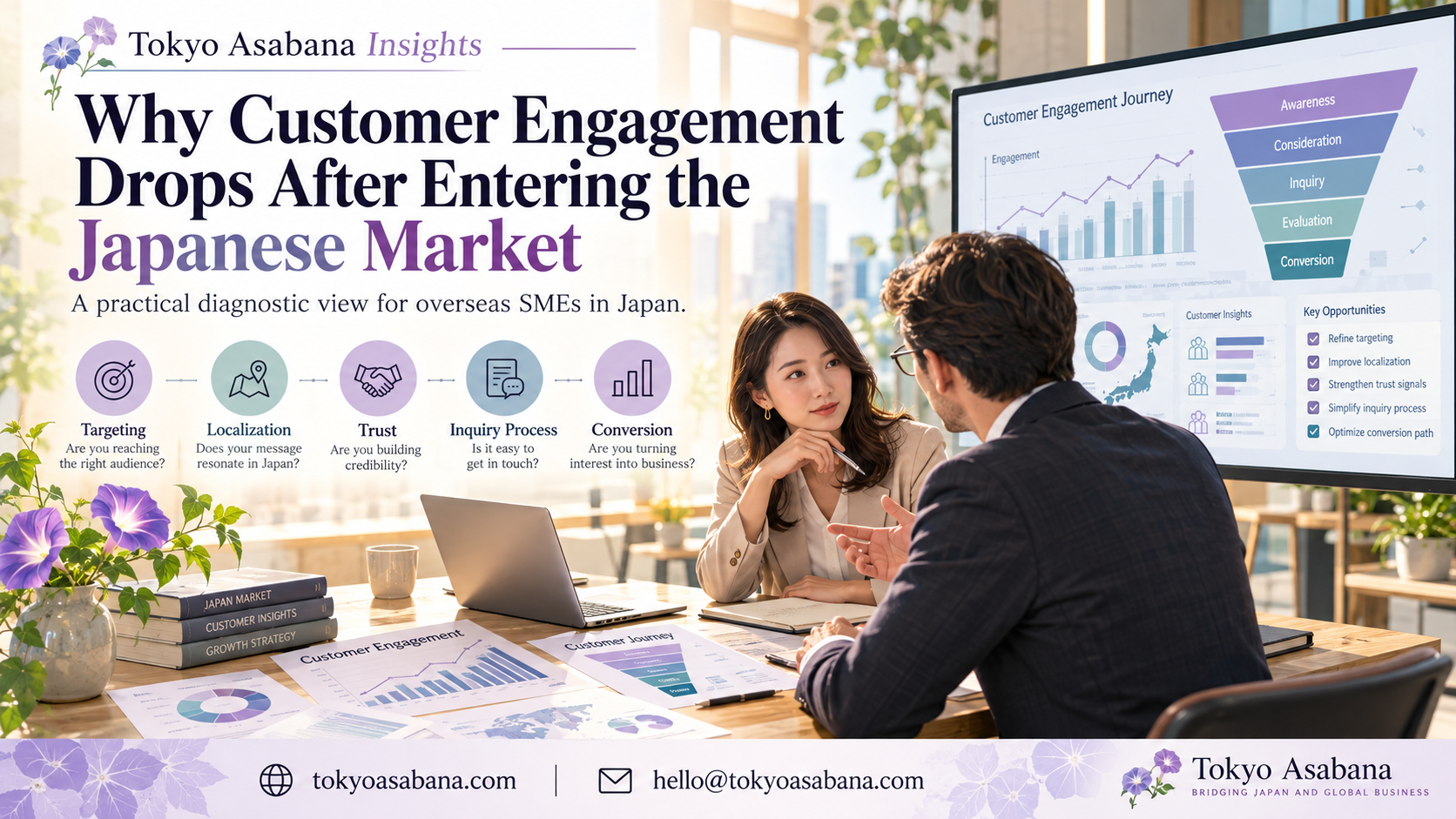
Entering Japan can create significant opportunities for overseas companies. However, a successful market launch does not necessarily lead to strong customer engagement.
Some international businesses discover that their websites attract visitors from Japan, yet relatively few visitors submit inquiries, register for services, request quotations, or arrange business meetings.
Others receive initial expressions of interest but struggle to convert those conversations into actual business.
This raises an important question:
Why does customer engagement sometimes drop after entering the Japanese market?
The answer is not necessarily that Japanese customers are uninterested in international products or services.
Lower engagement may reflect differences in customer expectations, communication, trust, purchasing processes, or the way an overseas company approaches the market.
For small and medium-sized enterprises (SMEs), understanding where potential customers disengage is essential before increasing marketing budgets or expanding local operations.
1. Customer Engagement Is Not the Same as Sales
Before diagnosing a problem, companies should define what they mean by customer engagement.
In a commercial context, engagement may involve several customer behaviors:
- Visiting a website or service page
- Reading product information
- Downloading business materials
- Registering for a service
- Submitting an inquiry
- Replying to business outreach
- Requesting a quotation
- Participating in a business meeting
- Returning for further information
Some of these actions may also be defined as conversions, depending on the company’s measurement system.
For example, a B2B company might treat a submitted inquiry as its primary conversion goal.
An online service provider might focus on registrations, while another business measures qualified meetings.
Google Analytics 4 also uses specific definitions for engagement metrics, which should not be confused with general sales activity or email response rates.
The first step is to decide which customer behavior matters to your business.
Without a clear definition, a company may conclude that engagement is declining when the real issue is a different stage of the customer journey.
2. Identify Where Japanese Customers Disengage
Customer engagement is not a single event.
It develops through multiple stages, and each stage can reveal different problems.
Consider a simplified customer journey:
| Customer Stage | Possible Signal | Potential Problem |
| Discovery | Search impressions or advertising reach | Limited visibility among relevant Japanese customers |
| Initial Interest | Website visits and content engagement | Weak messaging or unsuitable audience targeting |
| Evaluation | Service-page visits, downloads, return visits | Insufficient information or trust |
| Inquiry | Contact forms, emails, quotation requests | Communication barriers or unclear next steps |
| Business Discussion | Meetings and follow-up communication | Misaligned expectations or decision-making processes |
| Purchase | Orders, contracts, payments | Pricing, procurement, or commercial fit |
| Retention | Repeat purchases and ongoing use | Delivery quality, support, or customer experience |
These are possible explanations rather than universal rules.
For example, a company attracting significant Japanese website traffic but receiving few inquiries should examine its conversion process.
A company receiving many inquiries but few completed transactions may need to investigate pricing, qualification, procurement requirements, or service delivery expectations.
Different points of customer disengagement require different solutions.
3. Your Website May Attract Visitors Without Building Confidence
One common challenge is the difference between attracting attention and establishing enough confidence for a customer to take action.
An overseas company’s website may appear in Japanese search results or attract visitors through international advertising.
However, prospective customers may still have unanswered questions.
For example:
- What exactly does the company provide?
- Who is the service designed for?
- How does the service work?
- Is Japanese-language assistance available?
- Are prices or quotation procedures clear?
- Who handles questions after purchase?
- Has the company worked with comparable customers?
These questions are not unique to Japan, but the answers may be especially important when customers are evaluating an unfamiliar overseas provider.
A professional website does not automatically communicate commercial credibility.
For overseas SMEs, it may be more useful to improve a small number of important service pages than to invest immediately in more advertising.
Visibility brings potential customers to your website. Clarity helps them decide whether to engage.
4. Translation May Not Address Local Customer Expectations
Overseas companies often begin Japanese market entry by translating their existing marketing materials.
This can be a useful step, but translation alone may not explain the offering in a way that resonates with the intended audience.
For example, a company may promote its service with statements such as:
“We deliver innovative, world-class solutions.”
Such expressions may sound impressive but provide little information about practical customer benefits.
A more effective explanation may address:
- The specific business problem being solved
- Relevant customer segments
- Implementation procedures
- Expected deliverables
- Pricing and contractual conditions
- Support and communication arrangements
For Japanese B2B customers, it may also be important to explain how a service fits existing workflows or operational requirements.
Localization should therefore consider customer needs, not simply linguistic accuracy.
For SMEs with limited budgets, prioritizing commercially important materials can be more practical than translating everything.
5. The Company May Be Reaching the Wrong Japanese Audience
Lower engagement can occur even when a marketing campaign generates substantial traffic.
The problem may be customer targeting rather than the product itself.
For example, an overseas IT company may attract visitors interested in technology news, but those visitors may not be responsible for purchasing technical services.
An international education provider may reach students who are curious about overseas study opportunities but not the parents or institutions involved in purchasing decisions.
Similarly, English-language advertising may reach international residents in Japan without adequately reaching the intended Japanese corporate audience.
Before evaluating engagement, companies should examine:
- Where their visitors come from
- Whether the audience matches their target customer segment
- Which pages attract traffic
- Which visitors submit relevant inquiries
- Whether leads have purchasing authority
- Whether the channel reaches the intended decision-makers
High traffic from the wrong audience can create the appearance of weak engagement even when the underlying offering has potential.
The objective should be to attract commercially relevant customers rather than simply increase visitor numbers.
6. Trust and Local Support Can Influence Customer Decisions
Potential customers may hesitate to engage with an overseas provider when they are uncertain about what happens after the initial contact.
This can be especially relevant for services requiring ongoing communication, implementation, or coordination.
Questions may include:
- Can the company respond in Japanese?
- Is customer support available during suitable hours?
- Who is responsible for implementation?
- How are problems or misunderstandings resolved?
- Are there clear contractual terms?
- Can the overseas company provide relevant references?
An overseas SME does not necessarily need to establish a Japanese subsidiary to address every concern.
Depending on its business model, it may be able to improve documentation, create clearer communication procedures, provide localized support, or arrange specific Japan-side coordination.
However, companies should avoid implying that a local office or representative exists when it does not.
Trust is strengthened by clear information, consistent communication, and realistic commitments—not simply by appearing local.
7. Inquiry Forms and Communication Processes May Create Friction
Sometimes potential customers are interested, but the process of contacting the company is unnecessarily difficult.
For example:
- The inquiry form requests too much information.
- The customer cannot identify the correct contact point.
- Available meeting times are unsuitable for Japan.
- Responses arrive too slowly.
- The company provides unclear information about next steps.
- The customer must use an unfamiliar payment or booking process.
For B2B companies operating across time zones, meeting scheduling can be a particular challenge.
A business in North America may have limited working-hour overlap with Japan.
Without clear communication procedures, an interested prospect may lose momentum before an introductory meeting takes place.
Overseas SMEs should test their inquiry and booking processes from the perspective of a Japanese customer.
Questions worth examining include:
- Can a customer understand how to make contact?
- Is the expected response process explained?
- Are meeting arrangements practical across time zones?
- Are language options clear?
- Can customers understand available payment methods?
- Does the company follow up on genuine inquiries?
Small operational improvements may remove obstacles without requiring major marketing investments.
8. Initial Interest Does Not Always Mean Purchase Readiness
One of the most important distinctions in international business development is the difference between interest and purchasing intent.
A Japanese company may respond positively to an overseas provider’s introduction.
It may request additional information or agree to a preliminary meeting.
However, these actions do not necessarily indicate that a purchase decision is imminent.
The potential customer may still need to:
- Evaluate internal business requirements
- Compare alternative providers
- Confirm available budgets
- Consult additional stakeholders
- Assess contractual and operational risks
- Determine whether the proposed service fits existing processes
This means overseas companies should avoid treating every positive response as a qualified sales opportunity.
Similarly, a delayed reply does not necessarily indicate rejection.
For B2B businesses, a useful approach is to clarify the prospect’s needs, decision-making process, expected timeline, and next steps.
Engagement should be evaluated according to commercial relevance, not simply the friendliness or speed of a response.
9. Pricing and Service Scope May Be Unclear
Customer engagement can also decline when potential buyers do not understand what they are being asked to purchase.
For example, an overseas professional services company may advertise an introductory consultation without explaining whether further services require additional fees.
A customer may hesitate because the initial price appears to be the beginning of an undefined commitment.
Other potential concerns include:
- Unclear quotation procedures
- Unexpected additional charges
- Uncertain deliverables
- Limited information about cancellations
- Ambiguous customer responsibilities
- Unfamiliar international payment methods
Transparent pricing does not necessarily mean every business must publish a fixed price for all services.
Customized projects often require individual quotations.
However, companies should explain how fees are determined, what is included, and which services are charged separately.
For overseas SMEs, clear commercial conditions can reduce misunderstandings and improve the quality of inquiries.
10. Compare Engagement Across Markets Carefully
When reviewing Japanese market performance, overseas companies should avoid comparing figures without considering how those figures were collected.
For example, suppose an overseas company reports:
“Our customer engagement rate in Japan is half the rate in other markets.”
Before reaching a conclusion, it should examine several factors.
Are the metrics defined consistently?
Website engagement rates, inquiry rates, and sales conversion rates measure different behaviors.
Are the traffic sources comparable?
Visitors from search engines may behave differently from visitors arriving through paid advertising or referrals.
Are the customer segments similar?
Comparing Japanese corporate buyers with individual consumers in another country may produce misleading results.
Are the observation periods comparable?
A newly launched market may have limited brand recognition and relatively little performance data.
Are the sample sizes large enough?
A few inquiries or purchases may cause substantial percentage changes when traffic is limited.
Are the commercial outcomes different?
Japan may generate fewer leads but potentially higher-value business opportunities.
Companies should therefore evaluate engagement alongside lead quality, acquisition costs, conversion rates, and actual revenue.
A lower engagement rate may indicate a problem, but it does not identify the cause by itself.
11. A Practical Customer Engagement Diagnostic Framework
Overseas SMEs can begin with a focused review rather than immediately increasing spending.
The following framework can help organize the process.
| Step | Main Question | Practical Action |
| 1. Define | What does engagement mean for our business? | Select relevant customer and conversion metrics |
| 2. Locate | Where do customers disengage? | Examine the customer journey |
| 3. Compare | Are Japan and other markets being measured consistently? | Review segments, channels, periods, and sample sizes |
| 4. Investigate | What may explain the difference? | Review localization, trust, pricing, and communication |
| 5. Test | Which change could improve the situation? | Run a limited, measurable improvement |
| 6. Decide | Should we adjust, continue, or expand? | Evaluate results and commercial implications |
For example, a company might discover that Japanese visitors frequently access its service pages but rarely submit inquiries.
Rather than increasing advertising immediately, it could first review its service descriptions, contact procedures, language availability, and pricing information.
Another company may find that introductory meetings occur regularly but do not progress.
In that case, the problem may be related to lead qualification, proposal fit, commercial conditions, or internal purchasing processes.
The most useful diagnosis identifies the specific point of friction and the business decision it affects.
12. How Japan-Side Business Support Can Help
Not every overseas company experiencing low customer engagement needs a large marketing agency or permanent Japanese sales team.
Depending on the problem, focused Japan-side support may be appropriate.
For example:
- Market advisory can help review positioning and customer assumptions.
- Competitor research can help clarify local alternatives.
- Customer segment analysis can help improve targeting.
- Bilingual communication can help address language-related friction.
- Business development support can assist with relevant prospect identification and outreach.
- Local coordination can support meetings and communication with Japanese organizations.
These services address different parts of the customer journey.
The appropriate starting point depends on whether the company is experiencing a visibility problem, a communication problem, a commercial fit problem, or an execution problem.
Overseas SMEs should avoid assuming that every engagement challenge requires the same solution.
13. How Tokyo Asabana Supports Overseas Companies
Tokyo Asabana provides Japan-side business advisory, research, bilingual communication, business development, and local coordination support for overseas companies.
For SMEs exploring or developing opportunities in Japan, we help clarify practical business questions and define suitable support activities.
Depending on the agreed scope, services may include:
- Japan market entry advisory
- Customer segment and competitor research
- Business positioning discussions
- Potential customer or partner identification
- Business development and outreach support
- Bilingual business communication
- Meeting and stakeholder coordination
- Selected Japan-side project support
Companies can begin with a paid corporate consultation to discuss their current situation, identify priorities, and consider appropriate next steps.
Our standard corporate consultation options include:
- 30-minute preliminary corporate consultation: JPY 4,400
- 60-minute corporate advisory consultation: JPY 44,000
The preliminary consultation fee may be credited toward a qualifying further paid consultation for the same agreed scope within 14 calendar days, subject to applicable terms.
Market research, outreach, interpretation, coordination, and other project-based work are separately scoped and quoted.
Tokyo Asabana does not guarantee increases in engagement, customer acquisition, successful partnerships, or other commercial outcomes.
Where legal, tax, licensing, immigration, or other regulated professional services are required, appropriately qualified specialists should be involved.
Our approach emphasizes practical business support, transparent pricing, and clearly defined responsibilities.
Conclusion: Diagnose the Customer Journey Before Increasing Investment
Lower customer engagement after entering Japan does not automatically mean that Japanese customers reject an overseas company’s offering.
The problem may occur at any point in the customer journey—from visibility and initial interest to inquiry, business discussion, purchase, and retention.
For overseas SMEs, the most important questions are:
- Are we reaching the right Japanese customers?
- Do they understand our offering?
- Have we provided enough information to establish confidence?
- Is it easy for them to contact us?
- Are we interpreting interest and purchase readiness correctly?
- Are our engagement metrics commercially meaningful?
The answers can help determine whether the company should improve localization, adjust targeting, simplify communication, reconsider its value proposition, or seek additional Japan-side support.
Customer engagement is not simply about attracting attention. It is about creating a clear path from relevant customer interest to meaningful commercial relationships.
Understanding where that process breaks down is often more valuable than immediately spending more on marketing.
Facing Customer Engagement Challenges in Japan?
Tokyo Asabana supports overseas companies with paid Japan market entry advisory, business research, bilingual communication, and local coordination services.
If your company is receiving limited inquiries, struggling to reach Japanese business customers, or evaluating its next market development steps, you can begin with a corporate consultation to clarify the situation and discuss appropriate support.
Website: https://www.tokyoasabana.com
Services & Transparent Pricing: https://tokyoasabana.stores.jp/
Email: hello@tokyoasabana.com
Related Reading
Tokyo Asabana Insights|How to Test the Japanese Market Before Building a Local Team