
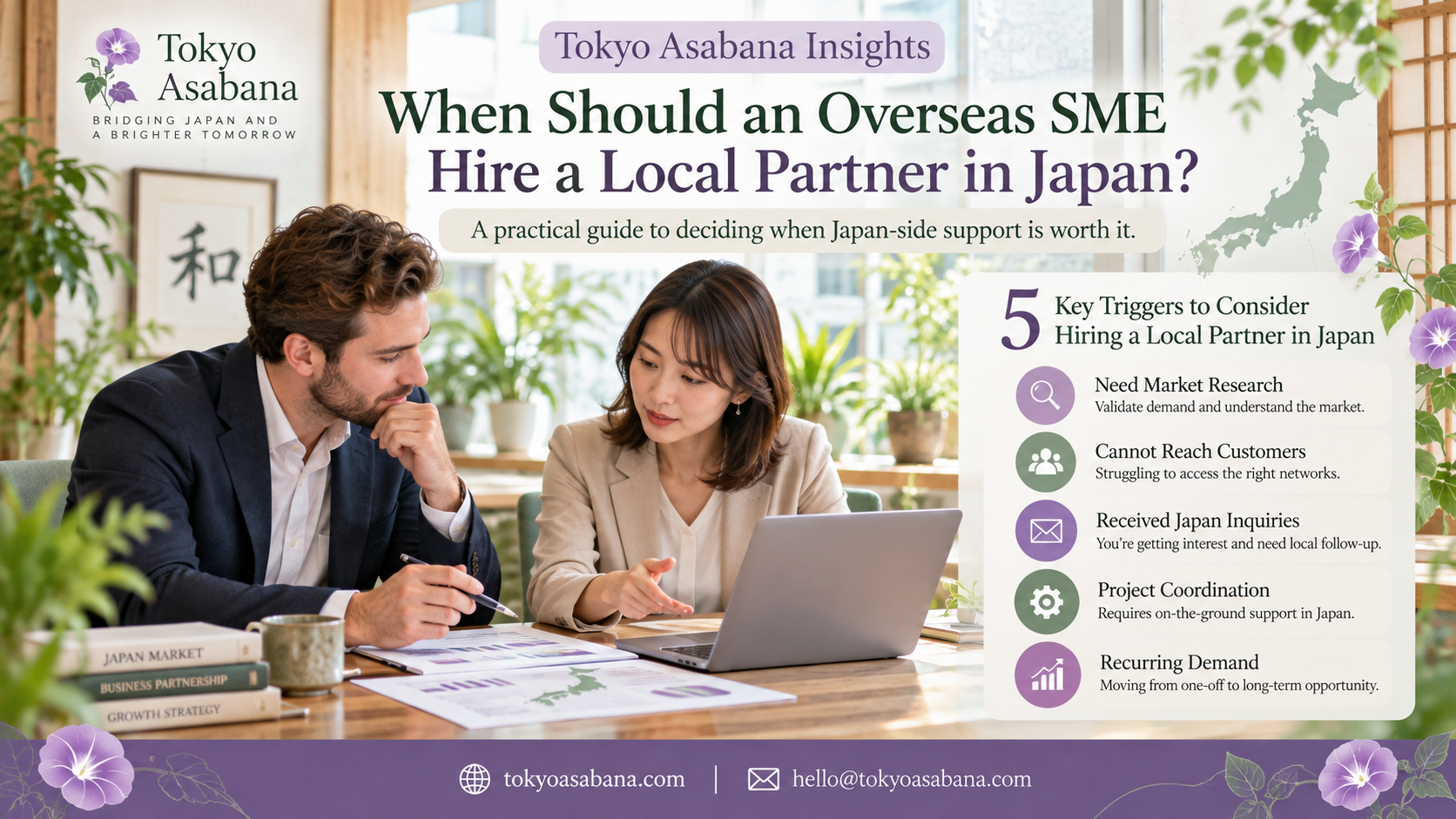
Entering the Japanese market can create valuable opportunities for overseas small and medium-sized enterprises (SMEs).
However, many companies face an important decision during the early stages of expansion:
When is the right time to hire a local partner in Japan?
Should you look for Japan-side support before approaching potential customers? Wait until you receive your first inquiry? Or establish a local team only after securing business?
There is no universal answer.
Some overseas companies can conduct preliminary research and customer outreach independently. Others may encounter language barriers, unfamiliar business practices, or coordination requirements that make local assistance useful much earlier.
The key is to understand when local support can address a specific business need—and when hiring someone would simply create additional costs without sufficient commercial justification.
For overseas SMEs, the right timing can make a significant difference to the efficiency and sustainability of their Japan market entry strategy.
1. Do Not Hire a Local Partner Simply Because You Are Interested in Japan
An overseas company may decide that Japan is an attractive market because of its economic size, established industries, or international business opportunities.
However, general interest in Japan does not automatically justify hiring a local consultant, representative, or business development provider.
Before engaging external support, consider several basic questions:
- What specific opportunity are we pursuing in Japan?
- Which products or services do we intend to offer?
- Who are our target customers?
- What have we already learned about Japanese market demand?
- What activities can our existing team manage?
- Which capabilities are missing?
- What decision or commercial objective would local support help us achieve?
For example, a software company that has not yet identified its intended Japanese customer segment may need an initial strategic discussion before commissioning business outreach.
Similarly, an overseas education provider exploring Japan may first need to understand customer expectations and potential distribution channels.
A local partner should help solve a defined problem, not become a substitute for having a clear business objective.
2. The First Trigger: You Need Information Your Existing Team Cannot Obtain Efficiently
One of the earliest reasons to engage a Japan-side partner is a lack of relevant market information.
Overseas companies can access substantial information about Japan through public sources.
However, general market reports may not answer industry-specific commercial questions.
For example:
- Which Japanese companies are relevant to our offering?
- How do competing service providers position themselves?
- What information do Japanese customers expect before making inquiries?
- Which potential partners match our business model?
- What are the practical barriers to approaching our target customers?
If these questions are preventing the company from making a decision, targeted Japan-side research or advisory support may be useful.
The company does not necessarily need an ongoing local representative at this stage.
A defined consultation or research assignment may be sufficient.
The appropriate first investment is often the information needed to make the next decision, rather than a long-term support contract.
3. The Second Trigger: You Have Identified Customers but Cannot Reach Them Effectively
A stronger reason to engage a local partner arises when an overseas company already understands its target customers but struggles to develop meaningful commercial communication.
This is common in cross-border B2B market development.
For example, an overseas IT company may have established services, international clients, and a clear value proposition.
It may also identify Japanese industries or organizations that appear commercially relevant.
However, the company may lack:
- Japanese-language business communication capabilities
- Knowledge of appropriate contact channels
- Resources for researching relevant decision-makers
- Experience preparing localized outreach messages
- Capacity to follow up across time zones
- Local coordination support for introductory meetings
In this situation, the issue is not necessarily the absence of a market opportunity.
It may be the gap between identifying an opportunity and being able to approach it effectively.
Japan-side business development support can help bridge that gap.
Depending on the agreed scope, this may include target company research, outreach preparation, business communication, and meeting coordination.
However, such support does not guarantee responses, meetings, customer acquisition, or sales.
Local business development support becomes more valuable when the company already knows whom it wants to reach and why those customers might be interested.
4. The Third Trigger: You Have Received Genuine Interest From Japan
Another important moment occurs when Japanese customers or organizations begin contacting the overseas company.
Examples include:
- A Japanese company requests additional service information.
- A potential business partner proposes an introductory meeting.
- An organization asks for a quotation.
- A prospective client wants to discuss implementation.
- A Japanese institution expresses interest in a joint project.
At this stage, the overseas company may need help converting initial communication into a structured business discussion.
Potential support could include:
- Clarifying Japanese-language inquiries
- Preparing bilingual business materials
- Coordinating meeting schedules
- Supporting communication between stakeholders
- Organizing follow-up information
- Identifying unresolved commercial questions
Nevertheless, an inquiry is not the same as a confirmed business opportunity.
A company should still examine whether the prospect has a genuine need, an appropriate budget, and a realistic decision-making process.
The presence of interest can justify further investigation, but it does not automatically justify permanent local staffing.
5. The Fourth Trigger: You Have a Specific Project That Requires Japan-Side Coordination
Some overseas companies need local assistance because they have a specific activity planned in Japan.
For example:
- Organizing a business seminar in Tokyo
- Arranging meetings with Japanese organizations
- Coordinating a professional presentation
- Communicating with local venues
- Preparing bilingual event materials
- Liaising with institutional stakeholders
- Supporting a business visit or selected local project
These activities may require knowledge of Japanese communication practices, scheduling, or institutional procedures.
An overseas organization may have a well-developed program but lack the local resources necessary to coordinate practical arrangements.
In such cases, project-based Japan-side support may be more appropriate than hiring a permanent employee or appointing an exclusive representative.
The engagement can be limited to a defined scope, timeline, and set of deliverables.
However, local coordinators cannot guarantee venue availability, institutional approval, third-party participation, or other outcomes beyond their control.
When the requirement is project-specific, the support arrangement can often be project-specific as well.
6. The Fifth Trigger: Your Japan-Related Work Is Becoming Recurring
An occasional inquiry or one-time project does not necessarily justify an ongoing local arrangement.
However, the situation may change when Japan-related activities become more frequent.
For example, an overseas SME might begin receiving regular inquiries, coordinating multiple partnerships, or conducting recurring business development activities.
At this stage, the company should consider whether a more structured arrangement would be useful.
Possible options include:
- Continuing with separate project-based assignments
- Establishing a defined monthly support arrangement
- Engaging a local business development provider
- Appointing a representative with limited, clearly documented authority
- Hiring employees or establishing local operations when commercially and legally appropriate
The correct choice depends on workload, continuity requirements, costs, commercial authority, and applicable regulatory considerations.
For example, a monthly retainer may be appropriate when tasks are recurring and the expected scope can be defined.
However, a retainer should not automatically imply unlimited support or responsibility for every activity in Japan.
Recurring business needs may justify recurring support—but the responsibilities and fees should remain clearly defined.
7. When You May Not Need a Local Partner Yet
Hiring a local partner is not always the best next step.
An overseas SME may reasonably postpone external support when:
The business objective is unclear.
The company has not decided what it wants to sell or whom it intends to target in Japan.
The offering has not been sufficiently developed.
The product or service is still changing significantly, making meaningful market testing difficult.
The company has no budget for market development.
If all research, communication, and outreach must be performed without compensation, the company may need to reconsider the scale or timing of its expansion plans.
The existing team can handle the immediate tasks.
Some overseas companies already have Japanese-language capabilities, relevant customer relationships, or suitable internal resources.
There is no defined work for the partner to perform.
Engaging someone without clear deliverables can create costs without producing useful business information.
The company is not prepared to act on the findings.
Research and advisory services are less valuable if the company lacks the resources or willingness to make subsequent decisions.
In these circumstances, internal preparation may be more appropriate.
A good Japan market entry decision includes knowing when not to purchase external services.
8. Local Partner, Local Employee, or Japanese Subsidiary?
Overseas SMEs sometimes treat these three options as interchangeable, but they represent different levels of commitment.
| Option | Typical Purpose | Main Considerations |
| Project-Based Local Partner | Research, outreach, communication, or coordination for defined activities | Scope, deliverables, fees, responsibilities |
| Ongoing External Partner | Recurring business development or Japan-side support | Workload, reporting, retainer terms, authority |
| Local Employee | Internal, continuing work under an employment arrangement | Salary, management, employment compliance, ongoing costs |
| Japanese Subsidiary | Establishing a local corporate presence | Business model, tax, registration, regulatory and operational obligations |
These options are not necessarily sequential.
A company may work with external partners while operating a Japanese subsidiary.
Another may conduct preliminary market research without establishing a local entity.
The suitable structure depends on the activities involved, regulatory requirements, and commercial objectives.
Importantly, hiring an external partner does not automatically eliminate legal or tax obligations associated with conducting business in Japan.
Companies should obtain appropriate professional advice where necessary.
9. Compare the Cost of Local Support With the Cost of Doing Nothing
Overseas companies often focus on the direct fee charged by a Japan-side partner.
However, the relevant commercial question is broader.
What happens if the company does not obtain the support?
Potential consequences may include:
- Delayed business discussions
- Missed communication opportunities
- Repeated ineffective outreach
- Unclear market assumptions
- Internal staff spending excessive time on unfamiliar tasks
- Postponed decisions about commercially relevant opportunities
These costs are not always easy to quantify, and external support does not necessarily eliminate them.
Nevertheless, companies should evaluate potential partners in terms of the decisions and activities they can support.
For example, paying for a focused market research assignment may be reasonable if the findings help determine whether a substantially larger investment is justified.
Similarly, defined business development support may be useful when the company has identified relevant customers but lacks the internal resources to approach them.
The value of a local partner should be assessed against a specific commercial objective, not simply against the lowest available service fee.
10. A Practical Decision Framework for Overseas SMEs
The following framework can help companies decide whether Japan-side support is appropriate.
| Your Current Situation | Potential Next Step | Possible Support |
| Interested in Japan but unsure where to begin | Clarify market objectives and assumptions | Initial advisory |
| Know the target market but lack specific information | Investigate customers, competitors, or partners | Targeted research |
| Have identified prospects but cannot reach them effectively | Develop focused outreach activities | Business development and bilingual communication |
| Have received genuine Japan-side inquiries | Organize commercial discussions | Meeting and communication support |
| Have a specific seminar, visit, or project | Define local responsibilities | Project-based coordination |
| Have recurring Japan-related business activities | Evaluate ongoing support needs | Retainer, representative arrangement, or internal staffing |
| Have validated substantial ongoing commercial demand | Consider a more permanent structure | Local team or entity, with appropriate specialist advice |
This framework does not replace a detailed commercial or regulatory assessment.
However, it highlights an important principle:
The level of Japan-side support should increase in response to actual business needs, rather than assumptions about what market entry must involve.
11. How to Structure an Initial Engagement With a Japan-Side Partner
Once an overseas SME decides that local assistance is appropriate, it should avoid beginning with an undefined arrangement.
A practical initial engagement should clarify:
Business objective
What does the company want to learn or accomplish?
Service scope
Will the provider deliver advisory, research, outreach, or coordination services?
Deliverables
What specific outputs or activities are included?
Responsibilities
What information and decisions must the overseas company provide?
Commercial terms
What are the fees, payment conditions, and possible additional costs?
Authority
Can the provider communicate on behalf of the company, and within what limits?
Next steps
How will both parties evaluate whether further cooperation is justified?
For companies uncertain about the appropriate arrangement, a limited paid consultation or clearly defined project may be a useful starting point.
This can allow both parties to assess practical compatibility before considering longer-term cooperation.
12. How Tokyo Asabana Supports Overseas SMEs
Tokyo Asabana provides Japan-side business advisory, research, bilingual communication, business development support, and local coordination services for overseas companies.
Our services are particularly relevant to businesses that need defined Japan-side assistance but are not necessarily ready to establish a permanent local team.
Depending on the agreed scope, support may include:
- Japan market entry advisory
- Competitor and customer segment research
- Potential business partner identification
- Target company research
- Business development and outreach support
- Bilingual business communication
- Meeting and stakeholder coordination
- Selected local project support
Companies can begin with a paid corporate consultation to clarify their objectives and identify suitable next steps.
Our standard corporate consultation options include:
- 30-minute preliminary corporate consultation: JPY 4,400
- 60-minute corporate advisory consultation: JPY 44,000
The preliminary consultation fee may be credited toward a qualifying further paid consultation for the same agreed scope within 14 calendar days, subject to applicable terms.
Research, outreach, interpretation, coordination, and other project-based activities are separately scoped and quoted.
Tokyo Asabana does not guarantee customer acquisition, successful partnerships, sales, or other commercial outcomes.
Where legal, tax, immigration, licensing, or other regulated professional services are required, appropriately qualified specialists should be involved.
Our approach emphasizes transparent pricing, defined responsibilities, and practical business support.
Conclusion: Hire Local Support When There Is a Clear Business Need
For overseas SMEs, engaging a local partner in Japan should not be an automatic first step.
Nor should it necessarily be delayed until the company has already built a substantial Japanese customer base.
The right timing depends on the company’s stage of development and the specific activities that require assistance.
An initial consultation may be enough when the company is still exploring the market.
Targeted research may be appropriate when information is missing.
Business development support can become valuable when relevant prospects have been identified.
Project-based coordination may be sufficient for specific meetings or events.
And ongoing local arrangements may make sense when Japan-related activities become recurring.
The right time to hire a Japan-side partner is when the work they will perform is clear, commercially relevant, and appropriately scoped.
For smaller overseas companies, this approach can help align local support costs with actual business needs while preserving flexibility for future expansion.
Considering Japan-Side Business Support?
Tokyo Asabana provides paid Japan market entry advisory, business research, bilingual communication, and local coordination services for overseas SMEs.
Whether you need an initial assessment, targeted research, business development assistance, or support for a specific Japan-related project, you can begin with a corporate consultation.
Website: https://www.tokyoasabana.com
Services & Transparent Pricing: https://tokyoasabana.stores.jp/
Email: hello@tokyoasabana.com
Related Reading
Tokyo Asabana Insights|How to Test the Japanese Market Before Building a Local Team
🌸Tokyo Asabana Service🌸|Your Japan Team—Before You Build a Japan Team