
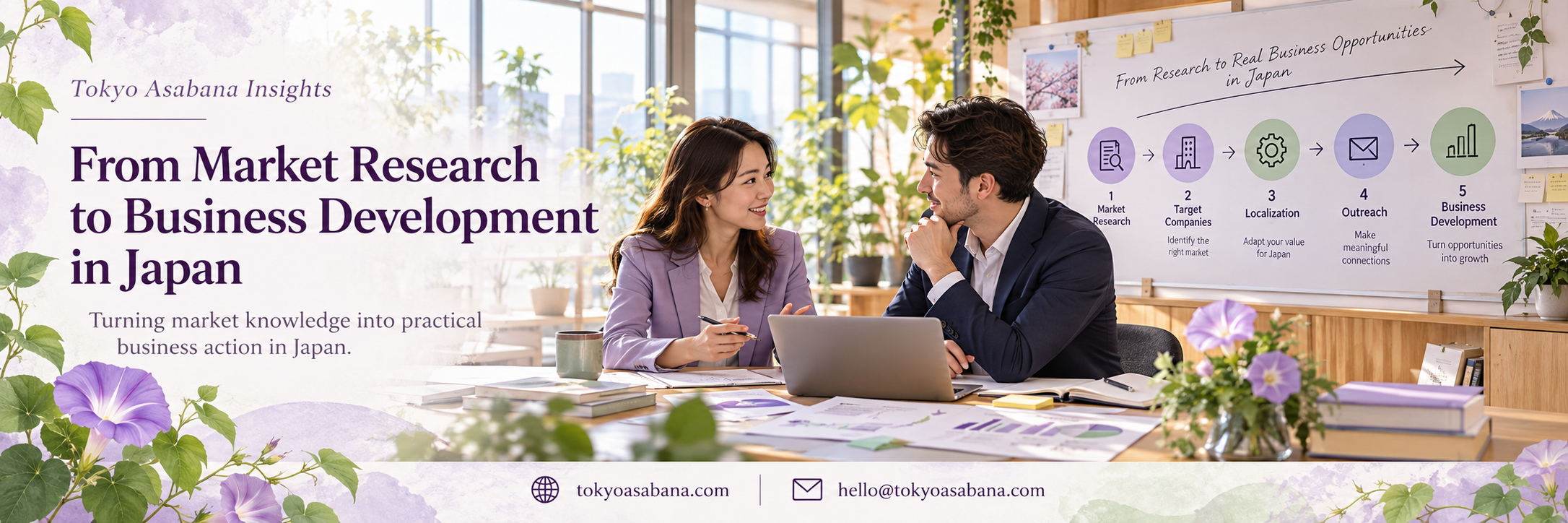
Japan can offer attractive opportunities for overseas companies, but understanding the market is only the beginning.
Many international businesses conduct preliminary research before entering Japan. They examine industry reports, identify competitors, estimate market potential, and develop an initial expansion strategy.
However, after completing their research, they often face another challenge:
How do we turn market information into actual business opportunities in Japan?
A market report may identify promising industries. It does not necessarily identify the right decision-makers.
A competitor analysis may reveal gaps in the market. It does not automatically generate customer inquiries.
A business strategy may recommend entering Japan. It does not explain who will contact potential customers, prepare localized proposals, or coordinate commercial discussions.
For overseas small and medium-sized enterprises (SMEs), this transition from market research to business development is often one of the most demanding stages of international expansion.
Understanding the Japanese market and developing business in Japan are two different capabilities.
1. What Market Research Can—and Cannot—Tell You
Market research provides information to support business decisions.
Depending on the project, it may include:
- Industry analysis and market trends
- Customer segment identification
- Competitor research
- Pricing and service comparisons
- Distribution channels
- Regulatory considerations
- Potential market entry opportunities
For example, an overseas software company may discover that several Japanese industries are investing in digital transformation.
An education provider may identify potential demand for international academic programs.
A professional services company may find that Japanese businesses increasingly require certain international capabilities.
These findings can help companies decide where to investigate further.
However, market research alone cannot establish that customers are willing to purchase a particular offering.
A market opportunity is not the same as a qualified sales opportunity.
To develop business, the company must move beyond general information and test commercial relevance with specific organizations.
2. The Gap Between Market Knowledge and Customer Access
One common market entry challenge is knowing which industries appear attractive without knowing how to reach the relevant customers.
For example, an overseas B2B company may identify Japanese manufacturers as a potential customer segment.
But that still leaves several unanswered questions:
- Which manufacturers are most relevant?
- Which companies might have a genuine need?
- Who is responsible for evaluating the proposed service?
- How should the company introduce its offering?
- Which communication channels are appropriate?
- How should interested prospects be followed up?
These questions belong to business development rather than general market research.
For SMEs without a Japanese sales team, answering them can require substantial additional work.
The real transition begins when broad market information is converted into a specific, commercially relevant target list.
3. Target Company Identification: Quality Matters More Than Quantity
A market research report may include a list of major Japanese companies.
However, well-known companies are not automatically suitable customers.
A large corporation may have complex procurement requirements, multiple decision-making layers, or existing supplier relationships.
A smaller company may have a more immediate need and a shorter decision process.
The reverse can also be true.
The relevant factor is not company size alone, but commercial fit.
When developing a target list, overseas SMEs should consider:
- Industry relevance
- Company size and business model
- Potential need for the offering
- International business activities
- Existing solutions or partnerships
- Appropriate departments and decision-makers
- Practical reasons for initiating contact
For example, a specialized overseas IT provider may benefit more from identifying 30 relevant Japanese companies than receiving a generic database of 500 organizations.
The purpose of target identification is not simply to collect names.
It is to explain why each organization may represent a plausible opportunity.
A useful business development list should be built around commercial relevance, not volume.
4. Localization: Turning Market Positioning Into Business Communication
Another challenge is translating a general market entry strategy into messages that Japanese customers can understand and evaluate.
An overseas company’s English-language introduction may emphasize innovation, global experience, or technical excellence.
However, prospective customers may want more specific information:
- What problem does the offering solve?
- How is the service delivered?
- What are the expected responsibilities?
- What are the pricing or quotation conditions?
- What support will be available?
- Why is the company contacting this particular organization?
Localization therefore involves more than translating existing materials.
It may require restructuring explanations, clarifying service scope, and adapting communication to the intended customer segment.
For B2B companies, a concise and relevant proposal can be more useful than a lengthy generic presentation.
Effective localization helps potential customers understand the commercial value of an offering, not simply read it in Japanese.
5. Business Outreach: Research Must Become Action
Once relevant companies have been identified and suitable materials prepared, the next step is business outreach.
Depending on the project, outreach may involve:
- Identifying appropriate contact points
- Preparing introductory messages
- Contacting prospective customers or partners
- Responding to initial questions
- Coordinating exploratory discussions
- Following up on agreed next steps
- Recording responses and objections
However, sending large numbers of emails does not automatically constitute effective business development.
A generic message requesting cooperation may provide little reason for the recipient to respond.
A more focused approach explains why the sender’s offering is relevant to the recipient’s business.
For example, instead of writing:
“We would like to explore potential collaboration in Japan.”
A more specific introduction might explain the company’s existing service, identify a relevant customer need, and suggest a clearly defined form of cooperation.
Overseas SMEs should also recognize that business outreach involves uncertainty.
A relevant prospect may not respond.
An interested organization may not have an immediate budget.
A positive introductory meeting may not lead to a contract.
Business development is a process of identifying and testing commercial opportunities—not a guarantee of sales.
6. Why Japanese Business Communication May Require Local Support
Overseas companies can often conduct research remotely.
However, moving into direct communication with Japanese organizations may introduce additional practical challenges.
These can include:
- Japanese-language correspondence
- Identifying relevant departments
- Understanding business communication conventions
- Coordinating meetings across time zones
- Preparing bilingual materials
- Clarifying commercial questions
- Supporting follow-up discussions
Not every overseas company needs a Japanese subsidiary or permanent local employee to address these challenges.
Depending on its business model, project requirements, and applicable regulations, external Japan-side support may assist with defined activities.
For example, a company may require help contacting selected Japanese organizations or coordinating an introductory meeting.
Another may need research and bilingual communication support before deciding whether to establish a local sales function.
Local support can help bridge operational gaps, but the scope and responsibilities should be agreed upon clearly.
7. Market Interest Is Not the Same as Commercial Readiness
One of the most important lessons in business development is the distinction between interest and purchasing intent.
A Japanese organization may respond positively to an overseas company’s introduction.
It may request further information or agree to an initial meeting.
However, these actions do not necessarily mean the organization is ready to purchase.
Several factors may still need to be clarified:
- The customer’s actual business need
- Available budget
- Decision-making authority
- Implementation requirements
- Procurement procedures
- Expected timing
- Commercial and contractual conditions
For overseas SMEs, the quality of an opportunity matters more than the number of positive responses.
For example, five introductory meetings without a defined business need may provide less immediate commercial value than one serious discussion with a company that has a specific requirement.
Interest can justify further discussion, but commercial readiness requires stronger evidence.
This distinction should be reflected in how companies evaluate their market entry progress.
8. Why Commission-Only Market Development Often Creates Problems
Some overseas companies propose commission-only arrangements when seeking Japan-side business development support.
The proposal may sound straightforward:
“We will pay you when you bring us customers.”
Such arrangements can be suitable for certain referral or sales activities.
However, there is an important distinction:
Referring an existing business opportunity is not the same as developing a new market.
Japan market development may require work long before a qualified customer exists.
This can include:
- Competitor and customer research
- Target company identification
- Decision-maker research
- Localization of business materials
- Outreach preparation
- Direct communication
- Follow-up and meeting coordination
These activities require time and resources regardless of whether a transaction ultimately occurs.
Therefore, commission-only arrangements may not be appropriate when substantial market development is required upfront.
Possible cooperation models include:
Project-based fees: Payment for defined research, outreach, or coordination activities.
Retainers: Recurring fees for ongoing services within an agreed scope.
Referral commissions: Compensation for qualifying introductions under defined contractual conditions.
Hybrid arrangements: A combination of agreed service fees and performance-related compensation.
The suitable model depends on the responsibilities and risks undertaken by each party.
For overseas SMEs, understanding these differences helps avoid unrealistic expectations.
9. How to Measure Progress From Research to Business Development
Companies should avoid measuring market entry progress solely by the number of reports produced, contacts collected, or emails sent.
These are activities, not necessarily commercial outcomes.
A more useful framework distinguishes several stages.
| Stage | Typical Activity | Useful Evidence |
| Market Research | Analyze industries, competitors, and customers | Market findings and identified opportunities |
| Target Identification | Select relevant Japanese organizations | Prioritized company list with commercial rationale |
| Localization | Prepare appropriate business materials | Clear, audience-relevant proposals |
| Business Outreach | Contact prospective customers or partners | Recorded outreach and responses |
| Opportunity Assessment | Evaluate inquiries and discussions | Evidence of needs, budget, authority, and timing |
| Commercial Development | Explore proposals, pilots, or agreements | Defined next steps and potential transactions |
Not every project progresses through these stages at the same speed.
Some companies may already have Japanese customers and can begin with commercial discussions.
Others may require additional research or regulatory review before approaching prospects.
The important principle is to link each stage to a business decision.
Meaningful progress is not simply doing more activities. It is reducing uncertainty and identifying commercially relevant opportunities.
10. A Practical Approach for Overseas SMEs
For smaller companies, the transition from market research to business development does not need to begin with a large, long-term investment.
A focused approach may be more appropriate.
Step 1: Define the commercial objective
Identify the product or service, intended customers, and desired business outcome.
Step 2: Conduct targeted research
Focus on the information required to evaluate the opportunity.
Step 3: Identify relevant organizations
Prepare a prioritized target list based on commercial fit.
Step 4: Localize the business proposition
Ensure prospective customers can understand the offering and proposed cooperation.
Step 5: Test targeted outreach
Contact selected organizations and gather feedback.
Step 6: Evaluate commercial signals
Distinguish general interest from genuine purchasing or partnership potential.
Step 7: Decide the next investment
Continue, adjust, expand, or pause based on the evidence.
The sequence may vary by industry, and certain activities may require specialist review before proceeding.
For some companies, external Japan-side advisory or project-based support can help organize this process without immediately establishing a permanent team.
11. How Tokyo Asabana Supports the Transition to Business Development
Tokyo Asabana provides Japan-side business advisory, research, bilingual communication, business development support, and local coordination services for overseas companies.
Our approach focuses on helping companies move from general market interest toward clearly defined commercial activities.
Depending on the agreed scope, support may include:
- Japan market entry advisory
- Competitor and customer segment research
- Target company identification
- Potential business partner research
- Business development and outreach support
- Bilingual business communication
- Meeting and stakeholder coordination
- Selected local project support in Japan
Companies can begin with a paid corporate consultation to clarify their objectives and identify suitable next steps.
Our standard corporate consultation options include:
- 30-minute preliminary corporate consultation: JPY 4,400
- 60-minute corporate advisory consultation: JPY 44,000
The preliminary consultation fee may be credited toward a qualifying further paid consultation for the same agreed scope within 14 calendar days, subject to applicable terms.
Research, outreach, interpretation, coordination, and other project-based services are separately scoped and quoted.
Tokyo Asabana does not guarantee customer acquisition, meetings, successful partnerships, sales, or other commercial outcomes.
Where legal, tax, immigration, licensing, or other regulated professional services are required, appropriately qualified specialists should be involved.
Our approach emphasizes transparent pricing, clearly defined responsibilities, and practical Japan-side business support.
Conclusion: Market Research Is the Beginning, Not the Final Goal
Market research is an important foundation for entering Japan.
However, a completed report does not automatically create business opportunities.
Overseas companies still need to identify relevant customers, communicate their value, approach potential partners, and assess whether genuine commercial demand exists.
For SMEs, the transition from research to business development should be deliberate and appropriately scoped.
The goal is not simply to generate more contacts or meetings.
It is to develop a clearer understanding of which opportunities are worth pursuing and what resources are required to pursue them.
Market research tells you where an opportunity may exist. Business development tests whether that opportunity can become a real commercial relationship.
For overseas companies entering Japan, understanding this distinction can help turn market knowledge into more practical business decisions.
Ready to Move Beyond Japan Market Research?
Tokyo Asabana provides paid Japan market entry advisory, business research, bilingual communication, business development, and local coordination services for overseas companies.
Whether your company needs targeted research, potential partner identification, or practical Japan-side business development support, you can begin with a corporate consultation to discuss your objectives.
Website: https://www.tokyoasabana.com
Services & Transparent Pricing: https://tokyoasabana.stores.jp/
Email: hello@tokyoasabana.com
Related Reading
Tokyo Asabana Insights|Why Japan Market Entry Requires More Than Market Research
Tokyo Asabana Insights|Why Overseas Companies Struggle to Get Replies from Japanese Businesses