
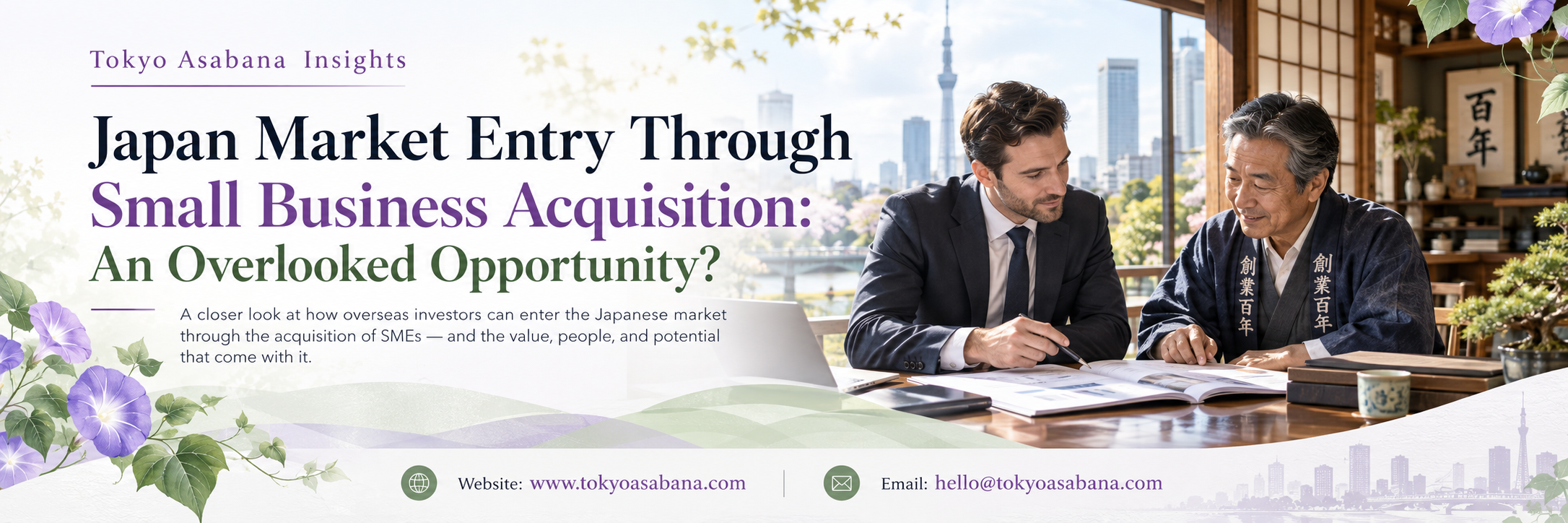
When overseas companies consider entering Japan, they often think about establishing a subsidiary, hiring local employees, appointing distributors, or developing partnerships with Japanese businesses.
But there may be another option worth exploring:
Acquiring an existing Japanese small or medium-sized enterprise (SME).
Japan has many long-established businesses with loyal customers, experienced employees, specialized knowledge, and established local relationships.
Some of these companies face an increasingly important challenge: business succession.
As their owners approach retirement, they may have no family member or employee willing and able to take over the business.
For overseas companies seeking access to the Japanese market, this raises an interesting question:
Could acquiring an established Japanese SME be an alternative to building a business from scratch?
The opportunity deserves attention, but so do the risks.
An existing company may provide valuable operating capabilities. It may also carry financial liabilities, outdated equipment, difficult employment arrangements, or a business model that depends heavily on its retiring owner.
Understanding the difference is essential.
1. Japan’s Business Succession Challenge
Japan’s business succession problem is not a new phenomenon.
Many Japanese SMEs were established decades ago by entrepreneurs who are now approaching or have already reached retirement age.
Traditionally, a family member might have taken over the company.
However, changing family structures, career preferences, regional demographics, and business conditions have made succession more complicated for some owners.
According to Teikoku Databank’s nationwide 2025 business succession survey, 50.1% of approximately 270,000 surveyed Japanese companies had no designated successor or had not finalized one.
Among small-scale businesses, the rate was even higher at 57.3%.
The overall figure has been improving in recent years, indicating that succession initiatives are making progress. Nevertheless, a substantial number of smaller enterprises still face uncertainty about their future ownership and management.
Japan’s Small and Medium Enterprise Agency has also identified business succession as an important issue for maintaining economic activity, employment, and local business capabilities.
Third-party business succession, including M&A, has consequently become an increasingly recognized option.
In fiscal year 2025, Japan’s public Business Succession and Handover Support Centers recorded 24,030 new consultation clients and 2,265 completed third-party succession transactions, both record highs.
However, these figures must be interpreted carefully.
A company without a successor is not necessarily for sale.
Some owners may continue operating. Others may select an internal successor, reorganize, or decide to close the business.
The number of businesses facing succession challenges should therefore not be confused with the number of acquisition targets available to foreign buyers.
2. Why Overseas Companies May Consider Acquiring Japanese SMEs
For an overseas company entering Japan, establishing operations from the beginning can be challenging.
It may need to recruit employees, build supplier networks, identify customers, develop Japanese-language sales materials, and establish credibility in an unfamiliar market.
An acquisition may provide access to some of these capabilities.
Potential advantages include:
Existing Customers
The company may already have commercial relationships and recurring revenue.
Experienced Employees
Local employees may understand customer requirements, industry practices, and operational procedures.
Supplier Relationships
Established procurement and distribution arrangements may help support ongoing operations.
Industry Knowledge
Some Japanese SMEs possess specialized technical capabilities, manufacturing processes, or professional expertise developed over many years.
Local Reputation
An established company may have credibility within a particular industry or geographic market.
Operating Infrastructure
The business may already have facilities, equipment, internal processes, or applicable business permits.
However, none of these benefits should be assumed to transfer automatically or remain unchanged after an acquisition.
Customers may leave. Employees may resign. Important contracts may contain change-of-control provisions. Licenses and permits may need separate review.
An acquisition can provide an existing business foundation, but its future value depends on whether that foundation can be preserved and developed.
3. Which Types of Japanese Small Businesses Might Interest Overseas Buyers?
Potential acquisition opportunities are not limited to large manufacturers or well-known brands.
Depending on investment objectives, overseas buyers may be interested in different categories of SMEs.
Small Manufacturing Companies
Japan has numerous specialized manufacturers producing components, machinery, precision parts, and industrial products.
Some possess technical knowledge or long-standing customer relationships that may be difficult to replicate.
An overseas industrial company might view such an acquisition as a way to establish Japanese manufacturing or supplier capabilities.
However, equipment conditions, environmental obligations, customer concentration, and the availability of skilled employees require careful evaluation.
Professional and Business Services
Small consulting, design, technical, translation, or other business service companies may possess established customer relationships and industry expertise.
For an overseas professional services company, these businesses could provide a starting point for local operations.
However, service businesses may be highly dependent on particular employees or the founder’s personal relationships.
Wholesale and Distribution
Established distributors or trading businesses may offer market access through existing suppliers, customer accounts, and sales channels.
An overseas supplier may be interested in acquiring a business with relevant distribution capabilities.
However, existing contractual obligations, inventory quality, supplier dependence, and customer retention must be examined.
Traditional Shops and Local Businesses
Japan also has long-established retailers, restaurants, specialty stores, and other local enterprises.
These may be attractive to investors interested in particular communities, brands, products, or operating concepts.
But such acquisitions can be more complex than they initially appear.
Profitability, location, leases, licensing, owner involvement, and daily management requirements can all affect commercial viability.
A business with a long history is not automatically a business with a sustainable future.
4. Acquisition vs. Starting From Scratch: Which Is More Practical?
The choice depends on the overseas company’s strategy, financial resources, industry, and management capabilities.
| Consideration | Establishing a New Business | Acquiring an Existing SME |
| Customer Relationships | Must generally be developed | May already exist |
| Employees | Recruitment required | Existing workforce may be available |
| Operating Processes | Built from the beginning | Existing processes may be inherited |
| Brand Reputation | Must be established | Existing reputation may have value |
| Initial Investment | Depends on business setup and launch | Depends on acquisition price and transaction costs |
| Financial Liabilities | Mainly related to new operations | Existing liabilities may be relevant |
| Management Integration | New team and systems | Existing people and systems require integration |
| Operational Flexibility | Greater freedom to design operations | May be constrained by inherited structures |
| Execution Risk | Market development and startup risk | Acquisition and integration risk |
Neither approach is universally better.
A business acquisition may shorten certain market development activities while introducing additional financial and operational responsibilities.
For overseas SMEs, the key question is:
Does acquiring this particular Japanese company provide greater strategic value than building the required capabilities independently?
That question must be answered through evidence rather than assumptions.
5. Why an Inexpensive Japanese Business May Still Be a Costly Acquisition
Some prospective buyers may be attracted by the idea of purchasing an established Japanese business at a relatively low price.
However, acquisition price is only one component of the total investment.
Consider a hypothetical small manufacturer with a long operating history.
The company may have recurring customers and recognizable products.
But closer examination could reveal:
- Aging machinery requiring replacement
- Declining operating margins
- Significant debt obligations
- Limited cash reserves
- Heavy dependence on one major customer
- Difficulty recruiting younger employees
- Outdated internal systems
- Insufficient documentation of operating procedures
- Revenue dependent on the retiring owner’s personal relationships
The buyer may need to invest substantial additional resources after completion.
Other important considerations may include lease obligations, taxes, employment arrangements, intellectual property ownership, litigation exposure, and regulatory compliance.
The transaction structure also matters.
Buying shares in a company is different from acquiring selected business assets.
The legal, tax, contractual, and liability consequences can differ considerably.
These matters require qualified professional advice.
A low purchase price does not necessarily indicate a low-risk or low-cost investment.
6. The Most Overlooked Risk: What Happens When the Owner Leaves?
In many small businesses, the founder or long-serving owner performs functions that may not appear clearly in the financial statements.
The owner may personally manage:
- Key customer relationships
- Supplier negotiations
- Employee decisions
- Product quality oversight
- Important industry connections
- Banking relationships
- Operational problem-solving
When ownership changes, these relationships and responsibilities may not transfer smoothly.
For example, a buyer may acquire a company with stable historical revenue.
However, if the original owner has been personally responsible for maintaining its largest accounts, some customers may reconsider their relationship after the owner retires.
Likewise, experienced employees may be uncertain about changes in management or working conditions.
For overseas buyers, these challenges can become more complicated when the new management team is located outside Japan.
Before pursuing an acquisition, ask:
Can the business operate successfully without its current owner?
A transition plan may be essential.
This could involve agreed handover periods, employee retention strategies, customer introductions, management succession planning, and documented operational procedures.
The feasibility of such arrangements depends on the particular business and transaction.
7. Can Foreign Companies Acquire Japanese SMEs?
Foreign investors can participate in Japanese business acquisitions, but the applicable legal and regulatory requirements depend on the buyer, target company, industry, transaction structure, and other circumstances.
One important consideration is Japan’s Foreign Exchange and Foreign Trade Act (FEFTA).
Certain foreign investments and acquisitions may be subject to prior notification, screening, or post-transaction reporting requirements.
Japan also enacted amendments in June 2026 expanding aspects of its foreign investment screening framework. Relevant commencement dates and implementing requirements must be checked for the particular transaction.
Other matters may include:
- Corporate law and acquisition structure
- Sector-specific licenses
- Tax consequences
- Employment and labor obligations
- Competition law
- Contractual restrictions
- Intellectual property
- Data protection
- Post-acquisition corporate governance
An overseas buyer should not assume that purchasing a Japanese company automatically resolves all regulatory or operational requirements.
Similarly, buying a business does not automatically establish an individual’s residence status or immigration eligibility in Japan.
Foreign acquisition feasibility should be assessed on a transaction-specific basis with qualified Japanese legal, tax, and financial specialists.
8. Where Can Overseas Buyers Begin Looking for Potential Targets?
Identifying a suitable company is often one of the earliest challenges.
Japan has various business succession initiatives, commercial M&A platforms, professional intermediaries, financial institutions, and public support organizations.
However, an overseas buyer should first clarify its own acquisition objectives.
Possible questions include:
- Which industry are we targeting?
- Do we want customers, technology, employees, facilities, or distribution channels?
- What geographic locations are acceptable?
- What is our intended investment range?
- What management resources can we provide after acquisition?
- Are we prepared to operate a business in Japanese?
- Do we have qualified advisers for the transaction?
- What characteristics would make a target unsuitable?
Without these criteria, an acquisition search can quickly become unfocused.
A company should not begin by asking:
“Which Japanese businesses are cheap?”
A better question is:
“Which types of Japanese businesses could support our long-term commercial objectives?”
9. Why Public Information Is Only the Beginning
Initial acquisition research may include:
- Company websites
- Industry directories
- Corporate registration information
- Publicly available business descriptions
- Product and service portfolios
- Company locations
- Industry reputation
- Publicly reported business developments
These sources may help identify companies that fit an acquisition thesis.
However, they rarely provide enough information to determine whether a business is available for sale or financially suitable for acquisition.
Important financial and legal information may be confidential.
An overseas company should also be cautious about drawing conclusions from a business owner’s age, company history, or apparent succession situation.
A company should never be described as an acquisition opportunity merely because its owner appears close to retirement.
Availability must be established through appropriate and authorized channels.
Detailed financial verification, valuation, and due diligence should involve qualified specialists.
10. What Should Buyers Investigate Before Making an Offer?
Once a potentially suitable business has been identified through appropriate channels, the buyer may need to assess several dimensions.
| Area | Important Questions |
| Strategic Fit | Why acquire this business instead of establishing a new operation? |
| Financial Position | Are revenue, cash flow, liabilities, and profitability sustainable? |
| Customers | How concentrated and stable are customer relationships? |
| Management | Can the company operate without its current owner? |
| Employees | Which capabilities are essential, and how can they be retained? |
| Operations | What equipment, systems, or processes require investment? |
| Contracts | What happens to important agreements after a change of ownership? |
| Compliance | Are permits, regulations, and reporting obligations satisfied? |
| Integration | How will the overseas buyer manage and support the company? |
| Transaction Costs | What advisory, legal, tax, financing, and integration costs are expected? |
This table is an initial framework, not a substitute for professional due diligence.
Japan’s Small and Medium Enterprise Agency has published SME M&A Guidelines addressing matters such as intermediary services, fees, conflicts of interest, contractual risks, and transaction safeguards.
The third edition emphasizes transparency and protections for parties involved in smaller business transactions.
Overseas buyers should engage appropriately qualified advisers before making binding commitments.
11. Why Post-Acquisition Integration Matters
Acquiring a company is not the end of Japan market entry.
In many cases, it is the beginning of a more demanding operational phase.
After completion, the new owner may need to manage:
- Employee communication
- Customer retention
- Supplier relationships
- Management transition
- Financial reporting
- Internal governance
- Technology and process integration
- Japanese-language business operations
- Organizational expectations
An overseas buyer that has no Japan-side management capability may underestimate these responsibilities.
Even if the acquisition itself is completed successfully, the operating business still needs leadership, oversight, and resources.
This is particularly important for smaller companies where internal processes may be less formalized.
The real test of an acquisition is not whether the buyer can complete the transaction, but whether the business can continue operating and developing afterward.
12. A Practical First-Stage Research Plan for Overseas SMEs
An overseas company interested in Japanese SME acquisitions does not necessarily need to begin with an expensive, unrestricted target search.
A smaller preliminary research project may be more useful.
Phase 1: Define the Acquisition Thesis
Clarify the intended strategic value.
Does the company want Japanese customers, local distribution, technical expertise, an established brand, or operating facilities?
Phase 2: Select a Target Industry
Focus on one or two relevant sectors rather than the entire Japanese SME market.
Phase 3: Establish Screening Criteria
Define desired company characteristics, geographical preferences, operational requirements, and major exclusion criteria.
Phase 4: Conduct Preliminary Market Research
Identify relevant industry structures, publicly available company information, and potential research or professional engagement channels.
Phase 5: Consult Qualified M&A Specialists
Determine what formal acquisition search, authorized introductions, valuation, legal due diligence, and transaction support may be necessary.
Phase 6: Decide Whether to Proceed
Evaluate whether the available evidence justifies more extensive professional engagement and acquisition-related expenses.
These phases are illustrative.
A preliminary research project does not guarantee the identification of companies willing to sell, access to confidential information, or successful acquisition opportunities.
A small research engagement should help determine whether a more substantial acquisition search is commercially justified.
13. How Tokyo Asabana Can Support Early-Stage Japan Market Research
Tokyo Asabana provides Japan market entry advisory, business research, trilingual communication, and selected Japan-side business coordination services for overseas companies.
For overseas SMEs exploring Japan market entry through potential business acquisition, an appropriately scoped preliminary engagement may include:
- Japan industry and market research
- Preliminary identification of companies matching agreed public-information criteria
- Research into relevant industry structures
- Review and organization of publicly available business information
- Preparation of research shortlists
- Trilingual business communication in Chinese, Japanese, and English
- Coordination with appropriately qualified professional advisers, where agreed
- Selected Japan-side business communication and project coordination
These services are intended to support early-stage commercial research and communication.
They do not constitute financial due diligence, business valuation, securities advice, legal advice, transaction brokerage, or acquisition execution.
Tokyo Asabana does not represent that a researched company is available for sale unless that information has been appropriately confirmed.
Formal target introductions, M&A intermediation, financial advisory services, negotiations, transaction documentation, and regulatory filings require separate evaluation and appropriately qualified parties.
Our role is to help overseas companies understand Japan-related business opportunities and organize suitable preliminary support—not to replace professional M&A advisers.
Corporate Consultation Options
30-minute preliminary corporate consultation: JPY 4,400
An introductory discussion to clarify the company’s Japan-related questions and potential research requirements.
60-minute corporate advisory consultation: JPY 44,000
A more detailed advisory discussion covering Japan market entry strategy, preliminary industry research needs, or potential Japan-side coordination requirements.
The preliminary consultation fee may be credited toward a qualifying subsequent corporate consultation within 14 calendar days, subject to applicable terms.
Market research, public-information company screening, trilingual communication, and coordination are separately scoped and quoted.
Services are paid in advance under agreed terms.
No acquisition opportunities, transaction outcomes, regulatory approvals, or investment returns are guaranteed.
Conclusion: An Existing Japanese Business Can Be a Starting Point, Not a Shortcut
Japan’s business succession challenges create an important question for overseas companies considering market entry.
Could acquiring an existing SME provide access to customers, employees, operating capabilities, and industry knowledge that would otherwise take years to develop?
In some circumstances, it may.
However, acquiring an established business is not automatically faster, cheaper, or less risky than building a new operation.
An existing company may bring substantial responsibilities and hidden complexities.
The absence of a successor does not guarantee that an owner wants to sell.
And even where an acquisition is possible, preserving customers, retaining employees, and managing the business after completion require careful planning.
For overseas SMEs, the most useful first step may be to assess whether an acquisition strategy genuinely matches their commercial objectives.
The opportunity is not simply to buy an old Japanese business. It is to identify a sustainable business whose capabilities, relationships, and future potential justify investment.
Japan market entry through small business acquisition deserves consideration as one possible strategy—but it should be approached with realistic expectations, appropriate professional support, and evidence-based decision-making.
Exploring Japan Market Entry Through Business Acquisition?
Tokyo Asabana supports overseas companies with preliminary Japan market research, industry analysis, public-information company screening, trilingual business communication, and selected local coordination.
If your company is considering Japanese SME acquisition as a possible market entry strategy, a paid corporate consultation can help clarify the preliminary research questions and determine which specialist services may be required.
Website: https://www.tokyoasabana.com
Services & Transparent Pricing: https://tokyoasabana.stores.jp/
Email: hello@tokyoasabana.com
Related Reading
Tokyo Asabana Services|A Good Japan Market Entry Pilot Should Be Small, Paid, and Measurable
Tokyo Asabana Insights|From Market Research to Business Development in Japan