
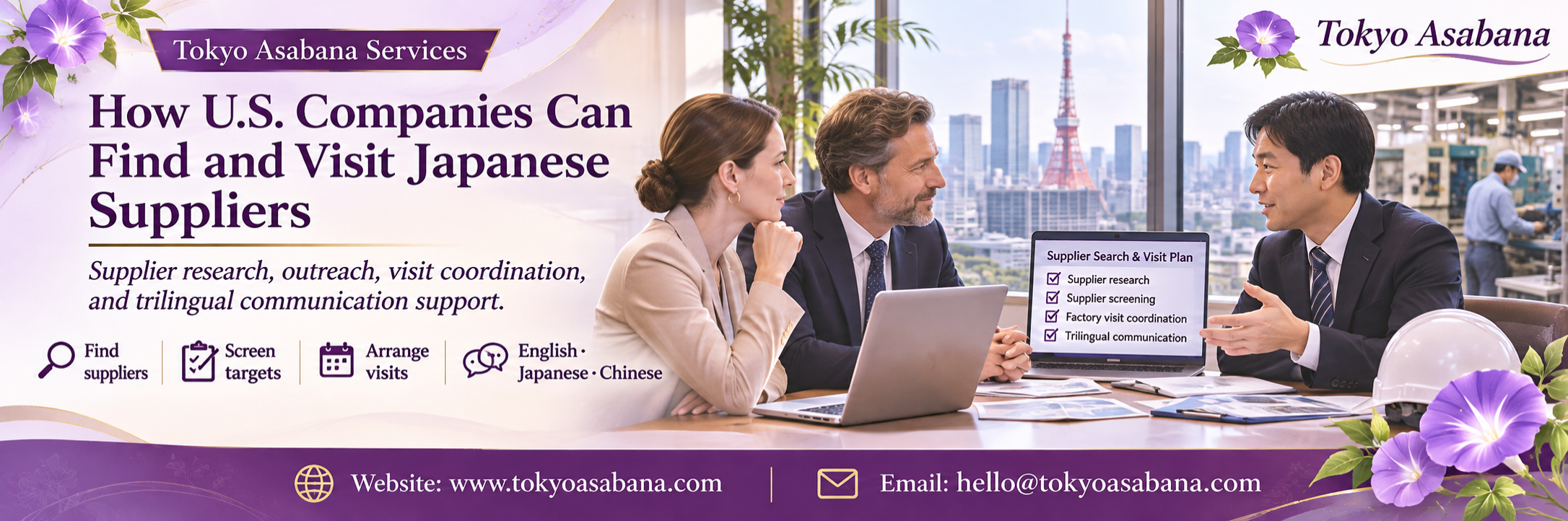
For many U.S. manufacturers, technology companies, and industrial businesses, finding the right supplier in Japan can be a valuable step toward building a more diversified international supply chain.
Japan has established industrial capabilities across areas such as precision machining, industrial components, automation, advanced materials, and specialized manufacturing.
However, identifying a Japanese supplier and arranging a productive business visit are not always straightforward.
A U.S. company may find a promising manufacturer online but encounter several practical questions:
- Does the Japanese company actually manufacture the required product?
- Can it handle the requested specifications or production volumes?
- Is it interested in working with an overseas customer?
- Who should be contacted, and in which language?
- Can the company arrange a factory visit?
- Will technical interpretation be required?
- How should multiple supplier meetings be coordinated across Japan?
These questions can become especially important when a U.S. company has limited time in Japan and no permanent local team.
A successful supplier visit starts long before the buyer arrives at the factory.
This guide explains how U.S. companies can approach Japanese supplier research, initial screening, business outreach, factory visits, and follow-up coordination.
It also outlines how Tokyo Asabana can provide selected Japan-side business support.
1. Why U.S. Companies Look for Japanese Suppliers
Companies may explore Japanese suppliers for a variety of commercial reasons.
Some are seeking specialized manufacturing capabilities that are difficult to source elsewhere.
Others want to diversify their procurement network, evaluate alternative suppliers, or establish direct relationships with Japanese manufacturers.
Potential areas of interest include:
- Precision machining
- Industrial gears and mechanical components
- Metalworking and fabrication
- Industrial automation
- Advanced materials
- Electronic and mechanical assemblies
- Specialty industrial components
- Custom manufacturing services
The appropriate supplier depends on the actual procurement requirements.
For example, a company seeking a custom-machined component may need to evaluate more than the manufacturer’s industry classification.
The buyer may need to understand available equipment, materials experience, tolerances, production capacity, inspection processes, and quality management systems.
A manufacturer’s website can provide useful preliminary information, but it rarely answers every technical and commercial question.
Supplier research should begin with the buyer’s requirements, not simply a list of Japanese companies.
2. Define Your Supplier Requirements Before Searching
One of the most common mistakes in international supplier sourcing is beginning the search too broadly.
A U.S. company might initially request:
“We need Japanese manufacturers that can produce specialized metal components.”
However, this description may cover hundreds of potential businesses with very different capabilities.
Before conducting research, the buyer should clarify the essential requirements.
These may include:
Product or Component Category
What exactly needs to be manufactured or supplied?
Materials
Which materials, grades, or industry specifications are relevant?
Manufacturing Processes
Does the project require CNC machining, grinding, casting, forging, fabrication, assembly, or another process?
Production Requirements
Is the buyer seeking prototypes, low-volume production, or recurring manufacturing capacity?
Quality Requirements
Are particular certifications, inspection procedures, traceability systems, or customer-specific standards necessary?
Commercial Requirements
What are the expected order volumes, delivery expectations, target pricing considerations, and preferred commercial terms?
Confidentiality
Which technical specifications can be shared during initial outreach, and which require an NDA or other safeguards?
Not all information should be disclosed immediately.
A useful first step is to prepare a non-confidential supplier requirement summary that allows potential manufacturers to evaluate basic relevance.
More detailed technical information can be exchanged later through an appropriately approved process.
3. Where Can U.S. Companies Find Japanese Suppliers?
There is no single database containing every suitable Japanese manufacturer.
Supplier research may combine several sources.
Manufacturer Websites
Japanese manufacturers often publish product descriptions, manufacturing processes, equipment information, and contact details on their websites.
Some offer English-language pages, while others primarily publish information in Japanese.
Searching in Japanese may therefore reveal additional companies that are less visible through English-language searches.
However, a company appearing in search results does not establish that it can meet the buyer’s requirements.
Industry Associations and Business Directories
Industry organizations, chambers of commerce, trade directories, and business databases may help identify potential suppliers.
Japan’s SME-related business platforms can also provide useful starting points for company discovery.
Trade Shows and Industrial Exhibitions
Industry exhibitions can help overseas buyers discover companies, compare product categories, and initiate direct conversations.
Depending on the event, supplier representatives may be available for technical or commercial discussions.
JETRO and Public Business Matching Resources
The Japan External Trade Organization (JETRO) operates business information and matching services.
Its e-Venue platform supports international business matching, while other programs and databases serve different types of international business relationships.
Program eligibility, participating companies, and the scope of support vary.
These public resources can complement private research, although they do not replace detailed supplier evaluation or project-specific coordination.
Independent Supplier Research
A U.S. buyer may also commission targeted Japan-side research based on specific product, industry, location, or manufacturing requirements.
This approach may be useful when the buyer needs a carefully defined shortlist rather than a large collection of unrelated company names.
The goal is not to find the greatest possible number of manufacturers. It is to identify companies worth investigating further.
4. How to Screen Potential Japanese Suppliers
After identifying potential suppliers, the next step is preliminary screening.
At this stage, the objective is to determine which companies appear relevant enough to justify additional communication or technical evaluation.
Possible screening criteria include:
| Screening Area | Questions to Consider |
| Product Relevance | Does the supplier manufacture the required type of component? |
| Manufacturing Processes | Are the relevant processes listed or otherwise supported by available information? |
| Materials | Does the supplier indicate experience with the necessary materials? |
| Capacity | Is there evidence suggesting it could handle the intended production scale? |
| Quality Systems | Are relevant certifications or quality processes identified? |
| Location | Where are the factory and main office located? |
| International Business | Does the company have experience serving overseas customers? |
| Communication | Are suitable business contact channels available? |
| Commercial Fit | Does the supplier’s business model appear compatible with the request? |
Publicly available information can support initial screening.
However, a company’s website may be outdated, incomplete, or insufficiently detailed.
An initial shortlist should therefore distinguish between:
- Information confirmed from public sources
- Information supplied directly by the manufacturer
- Information that still requires verification
Preliminary supplier screening is not the same as a formal technical audit or supplier qualification.
The buyer remains responsible for determining whether a manufacturer satisfies its engineering, procurement, quality, and compliance requirements.
5. Why Initial Outreach to Japanese Suppliers Can Be Challenging
Finding a relevant Japanese manufacturer does not guarantee that the company will respond to an overseas inquiry.
Several practical issues may affect initial communication.
The Inquiry May Be Too General
An email stating, “We are interested in cooperation,” may not give the recipient enough information to determine whether the request is relevant.
The Appropriate Contact May Be Unclear
A company website may list a general inquiry form rather than a dedicated international sales contact.
Technical Requirements May Be Missing
A manufacturer may need basic information about the component, manufacturing process, expected quantities, and project stage before deciding whether to engage.
Confidentiality May Need Clarification
If the project involves proprietary designs or sensitive technical information, the manufacturer may need an appropriate process before reviewing detailed documents.
Internal Review May Take Time
Depending on the company and inquiry, the recipient may need to consult engineering, production, management, or sales colleagues before responding.
A Japan-side business coordinator may help prepare an appropriate initial message, identify suitable contact channels, and track follow-up communication.
However, no service provider can guarantee that a manufacturer will reply, accept the project, or agree to a meeting.
Business outreach should be treated as a defined professional activity, not a guaranteed supplier introduction.
6. What Should a First Supplier Inquiry Include?
For an initial approach, clarity is often more useful than sending an extensive package of technical documentation.
A preliminary business inquiry may include:
Company Introduction
Who is the U.S. buyer, and what does it do?
Supplier Requirement
What category of product or manufacturing capability is being sought?
Project Stage
Is the buyer conducting early research, evaluating prototype production, or preparing for commercial procurement?
Basic Commercial Context
What information about anticipated volumes or timing can be shared?
Requested Next Step
Does the buyer want preliminary confirmation of capability, an online discussion, or consideration of an in-person visit?
Confidentiality Arrangements
Will additional technical documentation be provided after the relevant confidentiality process is agreed?
The appropriate level of detail depends on the project.
A professionally prepared Japanese-language inquiry can help communicate the purpose of the request, but accurate technical content must come from the buyer or an appropriately qualified specialist.
Business communication support should not be mistaken for engineering validation.
7. How to Arrange Factory Visits in Japan
For a U.S. company planning to visit Japanese suppliers, scheduling can become a substantial project of its own.
Manufacturers may be located in different prefectures or industrial regions rather than in central Tokyo.
A buyer may have only a few days available and may want to meet several companies during one trip.
Before booking travel, it is important to establish which manufacturers have actually agreed to receive visitors.
Step 1: Confirm the Purpose of Each Visit
Is the buyer interested in an introductory business meeting, a facility tour, a technical discussion, or a formal supplier audit?
These are not equivalent.
A manufacturer that welcomes a commercial introduction may not be prepared to provide access to production areas or confidential operating information.
Step 2: Identify the Appropriate Participants
The buyer should clarify whether it needs representatives from sales, engineering, production, quality assurance, or management.
The supplier may need time to arrange suitable personnel.
Step 3: Request Permission and Available Dates
Factory visits should be arranged in advance and remain subject to the manufacturer’s approval.
The manufacturer may impose restrictions on visitors, photography, equipment access, safety procedures, and disclosure of technical information.
Step 4: Coordinate the Agenda
A preliminary agenda may cover:
- Company introductions
- Overview of manufacturing capabilities
- General project requirements
- Commercial discussion
- Facility visit, if permitted
- Questions and next steps
A technical audit requires a different agenda and appropriately qualified personnel.
Step 5: Plan Transportation and Timing
Travel between industrial locations may require rail transportation, local buses, taxis, or other arrangements.
A realistic itinerary should consider travel connections, meeting durations, and the possibility of schedule changes.
For international visitors, a well-organized schedule can help reduce avoidable confusion and make better use of limited time in Japan.
A factory visit should be confirmed with the manufacturer before the buyer treats it as part of a fixed travel itinerary.
8. What Should U.S. Buyers Prepare Before a Factory Visit?
A productive factory visit requires preparation from both sides.
Before traveling, the U.S. company should consider the following checklist.
| Preparation Item | Why It Matters |
| Company Profile | Helps the supplier understand the buyer |
| Non-Confidential Project Summary | Provides context without unnecessary disclosure |
| Technical Questions | Clarifies what engineering information is needed |
| Commercial Questions | Supports preliminary discussion of volumes, pricing, and lead times |
| Visitor List | Allows the supplier to prepare for attendees |
| Meeting Agenda | Aligns expectations about the visit |
| Confidentiality Process | Helps control access to proprietary information |
| Interpretation Plan | Identifies whether specialist language support is necessary |
| Travel Arrangements | Reduces scheduling and transportation risks |
| Follow-Up Responsibilities | Clarifies what happens after the visit |
Visitors should also check the supplier’s requirements regarding protective equipment, security, visitor identification, photography, and use of electronic devices.
Where relevant, the buyer should confirm whether the planned discussion involves controlled technical information, export-control restrictions, or other sensitive materials.
These matters must be addressed by the responsible companies and qualified specialists.
9. Do You Need a Technical Interpreter?
Not every factory visit requires an interpreter.
Some Japanese suppliers have English-speaking sales or engineering personnel.
Others may be comfortable discussing general business matters in English but prefer Japanese for detailed technical discussions.
The buyer should determine the language needs before the visit.
There is an important distinction between:
General Business Communication
Company introductions, schedules, agendas, administrative coordination, and non-technical business correspondence.
Technical Interpretation
Detailed discussion of engineering drawings, tolerances, manufacturing processes, quality requirements, testing procedures, and specialized industry terminology.
Regulated or Sensitive Technical Information
Information requiring additional confidentiality, compliance, security, or export-control safeguards.
For complex manufacturing projects, engaging a qualified technical interpreter may be appropriate.
The buyer may also ask whether the supplier can provide a suitable English-speaking technical representative.
Tokyo Asabana supports business communication in Chinese, Japanese, and English, but specialized technical interpretation is not automatically included in general coordination services.
Where necessary and agreed, assistance may be provided in identifying or coordinating an external specialist.
The specialist’s availability, scope, qualifications, and fees must be confirmed separately.
The goal is to ensure that technical information is communicated accurately, not to assume that general multilingual ability replaces engineering expertise.
10. What Happens After the Factory Visit?
A supplier visit should lead to a clear record of next steps.
Without follow-up, even a productive meeting may fail to develop into a meaningful procurement process.
Typical follow-up activities may include:
- Confirming meeting participants
- Recording agreed action items
- Requesting additional commercial information
- Coordinating non-confidential documentation
- Confirming who will provide technical responses
- Scheduling further discussions
- Tracking pending replies
- Clarifying the next decision point
The buyer may subsequently need to conduct:
- Technical feasibility assessment
- Supplier qualification
- Quality audits
- Sample evaluation
- Commercial negotiation
- Contract review
- Procurement approval
These activities involve different responsibilities.
An independent Japan-side coordinator may assist with communication and administrative follow-up.
However, formal approval of the supplier should remain with the buyer’s qualified procurement, technical, quality, and compliance teams.
A successful visit is not necessarily a signed purchase order. It is a step toward a more informed supplier decision.
11. A Practical Japan Supplier Research and Visit Workflow
For U.S. companies without a Japan team, an external support project can be divided into manageable stages.
| Stage | Possible Japan-Side Support | Example Deliverable |
| 1. Requirement Review | Clarify commercial research criteria | Research scope and target profile |
| 2. Supplier Research | Identify relevant Japanese companies | Preliminary supplier shortlist |
| 3. Initial Screening | Organize publicly available business information | Screening summary |
| 4. Business Outreach | Contact approved target companies | Outreach activity report |
| 5. Meeting Coordination | Communicate with interested suppliers | Confirmed arrangements where accepted |
| 6. Visit Logistics | Coordinate agreed scheduling and travel details | Visit itinerary |
| 7. On-Site Support | Provide agreed business and logistical coordination | Coordination records |
| 8. Follow-Up | Track agreed communications and next steps | Follow-up summary |
Not every U.S. company needs all eight stages.
Some businesses have already identified suppliers and require only business communication and visit coordination.
Others need an initial research project before contacting any manufacturers.
A company may also prefer to begin with a small paid project, evaluate the results, and decide whether further work is justified.
This approach helps prevent an initial supplier search from becoming an unlimited engagement with unclear responsibilities.
12. How Should U.S. Companies Budget for Japan-Side Supplier Support?
Supplier research and factory visit coordination can involve several types of professional work.
For example:
Supplier Research
Researching relevant manufacturers based on agreed criteria.
Preliminary Screening
Organizing available information to identify potentially suitable candidates.
Japanese-Language Outreach
Preparing and sending approved business inquiries and tracking responses.
Meeting Coordination
Confirming schedules, participants, agendas, and visit requirements with willing suppliers.
On-Site Business Support
Providing agreed logistical and non-technical business coordination during a visit.
Post-Visit Follow-Up
Tracking agreed actions and arranging further communication.
These activities should not automatically be combined into an undefined, all-inclusive service.
The costs depend on the number of suppliers, complexity of requirements, locations, travel, specialist support, and project duration.
The buyer should also distinguish between professional service fees and third-party expenses, such as:
- International flights
- Hotels
- Train and local transportation
- Specialized interpretation
- Technical audits
- Independent inspection services
- Other approved project expenses
The payment responsibilities should be agreed upon in advance.
A clearly defined scope and transparent quotation make international supplier development easier to plan and evaluate.
13. When Is a Japan-Side Coordinator Especially Useful?
Japan-side coordination may be particularly valuable when a U.S. company:
- Has clear supplier requirements but limited Japanese-language capability
- Needs to research companies beyond English-language sources
- Wants to contact several manufacturers
- Already has Japanese suppliers but needs administrative follow-up
- Plans to visit multiple locations in Japan
- Needs help organizing schedules across time zones
- Wants a single point of contact for selected logistical arrangements
- Is not ready to hire a permanent Japan-based employee
However, outsourcing coordination does not eliminate the need for responsible internal decision-makers.
The U.S. company should retain control over supplier requirements, technical assessments, commercial approvals, contract decisions, and applicable compliance obligations.
14. How Tokyo Asabana Supports U.S. Companies Seeking Japanese Suppliers
Tokyo Asabana provides independent Japan-side business support for overseas companies, including U.S. manufacturers, technology businesses, and other SMEs exploring commercial relationships in Japan.
Our approach is based on clearly defined project scopes, paid professional services, and practical cross-border communication.
Depending on the client’s needs, possible services include:
Japanese Supplier Research
Identification of potential suppliers based on agreed industry, product, location, and public-information criteria.
Preliminary Supplier Screening
Organization of publicly available manufacturer profiles and information relevant to further commercial evaluation.
Japanese-Language Business Outreach
Preparation and coordination of approved initial communications with potential manufacturers.
Supplier Meeting and Factory Visit Coordination
Communication with suppliers concerning meeting availability, participants, schedules, agendas, and applicable visit arrangements.
Selected On-Site Business Coordination
Agreed business and logistical assistance during visits, subject to project scope, location, availability, and safety conditions.
Trilingual Business Communication
Communication support in Chinese, Japanese, and English for suitable non-technical business matters.
Post-Visit Follow-Up Coordination
Assistance organizing outstanding communications and agreed next steps.
Services can be commissioned individually or combined into a defined project.
For example, supplier research, outreach, and a factory visit may be quoted as separate work packages rather than being automatically included in a single consultation fee.
Important Service Boundaries
Tokyo Asabana is not a manufacturing engineering consultancy, technical inspection company, certification body, or procurement decision-maker.
Our services do not automatically include:
- Engineering design or validation
- Technical supplier qualification
- Factory quality audits
- Certification verification
- Specialized technical interpretation
- Contractual or legal due diligence
- Export-control or sanctions legal advice
- Guaranteed manufacturer acceptance
- Guaranteed purchase orders or production outcomes
Where specialized technical interpretation, inspection, legal review, or regulatory support is required, the client should engage appropriately qualified professionals.
Tokyo Asabana may assist with agreed administrative coordination involving such specialists.
For projects involving sensitive technologies, controlled technical data, defense-related applications, or other restricted information, the relevant parties must determine legal and compliance requirements before information is shared.
Tokyo Asabana does not undertake classified or restricted technical work.
Corporate Consultation Options
30-minute preliminary corporate consultation: JPY 4,400
An initial discussion to clarify supplier research requirements, planned Japan visits, and possible project scope.
60-minute corporate advisory consultation: JPY 44,000
A more detailed discussion covering Japan supplier development, business communication, research priorities, and coordination planning.
The preliminary consultation fee may be credited toward a qualifying subsequent corporate consultation within 14 calendar days, subject to applicable terms.
Supplier research, screening, outreach, factory visit coordination, on-site support, and follow-up services are separately scoped and quoted.
Services are paid in advance according to agreed terms.
Conclusion: Finding a Supplier Is Only the Beginning
For U.S. companies, Japan may offer valuable manufacturing and supply-chain opportunities.
However, developing a suitable supplier relationship requires more than finding a company name online.
The process may involve identifying relevant manufacturers, clarifying capabilities, preparing appropriate outreach, arranging meetings, coordinating factory visits, and following up after the discussions.
Some work can be supported through external Japan-side business coordination.
Other work—especially engineering validation, supplier qualification, legal review, and procurement approval—requires the buyer’s own experts or suitably qualified specialists.
The most effective approach is to separate research, outreach, coordination, and technical evaluation into clearly defined responsibilities.
For U.S. SMEs without a permanent Japan team, a targeted professional engagement can provide practical support while preserving control over important commercial and technical decisions.
Your Japan Team—Before You Build a Japan Team.
Looking for Japanese Suppliers or Planning Factory Visits?
Tokyo Asabana supports U.S. and other overseas companies with Japanese supplier research, preliminary screening, business outreach, trilingual communication, meeting coordination, and selected Japan-side visit support.
If your company is preparing a supplier search or a business trip to Japan, a paid corporate consultation can help clarify your requirements and define an appropriate scope of support.
Website: https://www.tokyoasabana.com
Services & Transparent Pricing: https://tokyoasabana.stores.jp/
Email: hello@tokyoasabana.com
Related Reading
Tokyo Asabana Services|A Good Japan Market Entry Pilot Should Be Small, Paid, and Measurable