
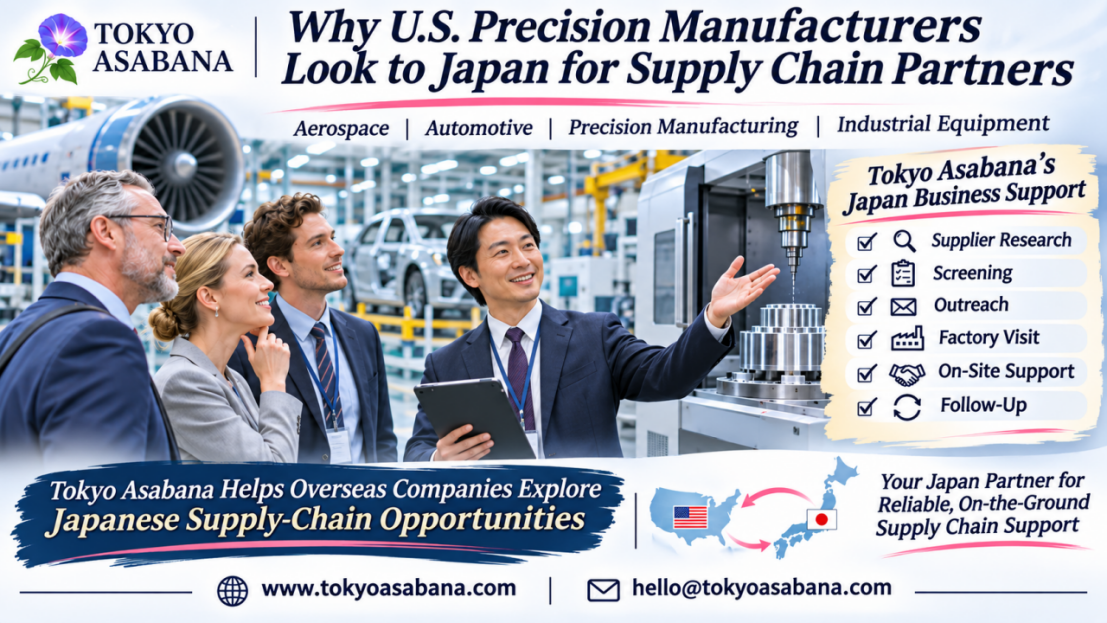
For a U.S. aerospace, automotive, industrial equipment, robotics, or precision manufacturing company, Japan is rarely the first place to look when the objective is simply to find the lowest-cost supplier.
That is not necessarily Japan’s strongest proposition.
The reason overseas manufacturers continue to look at Japan is different.
They may be searching for a supplier capable of producing a difficult component. They may need high-precision machining, specialized materials, demanding quality control, a reliable low-volume production partner, or a manufacturing process that is difficult to reproduce elsewhere.
Sometimes the problem is not price.
The problem is:
“We know the component we need. But we do not yet know who in Japan can actually make it.”
This is where Japan becomes interesting.
Japan remains one of the world’s major manufacturing economies, with deep industrial ecosystems spanning automotive equipment, materials, industrial machinery, robotics, aerospace, precision components, tooling, electronics, and advanced manufacturing.
But identifying a Japanese company on the internet is only the first step.
For an overseas buyer, the harder task is determining whether that company is really the right supplier — and then building a relationship that can move from an initial conversation to an actual business opportunity.
That process may involve:
supplier research → screening → outreach → technical and commercial discussion → factory visit → internal evaluation → follow-up → qualification → long-term cooperation
And this is exactly where Japan-side support can make a difference.
1. Why Do U.S. Precision Manufacturers Look to Japan?
There is no single reason.
Different manufacturers come to Japan with very different requirements.
But several patterns appear repeatedly.
1.1 They Are Not Always Looking for the Cheapest Supplier
For commodity products, price may dominate the purchasing decision.
Precision manufacturing is different.
When a component affects reliability, safety, dimensional accuracy, product life, thermal performance, motion control, or the overall quality of a larger system, purchasing decisions become more complex.
The buyer may care about:
- dimensional accuracy
- repeatability
- process stability
- material knowledge
- surface treatment
- heat treatment
- traceability
- quality management
- production consistency
- engineering responsiveness
- ability to handle difficult specifications
- low-volume or prototype capability
- willingness to improve a process over time
A lower unit price is not especially useful if the component repeatedly fails inspection or creates problems further downstream.
For this reason, a U.S. company may look at Japan when the requirement is not simply:
“Who can manufacture this?”
but rather:
“Who can manufacture this reliably, repeatedly, and at the level our application requires?”
2. Japan Has a Deep Manufacturing Ecosystem
When people outside Japan think of Japanese manufacturing, they often think first of large names in automobiles, electronics, machine tools, or industrial equipment.
But those large companies are only the visible part of the ecosystem.
Behind them are many:
- precision machining companies
- casting and forging companies
- gear manufacturers
- toolmakers
- surface-treatment specialists
- heat-treatment companies
- materials companies
- industrial equipment manufacturers
- inspection and measurement specialists
- mold and die companies
- component manufacturers
- engineering-oriented SMEs
- specialist subcontractors
Some of these companies have spent decades developing expertise in a relatively narrow process or product category.
They may not be globally famous.
Their English websites may be limited.
Their marketing may be minimal.
But their technical capability may be highly relevant to an overseas manufacturer.
This creates one of the paradoxes of Japanese supplier development:
Some of the suppliers worth investigating are not necessarily the easiest companies to discover from overseas.
3. Precision Machining: Where Japan Can Be Particularly Interesting
Suppose a U.S. manufacturer requires a relatively straightforward component that can be produced by thousands of suppliers globally.
Japan may not automatically be the most logical sourcing destination.
But the calculation changes when the requirement involves:
- very tight tolerances
- complicated geometries
- difficult materials
- specialized gears
- multi-process production
- small or medium production volumes
- prototypes
- high-value components
- sophisticated quality requirements
- demanding inspection standards
- unusual manufacturing processes
In such situations, technical capability and production discipline may become more important than simply minimizing unit cost.
Japanese SMEs have long operated inside demanding industrial supply chains, particularly in sectors such as automotive, machine tools, machinery, industrial equipment, electronics, and related component manufacturing.
This experience can make certain Japanese suppliers worth investigating for overseas buyers with difficult requirements.
4. Aerospace: Why Japan Matters
Aerospace illustrates this particularly well.
Aircraft and aerospace manufacturing involve highly complex supply chains.
The components involved may need to meet demanding requirements relating to:
- materials
- machining
- structural performance
- traceability
- documentation
- process control
- repeatability
- inspection
- quality management
Japan already participates in international aerospace supply chains, including collaboration with overseas OEMs and major aerospace programs.
The Japanese government has also identified aerospace as an area where international collaboration and domestic supply-chain capability remain strategically important.
This does not mean that every Japanese precision manufacturer can become an aerospace supplier.
Far from it.
A company may have excellent machining capability but lack the relevant certifications, documentation systems, customer history, production capacity, or specialized process controls required for a particular aerospace program.
That is why supplier discovery must be followed by screening.
The question is not:
“Is this Japanese company good?”
The better question is:
“Is this Japanese company suitable for this specific requirement?”
5. Automotive Expertise Can Also Create Capabilities Relevant to Other Industries
Japan’s automotive supply chain is another important part of the picture.
Japanese automotive suppliers have historically operated under strong expectations regarding:
Quality, Cost and Delivery — QCD.
Many have developed capabilities in areas such as:
- machining
- casting
- forging
- gears
- powertrain components
- tooling
- production engineering
- process optimization
- quality control
- high-volume manufacturing
As the automotive industry evolves through electrification, software, automation, and new mobility technologies, some Japanese suppliers are also looking beyond traditional automotive applications.
Capabilities originally developed for automotive customers may sometimes have relevance to:
- aerospace
- industrial machinery
- robotics
- defense-related manufacturing
- mobility
- energy
- advanced equipment
Again, this does not mean that capabilities transfer automatically.
But it creates opportunities for cross-industry supplier development.
A company that has spent decades solving difficult manufacturing problems for automotive OEMs or Tier 1 suppliers may possess processes, equipment, engineering knowledge, or quality disciplines that are relevant elsewhere.
6. Supply-Chain Diversification Is Becoming More Important
There is another reason overseas manufacturers increasingly examine additional sourcing regions:
resilience.
Global manufacturing companies have learned that concentrating too much production in one supplier, one country, or one manufacturing region can create significant risk.
Supply-chain strategy is therefore increasingly not only about:
“Where can we buy this most cheaply?”
It is also about:
“What happens if our primary source becomes unavailable?”
For some companies, Japan may therefore be considered as:
- a primary supplier location
- a second-source option
- a specialist supplier location
- a prototype or development partner
- a source for particularly difficult components
- part of a broader supply-chain diversification strategy
This does not mean moving an entire supply chain to Japan.
In many cases, the more realistic approach is selective.
A manufacturer may identify only a small number of components or processes where Japan offers something particularly valuable.
That can be enough.
7. The Hard Part Is Often Not Finding Companies — It Is Finding the Right Companies
Search engines make supplier discovery appear easy.
You can search:
“precision machining Japan”
“aerospace gear manufacturer Japan”
“CNC machining company Japan”
“Japanese automotive supplier”
and quickly produce a list.
But that list is not yet a supply chain.
It is simply a list of names.
The real work begins after that.
For every potential supplier, the overseas buyer may need to understand:
- What does the company actually manufacture?
- Which processes are performed internally?
- Which processes are subcontracted?
- What equipment does it have?
- What materials can it handle?
- What tolerances can it realistically maintain?
- What industries does it already serve?
- What certifications does it hold?
- Does it have export experience?
- Does it want overseas customers?
- Can it communicate in English?
- Does it have available capacity?
- Can it support prototypes or small volumes?
- Is the company comfortable with the buyer’s documentation requirements?
- Does it fit the commercial expectations of the project?
Without this filtering process, a long supplier list can actually create more work rather than less.
8. A Strong Supplier on Paper May Still Be the Wrong Supplier
This is an important point.
A supplier can be technically excellent and still be unsuitable.
For example:
A company may have impressive machines but no available capacity.
It may have excellent engineers but little interest in overseas business.
It may be capable of producing the component but only at volumes far above the buyer’s requirement.
It may be excellent for prototypes but unsuitable for production.
It may be comfortable with Japanese customers but unwilling to manage documentation or communication with an overseas client.
It may possess the necessary machining capability but rely on subcontractors for a process that the buyer considers critical.
It may simply have a different commercial expectation.
Therefore, supplier development involves evaluating several dimensions simultaneously:
Technical fit
Commercial fit
Operational fit
Communication fit
Strategic fit
A company does not need to be perfect in every dimension.
But the buyer needs to understand the trade-offs.
9. Why Outreach to Japanese Suppliers Can Be Difficult
Even after a promising supplier has been identified, another challenge begins:
contacting them.
An overseas company may send a perfectly reasonable English email and receive no response.
This does not necessarily mean the Japanese company is uninterested.
There can be many explanations.
The message may have reached the wrong department.
The recipient may not feel comfortable responding in English.
The company may need internal confirmation before engaging with an unfamiliar overseas organization.
The request may be too broad.
The buyer may not have explained clearly what it wants.
The company may not immediately understand why it was selected.
Or the supplier may simply be extremely busy.
For this reason, good outreach should answer several basic questions quickly:
Who are you?
Why are you contacting this specific company?
What are you trying to source or discuss?
Why might the opportunity be relevant to them?
What would you like them to do next?
A generic message such as:
“We are looking for suppliers in Japan. Please introduce your capabilities.”
is usually much weaker than a targeted message explaining why that company appears relevant.
10. Confidentiality Matters — Especially in Advanced Manufacturing
Precision manufacturing projects may involve commercially or technically sensitive information.
This is particularly important in industries such as aerospace, advanced machinery, automotive systems, defense-related manufacturing, robotics, electronics, and specialized industrial equipment.
A buyer may not want to disclose everything in the first email.
Nor should it necessarily do so.
Supplier engagement can therefore be structured in stages.
Stage 1: General capability discussion
The buyer can explain the broad category of requirement without disclosing sensitive information.
Stage 2: Preliminary fit assessment
Both parties determine whether the supplier appears capable and interested.
Stage 3: NDA or appropriate confidentiality arrangement
Where necessary, more detailed information can then be exchanged.
Stage 4: Technical and commercial evaluation
Drawings, specifications, processes, volumes, quality requirements, timelines, and other relevant information can be discussed according to the project.
A Japan-side coordinator does not replace the buyer’s engineering, legal, compliance, procurement, or export-control specialists.
But local coordination can help ensure that the commercial process around those discussions runs more smoothly.
11. Why Factory Visits Still Matter
In an era of video calls, digital brochures, virtual factory tours, AI search, and online databases, it is reasonable to ask:
Do overseas buyers really need to visit Japanese suppliers in person?
Sometimes, no.
A preliminary discussion can often happen online.
But for higher-value or more complex supplier relationships, an on-site visit can still be extremely useful.
A website tells you what the supplier wants you to see.
A factory visit helps you understand how the company actually operates.
12. What Can an Overseas Buyer Learn During a Factory Visit?
The exact checklist depends on the industry and project.
But a visit may help the buyer examine areas such as:
Production Equipment
What machines are installed?
How old are they?
What sizes and capabilities do they support?
Is the supplier continuously investing in equipment?
Process Flow
How does material move through the factory?
Which processes are internal?
Which processes are outsourced?
Where are the potential bottlenecks?
Quality Control
How are parts inspected?
What measurement equipment is used?
How are non-conforming parts handled?
How are inspection results recorded?
Traceability
Can the supplier trace materials, production lots, processes, and inspection records where required?
Process Control
For processes such as heat treatment, coating, surface treatment, or materials processing, what parameters are controlled and documented?
The important question is often not only whether one good result can be produced.
It is whether that result can be produced repeatedly.
Capacity
Can the supplier support the expected volume?
How much unused capacity exists?
What happens if demand increases?
Engineering Capability
Can engineers discuss manufacturability?
Can they suggest process improvements?
Can they understand why a tolerance or material specification matters?
Subcontracting
Which critical processes leave the facility?
Who controls those subcontractors?
How is quality managed across external processes?
Management Attitude
Is the company genuinely interested in the opportunity?
Does management understand the requirements of international business?
Is there willingness to invest in the relationship?
These factors are difficult to understand fully from a supplier database.
13. A Factory Visit Is Also About Human Trust
Manufacturing relationships are not purely technical.
They are also relationships between people.
A buyer may eventually depend on a supplier for years.
During that time, problems will happen.
A drawing will change.
Demand will suddenly increase.
A shipment may be delayed.
A quality issue may appear.
A machine may fail.
A material may become unavailable.
The question is not whether problems will ever occur.
The question is:
How will both sides respond when they do?
Face-to-face meetings can help both parties understand how the other organization communicates, makes decisions, handles uncertainty, and approaches long-term cooperation.
This is particularly relevant when the supplier and buyer operate across different languages, business cultures, time zones, and organizational structures.
14. The Practical Problem: Visiting Japanese Factories Is Not Always Easy
Imagine a U.S. executive arriving in Japan for several supplier meetings.
The business objective may be clear.
The practical logistics may not be.
A supplier could be located outside central Tokyo.
Another may be in a regional manufacturing cluster.
The visit may require trains, taxis, rental cars, or multiple transfers.
The supplier may have limited English support.
Documents may need to be prepared beforehand.
Meeting expectations may differ.
There may be lunch arrangements, security procedures, factory rules, photography restrictions, protective equipment requirements, or schedule changes.
And when the meeting ends, there is another issue:
What exactly did we learn?
That is why Tokyo Asabana’s on-site support can extend beyond simply attending the meeting.
15. Hotel-to-Hotel Business Accompaniment
For overseas corporate visitors, Tokyo Asabana can provide full on-site accompaniment depending on the project.
That can mean:
Hotel → transportation → supplier meeting or factory visit → on-site discussion → debrief → next steps → return to hotel
Rather than asking an overseas executive to navigate every local detail alone, Tokyo Asabana can remain with the client throughout the business day.
This can be particularly useful when:
- the visitor is unfamiliar with Japan
- the factory is outside major city centers
- several visits are scheduled
- Japanese-language coordination is required
- the meeting involves multiple stakeholders
- the client wants immediate discussion after the visit
- schedules may need to change during the day
This is not tourism support.
It is Japan-side business accompaniment and coordination.
The objective is to help the client stay focused on the business purpose of the visit.
16. Before the Visit: Preparation Is Often More Important Than the Meeting Itself
A successful supplier visit should not begin at the factory entrance.
It should begin much earlier.
Before the visit, the buyer should ideally understand:
- Why are we visiting this company?
- What do we already know?
- What information is still missing?
- Who will attend?
- What do we want to verify?
- What should we avoid disclosing?
- What documents should we bring?
- What questions must be answered?
- What would make this supplier a “yes”?
- What would make it a “no”?
- What would justify a second discussion?
Without this preparation, factory visits can become pleasant tours that generate very little decision-quality information.
A good visit should produce learning.
17. After the Visit: The Meeting After the Meeting
One of the most valuable moments can happen after everyone leaves the factory.
The visiting team can finally ask:
What did you think?
What did we notice?
Was the supplier stronger or weaker than expected?
What questions were not answered?
Was there anything important in the way they responded?
Do we want to continue?
What should we request next?
This is why post-meeting debriefing matters.
Memories fade quickly, especially when several supplier visits happen during one trip.
Recording impressions while they are still fresh can make later supplier comparison much more useful.
The meeting itself generates information.
The debrief turns that information into a decision.
18. Follow-Up Is Where Many Opportunities Quietly Die
After a positive factory visit, both sides may say:
“Let’s stay in touch.”
Then everyone returns to normal work.
Two weeks pass.
Then four.
Then six.
Nothing happens.
Cross-border business often fails not because the meeting was bad, but because the next step was never clearly defined.
A better ending to a meeting might be:
- Supplier sends capability documents by Friday.
- Buyer confirms annual volume range.
- NDA is reviewed.
- Technical discussion is scheduled.
- Sample RFQ is prepared.
- Supplier clarifies a specific manufacturing process.
- Buyer sends a drawing after internal approval.
- Both sides schedule another meeting.
The smaller and clearer the next step, the easier it is to maintain momentum.
19. Why Local Follow-Up Can Help
Follow-up with Japanese companies may involve more than forwarding another English email.
Sometimes it helps to understand:
- who currently owns the discussion
- whether the supplier is waiting for internal approval
- whether additional information is required
- whether the project has become lower priority
- whether the company is still interested
- whether there has simply been a communication gap
A Japan-side coordinator can help maintain continuity between the overseas buyer and the Japanese organization.
This does not guarantee a deal.
But it can prevent potentially useful conversations from disappearing simply because nobody owned the next step.
20. What Services May Overseas Precision Manufacturers Need in Japan?
For a U.S. manufacturer exploring Japanese suppliers, the support requirement may include several separate services.
These should not automatically be treated as the same task.
Supplier Research
Identifying companies that may fit the requirement.
Supplier Screening
Reducing a broad list to companies that appear most relevant.
Market Mapping
Understanding where relevant suppliers, technologies, clusters, or industry players are located.
Outreach
Contacting potential suppliers and testing their interest.
Communication Support
Helping both sides communicate across Japanese and English where appropriate.
Meeting Coordination
Scheduling discussions and ensuring both parties understand the meeting purpose.
Factory Visit Coordination
Organizing supplier visits and related business logistics.
On-Site Business Accompaniment
Supporting visiting executives throughout the business day, including hotel-to-hotel accompaniment where appropriate.
Post-Meeting Debrief
Organizing what was learned and identifying remaining questions.
Follow-Up Coordination
Helping maintain communication and move agreed next steps forward.
Japan-Side Advisory
Providing local context when the overseas company needs help understanding how to approach the Japanese market or business relationship.
21. How Tokyo Asabana Can Support Overseas Manufacturing Companies
Tokyo Asabana works with overseas companies exploring opportunities in Japan.
For manufacturing and supplier-development projects, support can be designed around the actual stage of the project.
Potential support includes:
1. Japanese Supplier Research
Researching relevant companies based on the customer’s initial requirements.
2. Supplier Screening
Organizing and narrowing potential targets based on available information and agreed criteria.
3. Initial Outreach
Contacting Japanese companies to explore potential interest.
4. Japan-Side Communication
Supporting business communication in Japanese and English, with Chinese also available where useful.
5. Meeting and Factory Visit Coordination
Helping arrange meetings and on-site supplier visits.
6. Full On-Site Business Accompaniment
Supporting overseas executives during their Japan business visits, including hotel-to-hotel accompaniment depending on the project.
7. Post-Meeting Debrief
Helping organize observations, questions, concerns, and next steps after meetings.
8. Follow-Up Coordination
Supporting continued communication between the overseas company and relevant Japanese parties.
22. What Tokyo Asabana Does Not Replace
For advanced manufacturing projects, it is equally important to define what local business support does not replace.
Tokyo Asabana does not replace the customer’s:
- engineering team
- procurement qualification process
- quality engineers
- certification specialists
- legal counsel
- export-control specialists
- security specialists
- technical auditors
When specialized regulated or technical expertise is required, the appropriate professionals should be involved.
Tokyo Asabana’s role is to help the Japan-side business process move forward.
That may include research, communication, local coordination, meetings, visits, and follow-up around the technical work.
23. Do You Need a Large Japan Project From Day One?
Usually, no.
A company exploring Japanese suppliers does not necessarily need to launch a large sourcing program immediately.
A smaller pilot can be more practical.
For example:
Step 1 — Define the Requirement
Clarify the component, process, supplier profile, and business objective.
Step 2 — Research a Limited Number of Suppliers
Rather than collecting hundreds of names, identify a focused group of potentially relevant companies.
Step 3 — Test Interest
Contact selected suppliers and observe response quality.
Step 4 — Hold Initial Meetings
Determine whether technical and commercial fit appears realistic.
Step 5 — Visit the Most Promising Companies
Use factory visits to deepen understanding.
Step 6 — Review the Results
Decide whether Japan deserves a larger sourcing effort.
This approach reduces risk.
It also gives the buyer real market information before committing larger resources.
24. What Should a Japan Supplier Pilot Measure?
A pilot should not be judged only by whether a purchase order appears immediately.
Useful measurements can include:
- number of relevant suppliers identified
- supplier response rate
- quality of responses
- willingness to work with overseas customers
- technical fit
- commercial fit
- certification fit
- communication capability
- common objections
- common capability gaps
- number of meetings generated
- number of suppliers worth visiting
- number of suppliers worth continuing discussions with
The objective of an early pilot is often:
to reduce uncertainty.
A good pilot tells management whether to invest more, change the requirement, change the target segment, or stop.
That is valuable even before revenue is generated.
25. Japan Is Not the Right Supply Base for Every Requirement
This point is important.
Japan should not be chosen simply because Japanese manufacturing has a strong reputation.
A supplier strategy should depend on the actual requirement.
If the buyer primarily needs:
- extremely low-cost commodity production
- massive volume at the lowest possible price
- a supplier located next to an overseas assembly facility
another sourcing location may be more appropriate.
But when the buyer needs:
- specialized manufacturing knowledge
- advanced precision
- difficult processes
- strong quality discipline
- a strategic second source
- a high-value technical supplier
- a long-term manufacturing relationship
Japan may deserve serious investigation.
26. The Best Japanese Supplier May Not Be the Most Visible One
One of the most interesting parts of Japanese industrial sourcing is that capability and marketing sophistication do not always move together.
A highly capable company may have:
- a simple website
- limited English content
- little social media presence
- few international marketing materials
- almost no overseas sales activity
From an American buyer’s perspective, such a company can be almost invisible.
This is why Japanese supplier research should not rely entirely on English-language Google results.
Industry associations, regional manufacturing networks, Japanese-language searches, supplier databases, trade exhibitions, existing industry relationships, and direct research may reveal companies that would otherwise be missed.
Finding them is only the beginning.
The next question is whether they actually want to work with you.
27. Japan-Side Support Is Ultimately About Reducing Friction
An overseas executive does not necessarily need someone in Japan because Japan is mysterious.
The practical issue is simpler.
Every international project creates friction:
language friction
information friction
distance friction
time-zone friction
coordination friction
cultural friction
follow-up friction
Each individual problem may be small.
But together they can slow down a project considerably.
A Japan-side partner helps reduce that friction.
That is the philosophy behind Tokyo Asabana’s approach:
“Your Japan Team — Before You Build a Japan Team.”
An overseas company may not yet need employees, an office, a subsidiary, or a full local procurement organization in Japan.
But it may still need someone on the ground.
Someone who can research.
Someone who can communicate.
Someone who can coordinate.
Someone who can accompany the team to a factory.
Someone who can help organize what happened afterward.
That intermediate stage can be extremely useful.
28. A Practical Example
Imagine a U.S. precision manufacturing company looking for a specialized Japanese component supplier.
Instead of immediately opening a Japanese office, the company could begin with:
Phase 1: Research
Define supplier criteria and identify potential Japanese companies.
Phase 2: Screening
Review capabilities and narrow the list.
Phase 3: Outreach
Contact selected suppliers and test interest.
Phase 4: Online Meetings
Hold preliminary discussions.
Phase 5: Japan Visit
Meet the strongest candidates and visit their facilities.
Phase 6: Hotel-to-Hotel Support
Tokyo Asabana accompanies the visiting team during the business day where required.
Phase 7: Debrief
Review each supplier immediately after the visit.
Phase 8: Follow-Up
Continue discussions with the most promising candidates.
Only after this process does the company need to decide:
Should we invest more resources in building this Japanese supply relationship?
That is a much smaller initial risk than building a local organization first.
29. Frequently Asked Questions
Can Tokyo Asabana directly manufacture parts?
No. Tokyo Asabana is not a manufacturer.
We support the Japan-side business process around supplier discovery, communication, meetings, visits, and coordination.
Can you guarantee that a Japanese supplier will accept our project?
No.
Supplier interest depends on technical requirements, volumes, capacity, commercial conditions, timing, certifications, strategic fit, and many other factors.
The purpose of research and outreach is to test that fit.
Can you accompany our team outside Tokyo?
Depending on the project and schedule, on-site support can include travel to supplier locations outside central Tokyo.
Project scope, transportation, travel requirements, and related costs should be discussed in advance.
Can you provide hotel-to-hotel accompaniment?
Yes, depending on the engagement.
Tokyo Asabana can provide full business-day accompaniment from the client’s hotel to meetings or factory visits and back, including coordination and post-meeting discussion.
Can you provide Japanese-English communication support?
Yes.
Tokyo Asabana can support Japanese and English business communication. Chinese support is also available.
Can you handle confidential projects?
Confidentiality requirements can be discussed before detailed information is shared.
Where an NDA or other formal arrangement is necessary, it should be agreed before sensitive materials are exchanged.
Do you provide engineering certification or technical auditing?
No.
Where formal engineering review, supplier certification, regulatory assessment, export-control advice, or specialized technical auditing is required, the appropriate qualified professionals should be involved.
Tokyo Asabana can support the surrounding business coordination.
Do we need to commit to a large project immediately?
Not necessarily.
A small, clearly defined pilot can often be a practical way to test whether Japan is worth deeper investigation.
30. Conclusion: Finding a Supplier Is Easy. Building the Right Supplier Relationship Is Harder.
For U.S. aerospace, automotive, industrial equipment, robotics, and precision manufacturing companies, Japan can offer access to a sophisticated manufacturing ecosystem.
But successful sourcing is not about collecting Japanese company names.
It requires answering a more difficult series of questions:
Who can actually meet the requirement?
Who wants to work with us?
Who should we visit?
What should we verify?
What did we learn during the visit?
Who is worth continuing with?
What happens next?
That is why Japan supplier development involves much more than procurement.
It involves:
research, screening, communication, relationship building, local judgment, on-site execution, and follow-up.
The goal is not simply to find a Japanese supplier.
The goal is to find the right supplier — and build a relationship that can actually work.
Explore Japan With a Local Business Partner
Tokyo Asabana supports overseas companies exploring business opportunities, supplier relationships, partnerships, and market-entry opportunities in Japan.
Depending on your project, support can include:
Supplier Research | Market Research | Target Screening | Outreach | Business Communication | Meeting Coordination | Factory Visit Coordination | Hotel-to-Hotel Business Accompaniment | Post-Meeting Debrief | Follow-Up
Our approach is simple:
Your Japan Team — Before You Build a Japan Team.
Website: https://www.tokyoasabana.com
Services & Transparent Pricing: https://tokyoasabana.stores.jp/
Email: hello@tokyoasabana.com
Related Reading
Tokyo Asabana Services|How U.S. Companies Can Find and Visit Japanese Suppliers
Tokyo Asabana B2B Case Study|A U.S. Manufacturing Company Seeking Business Opportunities in Japan