
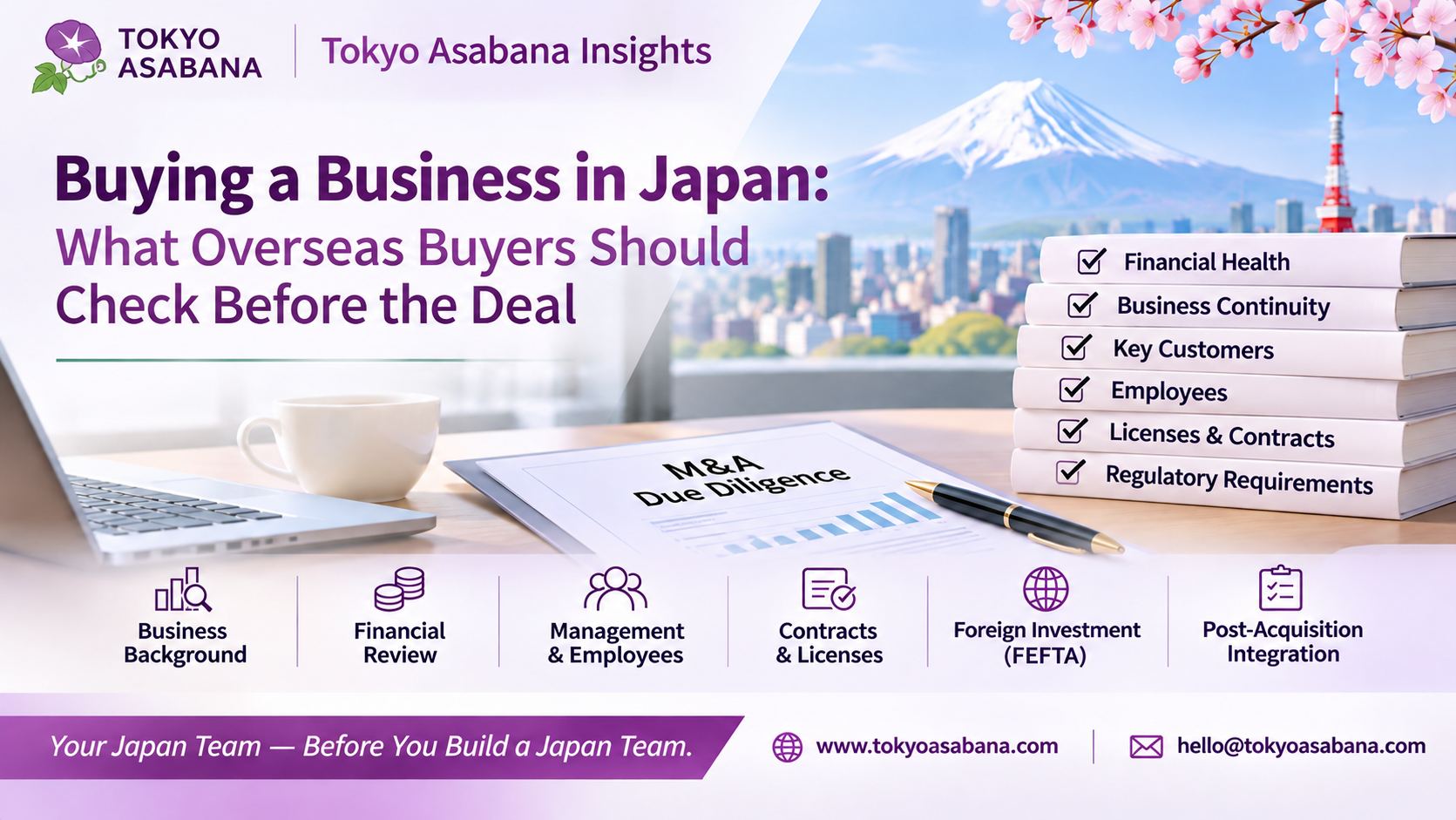
An Essential Pre-Acquisition Checklist for Overseas SMEs and International Investors
Introduction: A Long-Established Japanese Business Is Not Automatically a Good Investment
Japan has many small and medium-sized enterprises with decades of operating history, established customer relationships, specialized technical capabilities, and strong local reputations.
Some of these businesses face succession challenges as their owners approach retirement.
For overseas companies seeking to enter the Japanese market, acquiring an existing business may appear attractive.
Instead of building everything from scratch, a buyer might gain access to:
- Existing customers and revenue
- Experienced employees
- Supplier relationships
- Local operating facilities
- Industry knowledge and established business processes
- An existing brand or market position
However, an acquisition also involves responsibilities that may not be immediately visible.
A business can be inexpensive to acquire but expensive to operate.
A company with a 40-year history may have loyal customers, but it may also depend heavily on its retiring owner.
A small factory may possess valuable equipment and manufacturing expertise, but some machinery may require substantial investment.
A profitable-looking business may have liabilities or contractual obligations that are not obvious from its marketing materials.
Before making an acquisition decision, overseas buyers need to look beyond the asking price.
The real question is not simply whether a Japanese business is available for purchase, but whether its commercial value can be sustained after the ownership changes.
This article outlines key areas overseas buyers should investigate before acquiring a small business in Japan.
1. Understand Why the Business Is Being Sold
The first question may also be one of the most important:
Why does the current owner want to sell?
Business succession is one possible explanation.
An owner may be approaching retirement without a family member or employee willing to take over.
However, other motivations may include:
- Declining profitability
- Increasing operating costs
- Difficulty recruiting employees
- Loss of important customers
- Industry disruption
- Capital investment requirements
- Personal or financial circumstances
Not every reason indicates a serious problem.
For example, a financially healthy business may genuinely need a successor because its owner wishes to retire.
But buyers should avoid assuming that the absence of a successor is the only reason for a proposed sale.
Questions worth investigating include:
- How long has the owner been considering succession?
- Has the company previously explored a sale?
- Is the owner willing to support a transition?
- Are there operational problems influencing the decision?
- What would happen if the current owner remained in charge?
Understanding the seller’s motivation can help buyers assess both the opportunity and the potential risks.
2. Check the Financial Position — Not Just the Asking Price
A relatively low acquisition price can attract international investors.
However, the purchase price alone provides little information about the actual financial condition of the business.
Professional financial due diligence may need to examine:
Revenue and Profitability
Have sales remained stable over several years?
Are profits generated through ordinary operations or influenced by unusual one-time events?
Cash Flow
Does the company consistently generate sufficient cash to meet its operating obligations?
A business reporting accounting profits may still face cash-flow difficulties.
Existing Debt
What loans, guarantees, repayment obligations, or other financial liabilities exist?
Working Capital
How much cash is required to operate the company after acquisition?
Receivables and Inventory
Are outstanding customer payments collectible?
Is inventory current, usable, and appropriately valued?
Capital Expenditure
Will machinery, equipment, IT systems, or facilities require replacement?
Tax Obligations
Are there outstanding taxes, filing issues, or potential exposures requiring investigation?
These questions should be examined by appropriately qualified accounting, tax, and financial professionals.
A buyer should evaluate the total financial commitment, not just the amount paid to the seller.
3. Determine Whether the Business Can Operate Without Its Current Owner
This is particularly important when acquiring a smaller Japanese company.
In some owner-managed businesses, the founder is closely involved in daily operations.
The owner may personally handle:
- Major customer relationships
- Supplier negotiations
- Pricing decisions
- Employee management
- Banking relationships
- Quality control
- Business development
- Operational problem-solving
These responsibilities may not be fully documented.
An overseas buyer might acquire the company’s shares, equipment, and customer contracts without acquiring the personal trust that has supported the business for decades.
Consider a hypothetical situation.
A small Japanese manufacturer has maintained a relationship with an important customer for many years.
However, the customer communicates almost exclusively with the retiring owner.
After the acquisition, the owner leaves, and the overseas buyer assumes that existing orders will continue.
But the customer may wish to reassess the relationship.
The business has been acquired, but the relationship may not automatically transfer.
Before a transaction, overseas buyers should assess whether:
- Essential operating knowledge is documented
- Key employees can take over important responsibilities
- Major customers are likely to remain
- The current owner can participate in an agreed transition
- The new management team can operate effectively in Japan
An acquisition should include a realistic plan for management continuity.
4. Examine Customer Concentration and Revenue Quality
A Japanese SME may report stable revenue, but where does that revenue come from?
If a large proportion depends on one customer, the company may face significant commercial risk.
Buyers should investigate:
- Major customer concentration
- Contract duration
- Customer retention history
- Recurring versus one-time revenue
- Pricing and margin trends
- Dependence on the seller’s personal relationships
- Whether contracts are affected by a change of ownership
The same considerations apply to distribution businesses, professional service providers, and manufacturers.
For example, a company may appear profitable because it has maintained a long-term supply arrangement with one large customer.
But if that customer changes purchasing policy or reduces order volumes, future revenue could decline rapidly.
A diversified customer base does not eliminate risk, but understanding customer concentration is an essential part of evaluating business sustainability.
5. Review Employees, Management, and Workforce Continuity
An existing workforce may be one of the most valuable assets in a Japanese business acquisition.
Employees may possess technical knowledge, customer experience, operational expertise, and institutional memory.
However, workforce continuity cannot be taken for granted.
Before acquiring a business, consider:
- Which employees hold essential operational knowledge?
- Are important roles concentrated among a few individuals?
- What is the age distribution of the workforce?
- Are recruitment or retention problems already present?
- Are employment terms and compensation arrangements documented?
- Are there outstanding employment disputes or obligations?
- Who will manage the business after the acquisition?
Overseas buyers should also understand the employment implications of the proposed transaction structure.
A share acquisition and a business transfer may involve different legal and practical requirements.
A qualified Japanese labor and legal adviser should review relevant employment matters.
Keeping skilled employees may be just as important as acquiring the company’s equipment or customer relationships.
6. Check Licenses, Contracts, Intellectual Property, and Regulatory Obligations
An overseas buyer should not assume that every operating permission or contractual relationship will automatically continue after an acquisition.
Depending on the industry and transaction structure, important questions may include:
Business Licenses
Does the company hold the permits necessary for its activities?
Will the relevant authorization remain valid after the transaction, or will separate procedures be required?
Customer and Supplier Contracts
Do key contracts include change-of-control, assignment, termination, or consent provisions?
Property and Leases
Does the company own its premises or lease them?
Could the transaction affect existing property arrangements?
Intellectual Property
Who owns the company’s trademarks, patents, technical drawings, software, or proprietary information?
Compliance
Are there relevant industry regulations, environmental obligations, data protection requirements, or product-related responsibilities?
Litigation and Disputes
Are there current or potential disputes that could materially affect the business?
A formal legal due diligence process should evaluate these matters before binding commitments are made.
The presence of an existing license or contract does not necessarily mean it can be transferred without restriction.
7. Understand the Difference Between Share Acquisition and Business Transfer
Overseas buyers may encounter different transaction structures when considering Japanese SMEs.
Two common approaches are:
| Consideration | Share Acquisition | Business Transfer |
| Transaction Object | Shares in the existing company | Selected business assets and operations |
| Corporate Entity | Usually continues under new ownership | Buyer acquires agreed business elements |
| Existing Liabilities | Generally remain within the acquired company | Treatment depends on applicable law and transaction terms |
| Contracts | May continue, subject to relevant restrictions | May require separate transfer arrangements or consent |
| Employees | Employment relationships generally remain with the company | Transfer may require additional employment-related procedures |
| Permits and Licenses | Must be reviewed for applicable change-of-control requirements | Transferability or new applications may need review |
Neither structure is universally preferable.
The appropriate option depends on the business, desired assets, liabilities, regulatory requirements, and commercial objectives.
Tax consequences may also differ.
The transaction structure should be evaluated with qualified Japanese legal, accounting, and tax professionals before the buyer commits to a deal.
8. Can a Foreign Buyer Legally Acquire the Business?
Japan generally allows foreign investment, but some acquisitions are subject to foreign investment screening and reporting requirements.
Under Japan’s Foreign Exchange and Foreign Trade Act (FEFTA), certain investments by foreign investors may require prior notification and government review, particularly where designated sectors or national security considerations are involved.
Relevant sectors may include activities connected to sensitive technologies, infrastructure, manufacturing, or other regulated areas.
The rules can also depend on the buyer’s ownership and control, the target company’s activities, and the transaction structure.
Japan amended aspects of its foreign investment screening framework in 2026, further emphasizing the importance of checking the current requirements for each transaction.
Other matters may involve:
- Corporate registration and ownership
- Sector-specific regulations
- Tax and accounting obligations
- Employment law
- Competition law
- Data protection
- Export controls and sensitive technology
- Post-acquisition reporting
A foreign buyer should not assume that acquiring an existing Japanese company automatically provides immigration or residence rights.
Regulatory feasibility should be assessed before signing a binding acquisition agreement, not discovered after the transaction has been completed.
9. Investigate the Physical Assets and Operating Infrastructure
For businesses involving manufacturing, logistics, restaurants, retail, or other physical operations, asset condition can materially affect the investment.
A small factory may have operated successfully for decades, but some equipment may be approaching the end of its useful life.
A restaurant may have a strong local reputation but require expensive renovations.
A distribution business may rely on outdated inventory systems.
Before acquisition, buyers may need to examine:
- Machinery and equipment conditions
- Maintenance records
- Facility ownership or lease arrangements
- Inventory condition
- Safety and environmental obligations
- IT infrastructure
- Cybersecurity and operational resilience
- Required future capital expenditure
Relevant specialists should conduct physical, technical, environmental, or operational assessments as appropriate.
A low acquisition price can quickly lose its appeal if substantial reinvestment is required immediately after closing.
10. Review the M&A Adviser or Intermediary’s Role and Fees
Overseas buyers may engage M&A intermediaries, financial advisers, legal professionals, or other specialists during the acquisition process.
It is important to understand whom each adviser represents and how they are compensated.
Japan’s Small and Medium Enterprise Agency published the third edition of its SME M&A Guidelines in August 2024.
The guidelines place particular emphasis on transparency surrounding professional fees, services, conflicts of interest, contractual provisions, and transaction risks.
Before engaging an intermediary or adviser, buyers should ask:
- Does the adviser represent the buyer, seller, or both?
- What services are included?
- How are fees calculated?
- Is there a minimum fee?
- When are payments due?
- Are there additional charges?
- Are exclusivity or tail provisions included?
- What happens if the transaction does not proceed?
- How will confidential information be handled?
- Who is responsible for financial, legal, and tax due diligence?
Fee arrangements should be reviewed carefully rather than judged only by the headline percentage.
An intermediary introducing an acquisition target is not necessarily the same as an independent adviser protecting the buyer’s interests.
11. Prepare a Realistic Post-Acquisition Integration Plan
Acquiring a Japanese business is not simply a financial transaction.
The buyer must also consider how the business will operate afterward.
Questions may include:
Management
Who will make decisions in Japan?
Language
Can the overseas owner communicate effectively with Japanese employees, customers, and suppliers?
Customer Relationships
How will important business relationships be maintained?
Reporting
Will financial and operational reporting meet the buyer’s requirements?
Corporate Culture
How will management expectations and communication practices be aligned?
Business Development
Does the buyer intend to preserve the existing business, introduce new products, expand internationally, or pursue another strategy?
Transition Support
Will the former owner or existing management team participate in a structured handover?
An acquisition may provide immediate access to an operating company, but the new owner still needs the resources to manage it.
For overseas SMEs without a permanent Japan team, local communication and coordination requirements can be substantial.
12. A Practical Pre-Acquisition Checklist for Overseas Buyers
Before making a significant commitment, buyers should establish which questions have been answered and which still require specialist investigation.
| Area | Key Question |
| Seller Motivation | Why is the owner selling? |
| Financial Health | Are earnings, cash flow, and liabilities sustainable? |
| Total Investment | What additional funding will the business require? |
| Customers | How concentrated and secure are major accounts? |
| Management | Can the company operate without the current owner? |
| Employees | Can essential skills and personnel be retained? |
| Contracts | Will important agreements remain effective? |
| Licenses | Are all necessary approvals and permits addressed? |
| Assets | What repair, replacement, or modernization costs are expected? |
| Foreign Investment | Are FEFTA notifications or other regulatory procedures required? |
| Advisers | Are responsibilities, fees, and conflicts clearly understood? |
| Integration | Who will manage the business after acquisition? |
This checklist is intended for preliminary planning.
It does not replace formal legal, financial, tax, operational, or technical due diligence.
13. How Tokyo Asabana Can Support Early-Stage Research and Japan-Side Coordination
For overseas companies considering acquiring a Japanese SME, one of the earliest challenges is understanding the market before committing to an extensive transaction process.
A company may know that it wants to acquire a business in Japan but still need to clarify:
- Which industries fit its commercial objectives
- What types of Japanese businesses may be relevant
- Which regions or customer markets to prioritize
- What operational capabilities the buyer is seeking
- What information can be researched publicly
- Which specialist professionals should be involved
- Whether the acquisition strategy makes sense compared with other market entry options
Tokyo Asabana provides independent Japan market entry advisory, preliminary business research, and local coordination services.
Depending on the agreed project scope, potential support may include:
Japan Market and Industry Research
Research into relevant Japanese sectors, business environments, market structures, and potential opportunities.
Preliminary Company Identification
Identification of companies that match agreed research criteria using publicly available information.
A company appearing on a research shortlist is not necessarily available for acquisition.
Initial Business Information Review
Organization of publicly available information about company activities, products, services, locations, and market positioning.
Trilingual Business Communication
Tokyo Asabana provides business communication support in Chinese, Japanese, and English.
This can assist overseas businesses in organizing suitable Japan-related communications.
Professional Coordination
Where agreed, assistance coordinating communication and scheduling with appropriately qualified legal, financial, accounting, or M&A professionals.
On-Site Business Visit Accompaniment
Tokyo Asabana may accompany overseas clients to agreed company visits, business meetings, and other professional engagements in Japan.
Support can include business communication, meeting assistance, and local coordination, subject to appropriate arrangements and permissions.
Important Scope Distinction
Tokyo Asabana’s role is focused on market research, preliminary business assessment, communication, and agreed local coordination.
Formal acquisition matchmaking or brokerage, company valuation, financial due diligence, legal advice, tax advice, regulated investment advice, and transaction execution are not included in these general services.
Specialized professional work should be undertaken by appropriately qualified advisers.
Tokyo Asabana does not guarantee that any researched company is willing to sell, that an acquisition can be completed, or that the investment will generate a particular return.
14. Start with a Defined Research Project Before Committing to an Acquisition
An overseas company does not necessarily need to begin with a broad acquisition search.
A more practical initial approach may be to define a limited research project.
For example:
Step 1: Clarify the Acquisition Objective
Determine whether the buyer seeks customers, technology, distribution, skilled employees, manufacturing capacity, or another strategic capability.
Step 2: Select an Industry or Market Segment
Focus on a specific sector rather than searching across every small business in Japan.
Step 3: Establish Research Criteria
Define company characteristics, preferred locations, approximate operating scale, and major exclusions.
Step 4: Conduct Preliminary Market Research
Review relevant Japanese industry information and publicly available company profiles.
Step 5: Identify Professional Requirements
Determine which legal, financial, tax, operational, and regulatory specialists may be needed.
Step 6: Evaluate the Next Investment Decision
Decide whether the preliminary evidence supports commissioning formal acquisition search and due diligence services.
This approach does not eliminate acquisition risk.
However, it can help overseas buyers organize their priorities before making more substantial financial commitments.
A well-defined preliminary research project should reduce uncertainty, not promise a successful acquisition.
15. Corporate Consultation and Japan Business Support
Overseas companies exploring Japanese business acquisitions may begin with a paid corporate consultation to clarify their market entry objectives and preliminary research needs.
Corporate Pre-Consultation — 30 Minutes: JPY 4,400
An introductory discussion covering Japan-related business questions and possible next steps.
Corporate Advisory Consultation — 60 Minutes: JPY 44,000
A more detailed advisory session addressing Japanese market entry, initial research priorities, business development considerations, and local coordination requirements.
The preliminary consultation fee may be credited toward a qualifying subsequent corporate consultation within 14 calendar days, subject to applicable terms.
Additional market research, company information screening, business communication, and on-site coordination projects are separately scoped and quoted.
Fees, responsibilities, and deliverables are agreed in advance.
Conclusion: Buy a Sustainable Business, Not Just an Attractive Story
Japan’s business succession challenges may create opportunities for overseas investors and companies seeking an alternative route into the Japanese market.
An established company can offer customer relationships, technical expertise, experienced employees, and operating capabilities that would otherwise take time to develop.
However, a long history does not guarantee future profitability.
A low purchase price does not guarantee a low total investment.
And an existing customer base does not guarantee that relationships will survive an ownership change.
Before acquiring a Japanese business, overseas buyers should examine its financial health, management dependence, customer concentration, employees, assets, contracts, regulatory requirements, and post-acquisition operating needs.
The goal is not simply to purchase an established Japanese company. It is to identify a business that can remain viable and create value under new ownership.
For overseas SMEs, careful market research and appropriate professional support can help establish a more informed foundation for that decision.
Your Japan Team — Before You Build a Japan Team.
Considering a Business Acquisition in Japan?
Tokyo Asabana supports overseas companies with preliminary Japan market research, industry analysis, publicly available company information screening, trilingual business communication, and selected Japan-side coordination services.
If your company is exploring business acquisition as a possible Japan market entry strategy, a paid corporate consultation can help clarify your initial research requirements and identify appropriate next steps.
Website: https://www.tokyoasabana.com
Services & Transparent Pricing: https://tokyoasabana.stores.jp/
Email: hello@tokyoasabana.com
References and Further Reading
- Small and Medium Enterprise Agency — SME M&A Guidelines
- METI — SME M&A Guidelines, Third Edition (2024)
- Small and Medium Enterprise Agency — Business Succession Procedures
- Ministry of Finance — Inward Direct Investment Screening System
Disclaimer: This article provides general business information, not legal, tax, accounting, financial, or investment advice. Acquisition requirements and applicable regulations should be verified for each transaction with appropriately qualified professionals.
Related Reading
Tokyo Asabana Insights|When Should an Overseas SME Hire a Local Partner in Japan?