
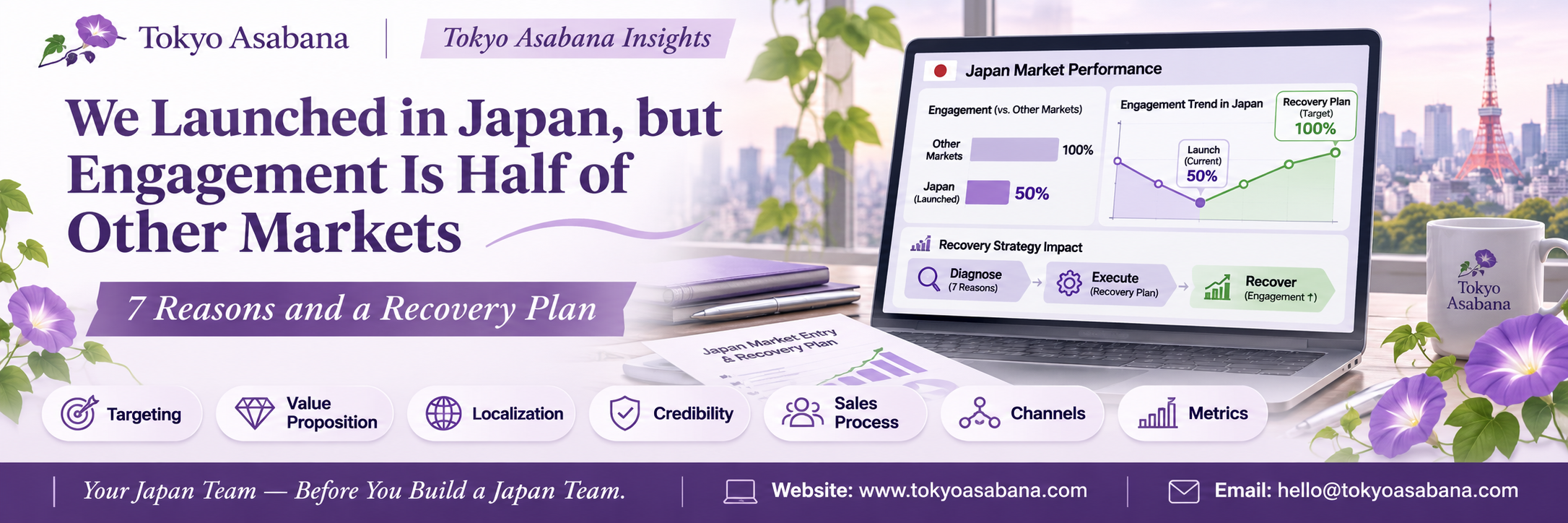
Why overseas companies struggle to generate customer engagement in Japan — and how to improve performance without immediately rebuilding their local operations.
Introduction: We Entered Japan. Why Is Engagement So Low?
Imagine an overseas company that has successfully expanded into several international markets.
Its products perform well in North America, Europe, and other regions.
The company has an established website, marketing materials, competitive products, and a business development strategy that has worked elsewhere.
Encouraged by its international success, the company launches in Japan.
However, several months later, management notices something unexpected.
Customer engagement in Japan is only half of what the company achieves in other markets.
Website visitors rarely submit inquiries.
Potential customers do not respond to outreach.
Marketing campaigns generate impressions but few meaningful conversations.
Sales opportunities take longer than expected to develop.
The company begins asking:
Is Japan simply a difficult market?
Are Japanese customers uninterested in our products?
Do we need a larger marketing budget or a local sales team?
Not necessarily.
Low engagement does not automatically mean that a product lacks demand in Japan.
It may indicate that the company’s positioning, communication, customer targeting, or sales process does not match the local market.
Before investing more money, overseas companies should identify exactly where engagement is breaking down.
This article explores seven possible reasons for weak customer engagement in Japan and presents a practical 90-day recovery plan.
1. The Company Is Targeting the Wrong Japanese Customers
One of the most common international expansion mistakes is assuming that the ideal customer profile will remain the same across countries.
A company may have a clearly defined target audience in the United States.
However, the same type of organization in Japan may operate differently.
For example, a U.S. software company might primarily sell to technology executives.
In Japan, similar purchasing decisions may involve business departments, information systems teams, procurement personnel, and senior management.
Likewise, an overseas education provider may discover that Japanese customers evaluate programs using different priorities, intermediaries, or decision-making processes.
The problem may not be insufficient demand.
The company may simply be approaching the wrong people with the wrong message.
What to Investigate
- Who actually experiences the problem your product solves?
- Who evaluates competing solutions?
- Who influences the purchasing decision?
- Who controls the budget?
- What alternatives are Japanese customers currently using?
- Which customer segments have demonstrated genuine interest?
Recommended Action
Review the original customer segmentation assumptions.
Conduct targeted interviews or preliminary market research to identify the most promising Japanese customer groups.
Instead of approaching every possible customer, begin with a small number of clearly defined segments.
Better targeting can be more valuable than increasing outreach volume.
2. The Value Proposition Has Not Been Adapted to Japan
A product can be successful internationally without having an equally compelling value proposition in Japan.
The problem is not necessarily the product itself.
It may be how the company explains its value.
Consider an overseas technology provider promoting:
“Move faster and disrupt your industry.”
This message may resonate with some customers.
However, other buyers may prioritize operational continuity, compatibility with existing systems, implementation support, risk reduction, or proven performance.
Similarly, a manufacturer promoting innovative engineering may need to explain how its products meet particular customer requirements, quality expectations, and operating conditions.
The same product can require a different commercial explanation in Japan.
What to Investigate
- What problem does the Japanese customer consider most important?
- What evidence supports your product’s value?
- How does your offer compare with local alternatives?
- Are you emphasizing benefits that Japanese buyers actually prioritize?
- Does your positioning address implementation risks and practical concerns?
Recommended Action
Test different value propositions with a small number of relevant customers.
For example, compare messages focused on:
- Cost reduction
- Operational reliability
- Quality improvement
- Productivity
- Ease of implementation
- Customer support
- Long-term business value
The objective is not to stereotype Japanese customers.
Different industries and buyer segments have different priorities.
The objective is to replace assumptions with evidence from the target market.
3. The Website Is Translated, but the Customer Journey Is Not Localized
Many overseas companies believe they have completed localization once their website is available in Japanese.
However, translation is only one part of the customer experience.
A Japanese-language website can still feel difficult to use if important commercial information is missing or unclear.
Potential issues include:
- Unfamiliar terminology
- Unclear pricing
- Limited Japanese-language support
- Overseas-only contact information
- Complicated inquiry forms
- Missing implementation details
- Unclear payment or contracting procedures
- Limited information about the company
A potential customer may understand the website perfectly but still hesitate to make contact.
Language accessibility and commercial confidence are two different things.
What to Investigate
Review the complete customer journey:
- How do Japanese customers discover the company?
- Which page do they visit first?
- What information do they need before making an inquiry?
- Is the next action obvious?
- What happens after the customer contacts the company?
- Can the customer receive appropriate follow-up in Japanese?
Recommended Action
Conduct a Japanese customer journey review.
Examine the website, inquiry forms, marketing materials, pricing explanations, and communication process.
Identify where visitors abandon the process.
Then improve the most important conversion points rather than translating every existing marketing asset again.
A localized customer journey should make it easier to understand, evaluate, and contact the business.
4. The Company Has Not Established Enough Local Credibility
Overseas companies sometimes underestimate the importance of helping potential Japanese customers evaluate business credibility.
A company may have an excellent international reputation.
However, Japanese customers may be unfamiliar with its name.
Potential buyers may want to understand:
- Who is behind the business?
- Does the company have relevant experience?
- Has it served comparable customers?
- What happens if a problem occurs?
- Is there a reliable contact person?
- Can the company provide support after purchase?
- Are its commercial terms clear?
This is especially relevant to smaller overseas companies that do not have globally recognized brands.
What to Investigate
- Does the Japanese website explain the company’s background?
- Are relevant case studies available?
- Can potential customers understand the company’s experience?
- Are service responsibilities and contact procedures clear?
- Does the company provide credible information about delivery and support?
Recommended Action
Develop appropriate credibility materials.
These may include:
- Company profiles
- Relevant project experience
- Customer testimonials, where authorized
- Clear service descriptions
- Business contact information
- Product documentation
- Frequently asked questions
- Information about local support arrangements
A Japanese office is not always necessary to begin building credibility.
However, a company should clearly explain how customers can communicate with it and what level of support is available.
Trust should be supported by verifiable information, not simply by attractive marketing claims.
5. The Sales and Follow-Up Process Does Not Match the Buying Journey
Low engagement may also reflect problems in the sales process.
An overseas company might generate inquiries but struggle to convert them into meaningful discussions.
For example:
- Initial responses arrive too slowly.
- Follow-up messages are too generic.
- Sales materials do not answer important questions.
- The company contacts people without decision-making authority.
- Potential customers need additional internal review.
- The next step is not clearly defined.
In B2B markets, purchasing decisions can involve multiple stakeholders.
A lack of immediate commitment should not automatically be interpreted as rejection.
However, slow progress should not be excused indefinitely as a cultural difference either.
A long sales cycle is not the same as a healthy sales pipeline.
What to Investigate
Track the following stages:
| Sales Stage | Key Question |
| Contact | Did the inquiry reach the appropriate person? |
| Response | Did the customer engage with the proposal? |
| Qualification | Is there a genuine business requirement? |
| Discussion | Were relevant stakeholders involved? |
| Evaluation | What additional information is needed? |
| Proposal | Is there a clear commercial next step? |
| Decision | What is preventing progress? |
Recommended Action
Create a structured follow-up process.
Record customer responses, unresolved questions, next actions, and responsible team members.
Adjust the communication strategy based on actual customer behavior rather than sending repeated generic messages.
Japanese-language business development support may help overseas companies coordinate communication when internal language resources are limited.
6. The Company Is Using the Wrong Marketing or Distribution Channels
A marketing channel that performs well in the United States may not produce the same results in Japan.
The company may be reaching the wrong audience, using the wrong message, or asking for an action that customers are not ready to take.
For example, an overseas company may invest heavily in general brand awareness campaigns while its actual customers prefer industry-specific information, direct introductions, technical demonstrations, or established distribution relationships.
The relevant channels depend on the industry and customer segment.
For some businesses, direct B2B outreach may be effective.
For others, distributors, industry associations, professional events, specialist platforms, or local partnerships may provide more appropriate access.
What to Investigate
- Where do target customers research potential suppliers?
- Which channels generate qualified inquiries?
- Are marketing impressions reaching actual buyers?
- Do current campaigns support the purchasing process?
- Would local partners provide useful market access?
- Are there relevant industry events or business networks?
Recommended Action
Compare channels using business outcomes rather than impressions alone.
A campaign generating thousands of visitors may be less valuable than a smaller campaign producing several relevant business conversations.
Instead of expanding every channel simultaneously, test a limited number of promising options.
Marketing success should be measured by meaningful commercial progress, not visibility alone.
7. The Company Is Measuring Engagement Incorrectly
Finally, the reported engagement problem may partly reflect how performance is being measured.
A company may say:
“Japan engagement is 50% lower than in other markets.”
But what exactly does engagement mean?
Is the company comparing:
- Website engagement rate?
- Qualified inquiries?
- Email reply rates?
- Meeting bookings?
- Trial registrations?
- Sales opportunities?
- Actual revenue?
These indicators measure different stages of the customer journey.
For example, a company may receive fewer inquiries from Japan but find that those inquiries are more relevant.
Alternatively, a website may receive substantial traffic while generating almost no commercial opportunities.
The company should also consider whether traffic sources, campaign budgets, audience composition, and reporting definitions are comparable across markets.
What to Investigate
Before drawing conclusions, compare equivalent performance indicators.
| Metric | What It Helps Evaluate |
| Relevant Website Traffic | Whether the business reaches potential customers |
| Inquiry Conversion Rate | Whether visitors take the intended action |
| Qualified Lead Rate | Whether inquiries match target customers |
| Outreach Response Rate | Whether business communication creates engagement |
| Meeting Conversion Rate | Whether conversations progress |
| Proposal Conversion Rate | Whether opportunities become commercially meaningful |
| Sales Conversion Rate | Whether customers ultimately purchase |
Recommended Action
Establish a consistent measurement framework.
Separate marketing problems from sales problems and operational bottlenecks.
A 50% engagement gap is a diagnostic signal, not an explanation.
Before increasing the budget, identify which specific stage is underperforming.
The Recovery Plan: How to Improve Japan Engagement in 90 Days
Once the possible causes have been identified, the next step is to design a structured improvement project.
For smaller overseas companies, the most effective approach may be a limited, measurable pilot rather than a complete market relaunch.
The following 90-day framework is an illustrative planning model.
Actual timelines should depend on the industry, customer access, available resources, and purchasing cycle.
Days 1–30: Diagnose the Problem
The first month should focus on understanding why performance differs from expectations.
Key Activities
1. Review Existing Performance
Analyze website activity, inquiry data, sales pipeline information, and campaign results.
Identify which stage is underperforming.
2. Reassess Target Customers
Review the ideal customer profile and compare it with actual Japanese customer behavior.
3. Examine Competitors
Research relevant Japanese and international alternatives.
Compare pricing, positioning, service descriptions, and customer communication.
4. Review Marketing Materials
Evaluate Japanese-language websites, company profiles, sales presentations, and inquiry procedures.
5. Gather Local Feedback
Where feasible, conduct targeted discussions with potential customers, partners, or other relevant market participants.
Expected Deliverables
- Japan engagement diagnostic summary
- Priority customer segments
- Preliminary competitor review
- Key communication and conversion problems
- Initial improvement recommendations
The objective is to identify the most likely causes before committing to additional spending.
Days 31–60: Test Improvements
The second month should focus on a limited number of practical changes.
Key Activities
1. Revise the Value Proposition
Test messaging that addresses the target customer’s actual priorities.
2. Improve Conversion Points
Make selected website pages, inquiry forms, and company materials clearer.
3. Adjust Business Outreach
Refine target lists, communication approaches, and follow-up procedures.
4. Test Alternative Channels
Evaluate selected industry contacts, local partnerships, or marketing channels.
5. Strengthen Credibility
Improve company introductions, case studies, relevant documentation, and support information.
Expected Deliverables
- Revised messaging
- Improved Japanese customer-facing materials
- Targeted outreach activity
- Customer or partner feedback
- Initial conversion and engagement observations
At this stage, the company should avoid changing every part of its market strategy simultaneously.
A controlled test makes it easier to identify which adjustments appear useful.
Days 61–90: Evaluate and Decide
The final month should focus on measuring results and identifying the next investment decision.
Key Activities
1. Compare Performance Against the Baseline
Evaluate the same indicators used during the diagnostic stage.
2. Identify Effective Improvements
Determine which changes produced meaningful engagement or stronger commercial opportunities.
3. Review the Sales Pipeline
Assess the quality of customer conversations, pending decisions, and potential next steps.
4. Evaluate Operating Requirements
Determine whether the business needs additional local communication, customer support, or business development resources.
5. Decide Whether to Expand
Consider whether to continue testing, refine the strategy, increase investment, or pause certain activities.
Expected Deliverables
- 90-day performance review
- Summary of completed tests
- Qualified lead and pipeline observations
- Recommended priorities
- Next-stage budget and resource considerations
The goal is not to guarantee that engagement doubles within 90 days.
It is to generate enough evidence to support a more informed business decision.
How Should Success Be Measured?
A recovery project should establish measurable objectives before execution begins.
Possible indicators include:
| Area | Example Measurement |
| Market Understanding | Number of relevant customer insights collected |
| Website | Inquiry conversion rate |
| Outreach | Responses from qualified target companies |
| Business Development | Qualified business discussions |
| Partnership Development | Relevant partner conversations |
| Sales Pipeline | Opportunities with agreed next steps |
| Execution | Completion of defined project deliverables |
Targets should be agreed based on the company’s starting position.
A business with an existing Japanese customer base may require different metrics from a company testing Japan for the first time.
Likewise, a manufacturing supplier may have a very different sales cycle from a digital subscription business.
The important principle is consistency.
Measure progress against the original problem, not against arbitrary activity targets.
Should You Hire a Japan Team or Outsource the Recovery Project?
When engagement remains low, overseas companies may consider hiring local employees or expanding their Japanese operations.
Sometimes this is appropriate.
However, it may be premature if the business has not yet identified the underlying problem.
Before creating a permanent local team, companies should ask:
- Has customer demand been sufficiently validated?
- Is the current positioning appropriate?
- Are target customers clearly defined?
- Is the sales process producing qualified opportunities?
- Which local activities actually require dedicated personnel?
- Could a limited external project resolve the immediate bottleneck?
An independent Japan-side business support provider may help with selected research, communication, and coordination activities.
For example, a company may need an experienced local professional to conduct preliminary customer research, coordinate outreach, or arrange business discussions.
These activities can be scoped independently from long-term staffing decisions.
The question is not whether local employees are valuable. It is whether hiring them is the right next investment at the current stage.
How Tokyo Asabana Supports Overseas Companies
Tokyo Asabana provides independent Japan market entry advisory, business development, and local coordination services for overseas companies.
Our services are particularly relevant to international SMEs that need practical Japan-side support without immediately establishing a permanent local team.
Depending on the agreed project scope, Tokyo Asabana may assist with:
Japan Market Assessment
Reviewing market entry objectives, potential customer groups, and preliminary business assumptions.
Market Validation and Competitor Research
Researching Japanese competitors, customer segments, commercial positioning, and potential market opportunities.
Customer Engagement Review
Examining selected marketing materials, business communication processes, and potential engagement bottlenecks.
Japanese-Language Business Outreach
Preparing and coordinating approved business communications with relevant Japanese organizations.
Business Development and Partner Research
Identifying potential customers, partners, and business development channels based on agreed criteria.
Trilingual Business Communication
Tokyo Asabana provides business communication support in Chinese, Japanese, and English.
This helps overseas companies communicate with Japanese organizations and coordinate cross-border business activities.
Business Meeting and On-Site Visit Support
Assisting with meeting coordination, company visits, and agreed on-site business accompaniment in Japan.
Project Coordination and Follow-Up
Organizing agreed tasks, communication responsibilities, follow-up activities, and project progress.
Services can be commissioned individually or combined into a defined project.
Tokyo Asabana does not guarantee customer responses, specific engagement improvements, sales opportunities, or commercial outcomes.
We focus on clearly defined professional work, practical market information, and measurable project deliverables.
Start with a Paid Corporate Consultation
Overseas businesses experiencing low engagement in Japan may begin with a paid consultation.
Corporate Pre-Consultation — 30 Minutes: JPY 4,400
An introductory discussion to understand the company’s Japan market challenges and identify possible next steps.
Corporate Advisory Consultation — 60 Minutes: JPY 44,000
A more detailed advisory session addressing market entry strategy, customer engagement, business development, and local coordination requirements.
The preliminary consultation fee may be credited toward a qualifying subsequent corporate consultation within 14 calendar days, subject to applicable terms.
Additional research, outreach, coordination, and implementation support are separately scoped and quoted.
Fees, responsibilities, timelines, and deliverables are agreed in advance.
Conclusion: Low Engagement Is a Problem to Investigate, Not a Reason to Give Up
A company that performs well internationally may still encounter disappointing engagement in Japan.
However, weak early results do not automatically mean that the Japanese market is unsuitable.
The underlying problem may involve customer targeting, value proposition, localization, credibility, sales communication, marketing channels, or performance measurement.
The appropriate response is not always to increase advertising expenditure or immediately hire additional employees.
Instead, overseas businesses should identify where their customer journey is failing, test targeted improvements, and evaluate the results.
A structured 90-day recovery project can help create a clearer basis for the next decision.
Some companies may discover that their Japanese offering needs significant adjustment.
Others may find that relatively focused improvements in communication, positioning, or business development are worth testing.
And some may conclude that their resources would be better allocated elsewhere.
Each outcome can be commercially useful when it is supported by evidence.
Successful international expansion is not about repeating the same strategy in every market. It is about understanding what each market requires and adapting intelligently.
Your Japan Team — Before You Build a Japan Team.
Is Your Japan Market Engagement Below Expectations?
Tokyo Asabana supports overseas companies with preliminary market diagnostics, customer and competitor research, Japanese-language business development, trilingual communication, and local coordination.
If your business has already entered Japan but is struggling to generate meaningful engagement, a paid corporate consultation can help clarify the issues and possible next steps.
Website: https://www.tokyoasabana.com
Services & Transparent Pricing: https://tokyoasabana.stores.jp/
Email: hello@tokyoasabana.com
Related Reading
Tokyo Asabana Insights|Why Customer Engagement Drops After Entering the Japanese Market
Tokyo Asabana Insights|Japan Market Entry for Small Companies: A Practical 90-Day Plan