
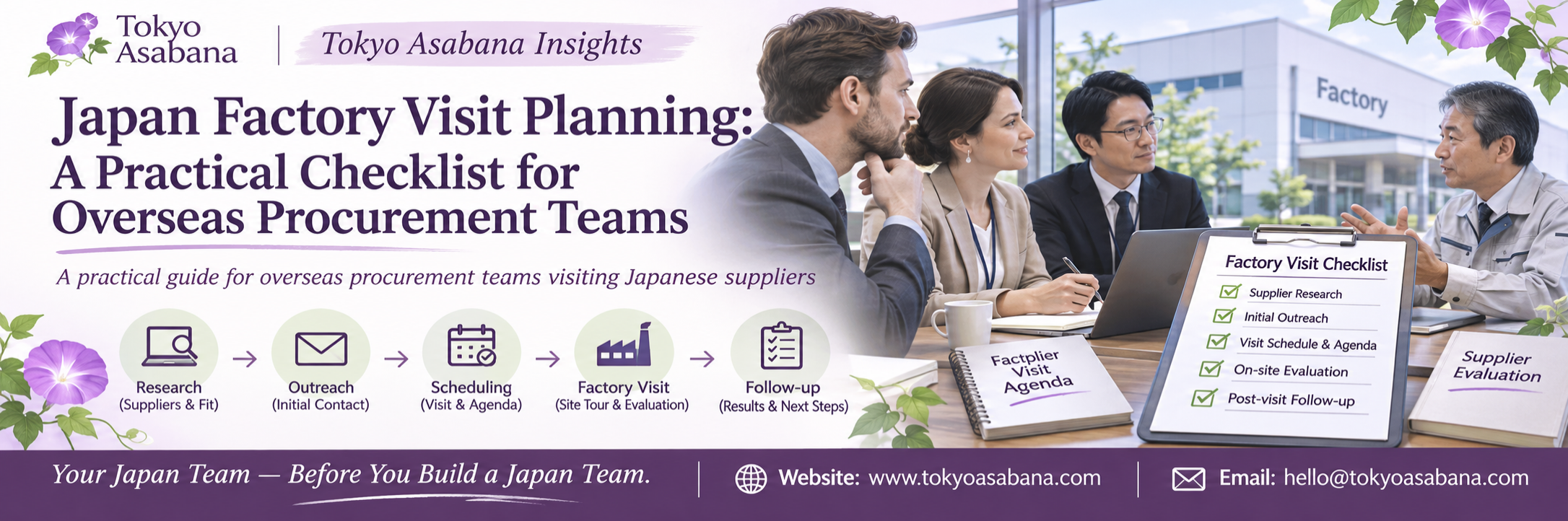
From Supplier Research to On-Site Meetings and Post-Visit Follow-Up — A Practical Guide for Overseas Buyers
Introduction: A Successful Factory Visit Begins Before You Arrive in Japan
For overseas procurement teams, visiting a Japanese factory can be an important step in developing new supplier relationships.
Japan offers a diverse manufacturing ecosystem, from large industrial companies to specialized small and medium-sized manufacturers.
For international buyers, an in-person visit can provide opportunities to understand a potential supplier’s capabilities, meet relevant personnel, discuss requirements, and evaluate whether further cooperation is worthwhile.
However, finding a Japanese manufacturer is not the same as securing a productive factory visit.
A company may identify promising suppliers online but struggle to establish contact, confirm appointments, communicate technical requirements, or coordinate a realistic travel schedule.
These challenges can be particularly significant for smaller overseas companies without Japanese-speaking procurement staff or an established local office.
This guide provides a practical checklist to help overseas procurement teams prepare, conduct, and follow up on business visits to Japanese manufacturers.
Save this checklist before planning your next supplier visit to Japan.
1. Before Contacting Suppliers: Define the Purpose of Your Visit
Before arranging flights or contacting Japanese companies, clarify what your procurement team wants to accomplish.
Different objectives require different preparation.
For example, are you visiting Japan to:
- Identify new manufacturing partners?
- Assess preliminary supplier capabilities?
- Explore alternative sourcing options?
- Discuss specific production requirements?
- Review manufacturing facilities?
- Meet existing suppliers?
- Evaluate opportunities for long-term cooperation?
A first introductory meeting will have different requirements from a formal technical audit or an advanced procurement negotiation.
Pre-Visit Checklist: Business Objectives
- Define the main purpose of the visit
- Identify the products or manufacturing capabilities required
- Establish preliminary supplier selection criteria
- Clarify expected order volumes or project scale, where available
- Identify the appropriate participants from your company
- Decide which discussions require technical specialists
- Define the information you want to obtain from each supplier
Practical Tip: Do not treat every factory visit as a formal supplier qualification exercise.
An introductory visit may be useful for establishing communication and understanding basic capabilities, while supplier approval may require additional technical, quality, financial, or compliance assessments.
2. Supplier Research: Find Companies That Match Your Requirements
Japan has many manufacturers with specialized capabilities.
However, identifying a company in the correct industry does not automatically mean it can meet your requirements.
Before contacting a potential supplier, conduct preliminary research.
Information Worth Reviewing
Company Background
- Company name and location
- Business history
- Main products and services
- Available information about company scale
- Relevant customer markets
Manufacturing Capabilities
- Main production processes
- Materials and product categories
- Available machinery or facilities
- Published technical capabilities
- Quality-related information
Business Suitability
- Potential fit with your requirements
- Available communication channels
- International business experience, where known
- Geographic location
- Potential limitations requiring further clarification
Supplier Research Checklist
- Prepare a preliminary supplier shortlist
- Review each company’s official website
- Verify available business contact information
- Identify relevant products or manufacturing capabilities
- Record unanswered technical and commercial questions
- Prioritize suppliers according to relevance
- Distinguish confirmed facts from assumptions
Important: Publicly available information can support preliminary research, but it should not be treated as verification of a company’s actual production capabilities or quality performance.
3. Initial Outreach: Contact Japanese Suppliers Before Booking Flights
One of the most important steps is establishing communication before committing to an international business trip.
An overseas buyer may identify several promising manufacturers and hope to visit them during a short stay in Japan.
However, a supplier appearing on a shortlist does not mean that it has agreed to receive visitors.
Before arranging travel, send a clear business inquiry.
What Should the Initial Inquiry Include?
A professional introductory message should explain:
- Your company’s name and business activities
- The general product or manufacturing capabilities you are seeking
- Why you are contacting this particular Japanese company
- The purpose of the proposed meeting
- Your preferred visit period
- The expected participants
- Your contact information
For specialized requirements, detailed technical information should only be shared through appropriate, approved channels.
Supplier Outreach Checklist
- Prepare a professional company introduction
- Explain the purpose of the inquiry
- Confirm that the contact channel is appropriate
- Provide relevant non-confidential project information
- Request a meeting rather than assuming availability
- Allow reasonable time for internal review
- Follow up professionally when appropriate
- Record each supplier’s response status
Remember: A supplier list is not a confirmed factory visit schedule.
4. Confirm the Factory Visit Arrangements
Once a supplier expresses interest, the next step is to confirm the actual visit.
A general expression of interest should not be confused with a finalized appointment.
For each supplier, confirm:
- Date and time
- Factory or office address
- Meeting location and entry instructions
- Names or roles of participating personnel
- Expected meeting duration
- Purpose and agenda
- Whether production areas can be visited
- Visitor identification requirements
- Photography and recording restrictions
- Safety instructions and required protective equipment
Some companies may permit business meetings without allowing visitors to enter production areas.
Other facilities may have restricted zones or additional access procedures.
Visit Confirmation Checklist
- Date and time confirmed by the host
- Exact facility address verified
- Host contact person identified
- Visitor names submitted if required
- Meeting agenda agreed
- Factory tour permission confirmed
- Safety and visitor requirements reviewed
- Confidentiality and information-sharing procedures clarified
- Photography and recording rules confirmed
- Emergency contact details recorded
Practical Tip: Do not promise your management team a factory tour until the Japanese host has explicitly confirmed that production areas may be visited.
5. Travel Planning: Build a Realistic Japan Itinerary
Japanese manufacturers may be located outside major city centers.
Some industrial facilities are situated in regional areas requiring additional transportation arrangements.
A travel schedule that appears simple on a map may be difficult to complete in practice.
Before finalizing your itinerary, consider:
Transportation
How will the team travel from the airport, hotel, or previous meeting location?
Regional Travel
Will the visit require train transfers, taxis, or other local transport arrangements?
Meeting Duration
Has enough time been allocated for introductions, discussions, facility visits, and questions?
Schedule Changes
What happens if a meeting is delayed or the host requests a different time?
Accommodation
Is the hotel location practical for the planned business activities?
Japan Travel Checklist
- Confirm all meeting locations
- Review travel distances and transportation options
- Allow realistic travel buffers
- Check relevant Japanese public holidays and facility closures
- Confirm the appropriate entry and visa requirements
- Verify hotel arrangements
- Prepare a shared itinerary for the team
- Save key documents for offline access
- Establish a contingency plan for schedule changes
Practical Tip: A smaller number of confirmed, relevant meetings may produce more useful results than an overly ambitious itinerary.
6. Prepare the Right Documents Before the Visit
Procurement teams should prepare different materials for different stages of supplier engagement.
An initial discussion may require only a company profile and an overview of the proposed business relationship.
A more advanced discussion may require additional technical or commercial documentation.
Recommended Preparation Materials
Company Introduction
An overview of the overseas buyer, its business activities, and relevant experience.
Business Objectives
A clear explanation of the purpose of the supplier discussion.
Product or Project Overview
An appropriate summary of the requested product category or manufacturing capability.
Technical Requirements
Relevant specifications, drawings, standards, or testing requirements, where authorized for disclosure.
Commercial Questions
Potential production volumes, lead times, quotations, payment terms, and other relevant topics.
Meeting Agenda
A structured list of discussion points.
Confidentiality Arrangements
Appropriate procedures for handling proprietary or restricted information.
Document Preparation Checklist
- Company profile prepared
- Meeting agenda shared with the team
- Relevant product information organized
- Appropriate technical documents approved for sharing
- Confidentiality arrangements reviewed
- Key questions prepared
- Required language support arranged
- Document access and version control confirmed
Important: Technical drawings, proprietary manufacturing information, and sensitive data should not be distributed casually during preliminary business discussions.
7. During the Factory Visit: What Should Procurement Teams Observe?
A factory visit can provide information that may not be available through websites or introductory emails.
However, observations should be relevant to the purpose and agreed scope of the visit.
Procurement professionals may want to examine several areas.
A. Manufacturing Capabilities
- What products and processes does the company specialize in?
- What manufacturing operations are performed internally?
- Are important processes outsourced?
- What are the company’s stated capacity and lead-time capabilities?
- What constraints or limitations should be investigated further?
B. Quality Management
- What quality management processes are in place?
- Which standards or certifications does the company claim to hold?
- How are nonconforming products handled?
- What testing or inspection processes are used?
- What additional evidence is required for qualification?
C. Operational Continuity
- How does the company maintain equipment?
- Are important processes dependent on a small number of employees?
- How does it manage production interruptions?
- What are the major operational risks?
D. Communication and Management
- Who will serve as the main business contact?
- Who handles technical questions?
- How are decisions made?
- What information is needed for future discussions?
- What response or follow-up process can be agreed?
On-Site Observation Checklist
- Meet the relevant business representatives
- Clarify supplier capabilities
- Discuss production and operational requirements
- Review relevant quality-related information
- Identify questions requiring specialist verification
- Confirm commercial communication channels
- Record agreed next steps
- Respect all facility safety and confidentiality rules
Important: An introductory factory visit is not a substitute for a qualified technical audit, supplier quality assessment, or independent certification review.
8. Business Etiquette: Practical Considerations in Japan
Professional preparation is particularly important when visiting Japanese companies.
Although business practices vary across industries and organizations, overseas visitors should generally plan for formal introductions, punctual arrival, and organized discussions.
Useful Practices
Arrive on Time
Plan to arrive approximately 5–10 minutes before the agreed meeting time, unless the host provides different instructions.
Bring Business Cards
Prepare sufficient business cards for the participants you expect to meet.
Prepare a Clear Agenda
Explain the business purpose of the visit and allow time for relevant questions.
Respect the Host’s Schedule
Avoid assuming that additional meetings or facility access can be arranged without prior agreement.
Follow Facility Rules
Do not enter restricted areas, photograph equipment, or record conversations without permission.
Avoid Assuming Immediate Agreement
A constructive meeting does not necessarily mean that technical suitability or commercial terms have been accepted.
Business Etiquette Checklist
- Business cards prepared
- Appropriate attire selected
- Meeting agenda confirmed
- Team arrival time agreed
- Japanese business communication support arranged if needed
- Photography permission obtained before taking pictures
- Meeting notes assigned to a team member
- Host representatives thanked after the visit
9. Separate Business Coordination From Technical Evaluation
An overseas procurement team may benefit from local assistance during a Japan factory visit.
However, the responsibilities of each participant should be clear.
| Activity | Typical Responsibility |
| Business Meeting Coordination | Japan-side coordinator or procurement team |
| Japanese-Language Business Communication | Appropriate language support personnel |
| Local Travel and Scheduling Coordination | Agreed local support provider |
| Technical Capability Assessment | Qualified engineering or technical specialists |
| Supplier Quality Audit | Qualified supplier quality or audit professionals |
| Commercial Negotiations | Authorized buyer and supplier representatives |
| Procurement Approval | Overseas buyer’s responsible team |
| Follow-Up Coordination | Agreed project participants |
A Japan-side business coordinator may attend meetings that include technical discussions and help facilitate appropriate communication and organization.
However, participation in a technical meeting does not automatically imply responsibility for engineering decisions, formal technical interpretation, supplier certification, or procurement approval.
The buyer should retain responsibility for technical and commercial decisions unless a different arrangement has been explicitly agreed with appropriately qualified professionals.
10. After the Visit: Follow-Up Is Part of Supplier Development
A factory visit should not end when the overseas team returns home.
The next stage is to convert discussions into documented actions.
Potential next steps may include:
- Requesting additional company information
- Clarifying technical questions
- Obtaining commercial quotations
- Discussing samples or testing requirements
- Arranging further specialist assessments
- Reviewing proposed commercial terms
- Scheduling another meeting
- Recording the reasons for discontinuing discussions
Post-Visit Checklist
- Prepare an internal meeting summary
- Record important observations
- Separate verified facts from unconfirmed statements
- Document outstanding technical questions
- Assign responsibility for each follow-up action
- Confirm requested documents or information
- Send a professional thank-you message
- Agree on appropriate next steps
- Update the supplier evaluation record
- Decide whether further qualification work is required
A productive visit should result in clearer information and an agreed next step, even when no immediate purchase decision is made.
Printable Japan Factory Visit Checklist
Copy, save, or print this section for your procurement team.
Phase 1 — Before Outreach
- Define procurement objectives
- Identify required manufacturing capabilities
- Establish supplier selection criteria
- Research potential Japanese manufacturers
- Prepare preliminary supplier profiles
- Identify appropriate contact channels
- Prepare approved business introduction materials
Phase 2 — Before Booking Travel
- Send supplier inquiries
- Record responses
- Confirm mutual interest
- Agree on meeting objectives
- Verify actual appointment acceptance
- Confirm the participating representatives
- Check factory visit permissions
- Review confidentiality requirements
Phase 3 — Before Departure
- Confirm appointment dates and times
- Verify addresses and entry procedures
- Review local transportation
- Confirm travel documentation
- Prepare company profiles and business cards
- Organize technical documents where applicable
- Confirm language and meeting support
- Review safety instructions
- Prepare meeting questions
- Establish emergency contacts
Phase 4 — During the Visit
- Arrive at the agreed location on time
- Complete visitor registration
- Follow host safety requirements
- Introduce all participants
- Confirm meeting objectives
- Discuss relevant manufacturing capabilities
- Record technical questions for specialist review
- Clarify commercial communication channels
- Confirm next steps
- Thank the host
Phase 5 — After the Visit
- Prepare a visit summary
- Update supplier evaluation records
- Record outstanding questions
- Request necessary follow-up information
- Assign action owners
- Agree on follow-up timing
- Send appropriate business correspondence
- Determine whether further qualification is required
Supplier Visit Evaluation Scorecard
Internal working template — adapt the criteria to your industry.
Use a simple 1–5 score for each area:
1 = Major concerns
2 = Below expectations
3 = Requires further investigation
4 = Generally promising
5 = Strong preliminary fit
| Evaluation Area | Score (1–5) | Notes |
| Relevant Manufacturing Capabilities | ___ | |
| Product / Process Fit | ___ | |
| Quality Management Information | ___ | |
| Production Capacity Information | ___ | |
| Communication Responsiveness | ___ | |
| Commercial Compatibility | ___ | |
| Operational Continuity | ___ | |
| Potential for Further Cooperation | ___ |
Overall Assessment:
- Proceed to additional technical or commercial evaluation
- Request further information before deciding
- Keep as a potential future supplier
- Discontinue the current opportunity
Outstanding Questions:
Next Action:
Responsible Person:
Target Follow-Up Date:
This preliminary scorecard is a discussion aid, not a formal supplier audit or qualification methodology. Scores should not replace evidence-based technical, quality, financial, or compliance assessments.
Sample Post-Visit Follow-Up Email
Subject: Thank You for the Factory Visit — [Company Name]
Dear [Contact Name],
Thank you very much for welcoming our team to your facility on [Date].
We appreciated the opportunity to learn more about your company’s manufacturing capabilities and discuss potential areas of cooperation.
Following our meeting, we would like to confirm the following next steps:
- [Agreed Action 1]
- [Agreed Action 2]
- [Additional Information Requested]
Please let us know if any of the above points require clarification.
We look forward to continuing our discussions.
Best regards,
[Name]
[Company]
[Contact Information]
How Tokyo Asabana Supports Overseas Procurement Teams
For overseas companies planning supplier research and business visits in Japan, local coordination can be an important part of the process.
Tokyo Asabana provides independent Japan market entry advisory and business coordination services.
Depending on the agreed project scope, we may support:
Japanese Supplier Research
Identifying potentially relevant Japanese manufacturers based on agreed business and research criteria.
Preliminary Company Screening
Organizing publicly available supplier information and identifying questions requiring further investigation.
Japanese-Language Business Outreach
Preparing and coordinating approved business inquiries and relevant follow-up communication.
Business Meeting and Factory Visit Coordination
Assisting with appointment requests, agreed schedules, meeting arrangements, and local coordination.
On-Site Business Visit Accompaniment
Tokyo Asabana can accompany overseas clients to Japanese suppliers, factories, business meetings, and other professional engagements.
Support may include business communication, meeting assistance, and local coordination.
Trilingual Business Communication
Tokyo Asabana provides business communication support in:
Chinese | Japanese | English
This can help overseas companies communicate with Japanese organizations and coordinate business activities across languages.
Post-Visit Coordination
Helping organize agreed follow-up activities and maintain business communication after meetings.
Scope and Responsibilities
Services are defined and quoted according to the client’s needs.
Tokyo Asabana does not guarantee supplier responses, appointment acceptance, factory access, commercial agreements, or procurement outcomes.
Formal supplier quality audits, engineering assessments, regulated technical services, and procurement approval remain the responsibility of appropriately qualified professionals.
Planning Your Next Factory Visit to Japan?
Whether your company is identifying new Japanese suppliers, preparing introductory meetings, or arranging an overseas procurement delegation, early preparation can help reduce uncertainty and improve the usefulness of the visit.
Tokyo Asabana offers paid business consultations and separately scoped Japan-side support services.
Corporate Pre-Consultation — 30 Minutes: JPY 4,400
An introductory discussion to clarify your Japan-related business requirements.
Corporate Advisory Consultation — 60 Minutes: JPY 44,000
A more detailed discussion covering Japanese supplier research, business development, and potential coordination requirements.
The preliminary consultation fee may be credited toward a qualifying subsequent corporate consultation within 14 calendar days, subject to applicable terms.
Supplier research, business outreach, meeting arrangements, and on-site accompaniment are quoted separately according to the agreed scope.
Your Japan Team — Before You Build a Japan Team.
Website: https://www.tokyoasabana.com
Services & Transparent Pricing: https://tokyoasabana.stores.jp/
Email: hello@tokyoasabana.com
Disclaimer: This article provides general business planning information. Factory access, visitor requirements, technical discussions, and supplier qualification procedures depend on the relevant companies, industries, and applicable regulations. Overseas buyers should verify their own travel requirements and involve appropriately qualified specialists where necessary.
Related Reading
Tokyo Asabana Services|How U.S. Companies Can Find and Visit Japanese Suppliers
Tokyo Asabana B2B Case Study|A U.S. Manufacturing Company Seeking Business Opportunities in Japan