
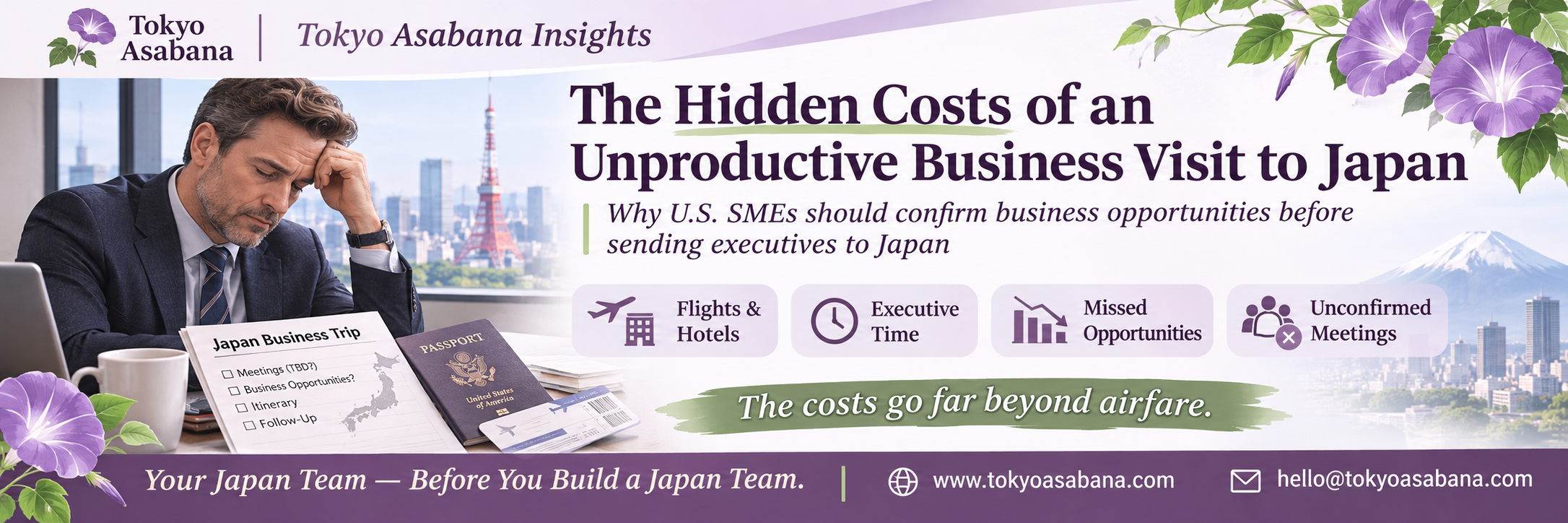
Why U.S. SMEs Should Confirm Business Opportunities Before Sending Executives to Japan
Introduction: Your CEO Flew to Japan. But How Many Meetings Actually Happened?
Imagine a U.S. manufacturing company with approximately 50 employees.
The company is exploring opportunities to work with Japanese manufacturers, suppliers, or potential business partners.
Its CEO believes that visiting Japan personally could accelerate the process.
The company identifies several Japanese businesses online, sends introductory emails, and begins planning a business trip.
Flights are booked.
Hotels are reserved.
The CEO clears an entire week from the executive calendar.
However, shortly before departure, an uncomfortable reality becomes clear.
Only one meeting has been firmly confirmed.
Several companies have not responded.
Others have acknowledged the inquiry but have not agreed to an appointment.
The CEO may still decide to travel.
But what happens if the trip produces little meaningful commercial progress?
For a smaller American company, an unproductive Japan business visit can cost far more than the airline ticket.
The real costs may include executive time, preparation expenses, disrupted business operations, and missed opportunities elsewhere.
More importantly, an overseas business trip should generate enough value to justify the resources committed to it.
This article explores the hidden costs of poorly prepared business visits to Japan and explains how overseas SMEs can improve their planning before committing to international travel.
The U.S. manufacturing company described above is a hypothetical example, not an account of an actual Tokyo Asabana client.
1. The Visible Costs: Flights, Hotels, and Transportation
Let’s begin with the expenses that are easiest to identify.
Consider a hypothetical U.S. company sending two senior employees to Japan for a five-day business visit.
The team includes:
- The CEO
- A senior procurement or business development manager
Their objective is to meet potential Japanese manufacturing partners and explore opportunities for future cooperation.
Illustrative Business Trip Budget
| Expense | Estimated Cost (USD) |
| Round-trip international flights for two | $5,000 |
| Hotels for two travelers | $2,000 |
| Local transportation and regional travel | $1,000 |
| Meals and incidental expenses | $800 |
| Travel preparation and miscellaneous expenses | $700 |
| Total Direct Expenses | $9,500 |
These figures are hypothetical planning assumptions, not current travel quotations or industry averages. Actual costs vary significantly by departure city, travel dates, flight class, hotel selection, and itinerary.
For a large multinational corporation, this amount may represent a relatively small business development expense.
For a U.S. SME, however, it may be a meaningful investment.
And this is only the beginning.
Direct travel expenses do not capture the full economic cost of sending senior management overseas.
2. Hidden Cost #1: Executive Time Has a Real Business Value
A CEO’s time is not free simply because the company does not issue a separate invoice for it.
For a smaller business, senior executives often manage multiple responsibilities.
The CEO may be involved in:
- Major customer relationships
- Sales and business development
- Financial decisions
- Supplier negotiations
- Employee management
- Operational planning
- Strategic partnerships
When the CEO spends a week traveling internationally, some of these responsibilities may need to be postponed or delegated.
A factory visit may require several hours.
However, international travel can consume substantially more time through flights, transfers, preparation, and schedule disruptions.
An Illustrative Executive Time Calculation
Suppose the company estimates the internal economic value of the CEO’s working time at $200 per hour.
If travel and business activities occupy 50 working hours, the implied opportunity cost is:
50 hours × $200 = $10,000
This is not necessarily an additional cash payment.
It is an illustrative estimate of executive capacity committed to the trip.
The procurement manager’s time also carries an opportunity cost.
For smaller organizations, the absence of senior decision-makers can have operational consequences beyond their salaries.
A poorly planned business trip may consume management capacity that could otherwise support revenue-generating activities.
3. Hidden Cost #2: An Unconfirmed Supplier List Creates False Confidence
One of the most common mistakes in international supplier development is confusing potential suppliers with confirmed business appointments.
An American company may identify ten Japanese manufacturers that appear relevant to its requirements.
These businesses might possess appropriate manufacturing technologies, product categories, or industry experience.
However, several important stages separate research from a productive meeting.
| Stage | What It Actually Means |
| Supplier Identified | A potentially relevant company has been found |
| Initial Inquiry Sent | The company has been contacted |
| Response Received | Communication has begun |
| Mutual Interest Confirmed | Both sides see a reason to continue |
| Meeting Accepted | The Japanese company agrees to meet |
| Visit Confirmed | Date, location, participants, and arrangements are established |
A company might have ten potential suppliers but only one confirmed meeting.
These are two very different situations.
A supplier list is not a meeting schedule.
For American executives planning a short business trip, this distinction matters enormously.
A productive itinerary requires more than relevant company names.
It requires actual engagement from the organizations being visited.
4. Hidden Cost #3: The Wrong Meeting Can Be Almost as Expensive as No Meeting
Even when a meeting is confirmed, it may not produce meaningful business value.
Imagine that an American manufacturing executive travels to Japan expecting to discuss a potential commercial partnership.
However, the Japanese company has understood the meeting as a general introductory conversation.
The appropriate technical or commercial decision-makers may not be present.
The American visitor may have prepared detailed questions, but the host may not be ready to discuss them.
Both sides have invested time.
Yet neither has enough information to make progress.
Why Does This Happen?
Several factors can contribute:
Unclear Objectives
The initial meeting request does not explain what the overseas company hopes to accomplish.
Insufficient Business Information
The Japanese organization has not received enough information to determine which employees should participate.
Different Expectations
One side expects a technical discussion while the other anticipates a general business introduction.
Inadequate Preparation
Necessary documents, product information, or commercial questions have not been prepared.
Missing Decision-Makers
Relevant participants are unavailable or have not been invited.
A Better Approach
Before confirming a visit, establish:
- The purpose of the meeting
- The expected discussion topics
- The appropriate participants
- The information each party should prepare
- The proposed next step after the meeting
The objective is not simply to fill the calendar. It is to make each confirmed meeting commercially meaningful.
5. Hidden Cost #4: Japanese Business Communication Takes Preparation
A U.S. business may have an excellent product and a credible company background.
However, its initial outreach may not communicate enough information for Japanese recipients to evaluate the opportunity.
Consider a message such as:
“We will be visiting Japan next month and would love to meet your team.”
This may sound friendly and direct.
But from the recipient’s perspective, several questions remain unanswered.
Who is the overseas company?
Why has it contacted this particular Japanese business?
What products or capabilities are relevant?
What is the proposed business relationship?
Why should the Japanese company allocate employee time to this meeting?
A more informative inquiry can help clarify the purpose.
What a Stronger Business Inquiry Should Include
- A brief introduction to the American company
- Relevant business activities and capabilities
- The reason for approaching the Japanese organization
- A clear, appropriate business objective
- The type of discussion requested
- Proposed dates and participants
- Contact information and possible next steps
Japanese-language communication may also be useful when the potential partner primarily operates domestically.
However, language is only one part of the challenge.
The proposal must also make commercial sense to the recipient.
Professional outreach should explain why the meeting could be worthwhile for both sides.
6. Hidden Cost #5: Last-Minute Arrangements Increase Operational Risk
Japan has extensive transportation infrastructure, but business locations are not always convenient for international visitors.
Manufacturing facilities may be located outside central Tokyo or other major commercial districts.
A procurement team may need to arrange regional train travel, taxis, or other transportation.
The actual meeting location may also differ from the company’s headquarters.
For example, a Japanese manufacturer may have:
- A registered headquarters in Tokyo
- A sales office in another city
- Production facilities in a regional industrial area
A meeting at the headquarters is not necessarily a factory visit.
And permission to visit an office does not automatically include access to manufacturing facilities.
Common Planning Risks
- Incorrect meeting addresses
- Unrealistic travel times
- Unconfirmed factory access
- Missing visitor registration details
- Inappropriate meeting participants
- Incomplete safety preparations
- Last-minute schedule changes
Some risks cannot be eliminated.
However, better coordination can reduce avoidable problems.
International business travel should be planned around confirmed business activities, not assumptions about what might be possible after arrival.
7. Hidden Cost #6: Missed Opportunities Back Home
For a U.S. SME, executive attention is often a scarce resource.
A week spent in Japan may mean postponing important activities in the United States.
For example:
- A major customer negotiation
- A domestic supplier review
- An operational improvement project
- A financing discussion
- A new business proposal
- Internal management decisions
These activities may not have a precise monetary value that can be calculated in advance.
Nevertheless, they are part of the decision.
When evaluating a business trip, American executives should ask:
What will this trip accomplish that cannot reasonably be accomplished through preliminary remote communication?
Face-to-face discussions can create substantial value.
But visiting Japan before potential partners are ready may not be the best use of management time.
8. Hidden Cost #7: No Follow-Up Means Lost Commercial Value
Even a successful business meeting does not automatically create a business relationship.
After returning to the United States, the overseas company may need to:
- Request additional supplier information
- Clarify technical or commercial requirements
- Review quotations
- Coordinate further discussions
- Organize product samples or evaluation procedures
- Discuss possible next steps
Without a clear follow-up process, promising conversations may lose momentum.
Communication across time zones and languages can create additional coordination requirements.
For smaller American companies without Japanese-speaking employees, these activities may compete with existing operational responsibilities.
Recommended Follow-Up Process
Within the agreed follow-up period:
- Prepare a meeting summary.
- Record the information received.
- Identify unresolved questions.
- Assign responsibility for next actions.
- Send appropriate follow-up communication.
- Track progress toward the next commercial decision.
A productive business visit should create a clear next step, not simply a collection of business cards.
9. The Real Cost of an Unproductive Japan Business Trip
Let’s return to our hypothetical U.S. manufacturing company.
Its two senior employees travel to Japan for five days.
The direct expenses are estimated at $9,500.
The CEO’s time has an illustrative opportunity value of $10,000.
The procurement manager’s time, internal preparation, and other commitments may add further economic costs.
The company has therefore committed considerably more resources than the travel invoices alone suggest.
But suppose most planned business meetings were never confirmed.
The company returns with limited information and few actionable next steps.
Was the trip worth the investment?
Possibly — if the objective was broad market exploration and the team gained useful insights.
However, if the primary purpose was to conduct specific supplier discussions, the trip may have fallen short of its commercial objectives.
Business Visit ROI: Questions Every U.S. SME Should Ask
| Question | Why It Matters |
| How many meetings are confirmed? | Measures itinerary readiness |
| Are the correct participants attending? | Supports meaningful discussion |
| What information will we obtain? | Clarifies expected value |
| What is the full travel investment? | Captures direct expenses |
| How much executive time is required? | Recognizes opportunity cost |
| What happens after the visit? | Supports commercial continuity |
An unproductive international trip is expensive not only because money was spent, but because the investment may fail to generate the information or relationships needed for the next decision.
10. A Better Strategy: Prepare in Japan Before Executives Leave the United States
For American SMEs, one alternative is to begin with a structured Japan-side preparation project.
Rather than sending executives overseas to discover whether potential partners are interested, the company can first clarify which opportunities are worth pursuing.
A practical sequence may look like this:
Step 1: Identify Relevant Japanese Companies
Research potential manufacturers, suppliers, customers, or commercial partners.
Step 2: Conduct Preliminary Screening
Review publicly available information and assess relevance against agreed business criteria.
Step 3: Prepare Business Outreach
Develop appropriate company introductions and non-confidential business proposals.
Step 4: Establish Communication
Contact potential Japanese partners through suitable channels.
Step 5: Confirm Business Interest
Clarify whether the organization is interested in further discussion.
Step 6: Arrange Meetings
Coordinate dates, participants, locations, and business objectives.
Step 7: Prepare the Visit
Review the itinerary, local transportation, visitor requirements, and meeting agendas.
Step 8: Conduct the Visit
Attend confirmed meetings and carry out the agreed business activities.
Step 9: Manage Follow-Up
Organize relevant next steps and maintain appropriate communication.
This approach does not guarantee that Japanese organizations will respond or agree to meetings.
It does, however, help the overseas business distinguish viable opportunities from speculative possibilities before committing to international travel.
The goal is to make the business trip the result of preparation, not the substitute for it.
11. When Should an American Company Postpone a Japan Business Visit?
Postponing a business trip does not automatically mean abandoning the Japanese market.
Sometimes it is a commercially sensible decision.
A company may want to reconsider its timing when:
- Most important meetings remain unconfirmed
- Potential partners have not expressed sufficient interest
- Essential business information is missing
- Relevant participants are unavailable
- Confidentiality or compliance arrangements remain unresolved
- The itinerary is impractical
- The expected business value is unclear
However, the appropriate decision depends on the purpose of the visit.
A company attending an industry exhibition, conducting broad market research, or maintaining existing relationships may have valid reasons to travel without a full schedule of private meetings.
The key is to evaluate the trip against its actual objectives.
Sometimes the smartest business decision is to visit Japan later — with better preparation and stronger opportunities.
12. How Tokyo Asabana Supports U.S. Companies Planning Business Visits to Japan
Tokyo Asabana provides independent Japan market entry advisory, business development support, and local business coordination services for overseas companies.
Our services are particularly relevant to American SMEs that need practical Japan-side support without immediately establishing a permanent local team.
Depending on the agreed project scope, Tokyo Asabana can assist with the following activities.
Japanese Supplier and Business Partner Research
Identifying potentially relevant Japanese manufacturers, service providers, customers, and commercial partners.
Preliminary Company Screening
Reviewing publicly available company information and preparing relevant research summaries.
Japanese-Language Business Outreach
Preparing and coordinating approved business inquiries and follow-up communications.
Meeting and Factory Visit Coordination
Assisting with meeting requests, scheduling, participant confirmation, and agreed arrangements for business visits.
On-Site Business Visit Accompaniment
Tokyo Asabana can accompany overseas clients to Japanese companies, factories, supplier meetings, and other professional engagements.
Support may include business communication, meeting assistance, and local coordination.
Trilingual Business Communication
Tokyo Asabana provides business communication support in:
English | Japanese | Chinese
This helps overseas companies communicate with Japanese organizations and coordinate international business activities.
Post-Visit Follow-Up
Helping organize agreed follow-up actions and maintain communication after business meetings.
Professional Coordination
Where specialized expertise is required, Tokyo Asabana may also assist in identifying, contacting, and coordinating with relevant professionals in Japan.
Technical assessments, formal supplier audits, regulated professional advice, and procurement approval remain with appropriately qualified specialists.
13. Why Outsourcing Selected Japan-Side Tasks May Make Sense for U.S. SMEs
Large multinational corporations may have established offices and dedicated employees in Japan.
Smaller American companies often operate differently.
They may have strong products, technical expertise, and established customer relationships in the United States, but limited resources for international business development.
Hiring permanent employees in Japan may not be justified during the early stages of market exploration.
At the same time, asking a busy U.S. executive to manage every Japanese-language inquiry, meeting schedule, and local arrangement may not be efficient.
A separately scoped Japan-side support project can help address selected operational needs.
For example, an American company may already know which Japanese businesses it wants to meet.
In that case, it may need meeting coordination or on-site accompaniment rather than an extensive market research project.
Another company may need preliminary supplier research before determining whether a business visit makes sense.
The right service should reflect the company’s actual requirements, not an unnecessarily large engagement.
Tokyo Asabana’s services are designed around defined responsibilities, transparent pricing, and agreed deliverables.
We do not guarantee supplier responses, confirmed appointments, business contracts, or procurement outcomes.
14. Start With a Paid Corporate Consultation
If your U.S. company is considering a business visit to Japan, an initial consultation can help clarify the purpose of the trip and identify potential support requirements.
Corporate Pre-Consultation — 30 Minutes: JPY 4,400
An introductory online consultation to discuss Japan-related business objectives and possible next steps.
Corporate Advisory Consultation — 60 Minutes: JPY 44,000
A more detailed discussion covering market entry strategy, Japanese business partners, supplier research, and visit coordination requirements.
The preliminary consultation fee may be credited toward a qualifying subsequent corporate consultation within 14 calendar days, subject to applicable terms.
Supplier research, outreach, business meeting coordination, and on-site accompaniment are separately scoped and quoted according to agreed requirements.
A small professional consultation can help clarify the next decision before a company commits substantial executive time and travel resources.
Conclusion: The Most Expensive Business Trip Is One Without a Clear Purpose
Japan offers valuable business opportunities for American manufacturers, technology companies, education providers, and other overseas businesses.
In-person meetings can help build relationships, clarify requirements, and create opportunities for future cooperation.
However, international travel should be supported by realistic objectives and adequate preparation.
For smaller U.S. companies, an unproductive business trip can involve much more than airfare and hotel expenses.
It can consume executive capacity, interrupt domestic business activities, and create additional follow-up work without delivering meaningful commercial progress.
A better approach is to research potential partners, establish communication, confirm relevant meetings, and prepare a practical itinerary before traveling.
Not every meeting will produce a commercial agreement.
Not every supplier will be suitable.
And not every potential partner will respond.
But a well-prepared business visit can help management make more informed decisions about its next steps in Japan.
Before sending your executives to Japan, make sure the opportunities are worth the journey.
Your Japan Team — Before You Build a Japan Team.
Planning a Business Visit to Japan?
Tokyo Asabana supports U.S. and other overseas companies with Japan-side business research, Japanese-language outreach, business meeting coordination, trilingual communication, and on-site business visit accompaniment.
Whether your company is exploring Japanese manufacturers, potential suppliers, or commercial partnerships, a paid corporate consultation can help clarify your objectives and possible support requirements.
Website: https://www.tokyoasabana.com
Services & Transparent Pricing: https://tokyoasabana.stores.jp/
Email: hello@tokyoasabana.com
Disclaimer: The U.S. manufacturing company and travel budget presented in this article are hypothetical examples for illustration. They do not describe an actual Tokyo Asabana client, disclose confidential project information, or represent verified market-average travel costs. Actual business travel costs, executive opportunity costs, and commercial outcomes vary by company and circumstances.
Related Reading
Tokyo Asabana Services|How U.S. Companies Can Find and Visit Japanese Suppliers
Tokyo Asabana B2B Case Study|A U.S. Manufacturing Company Seeking Business Opportunities in Japan