
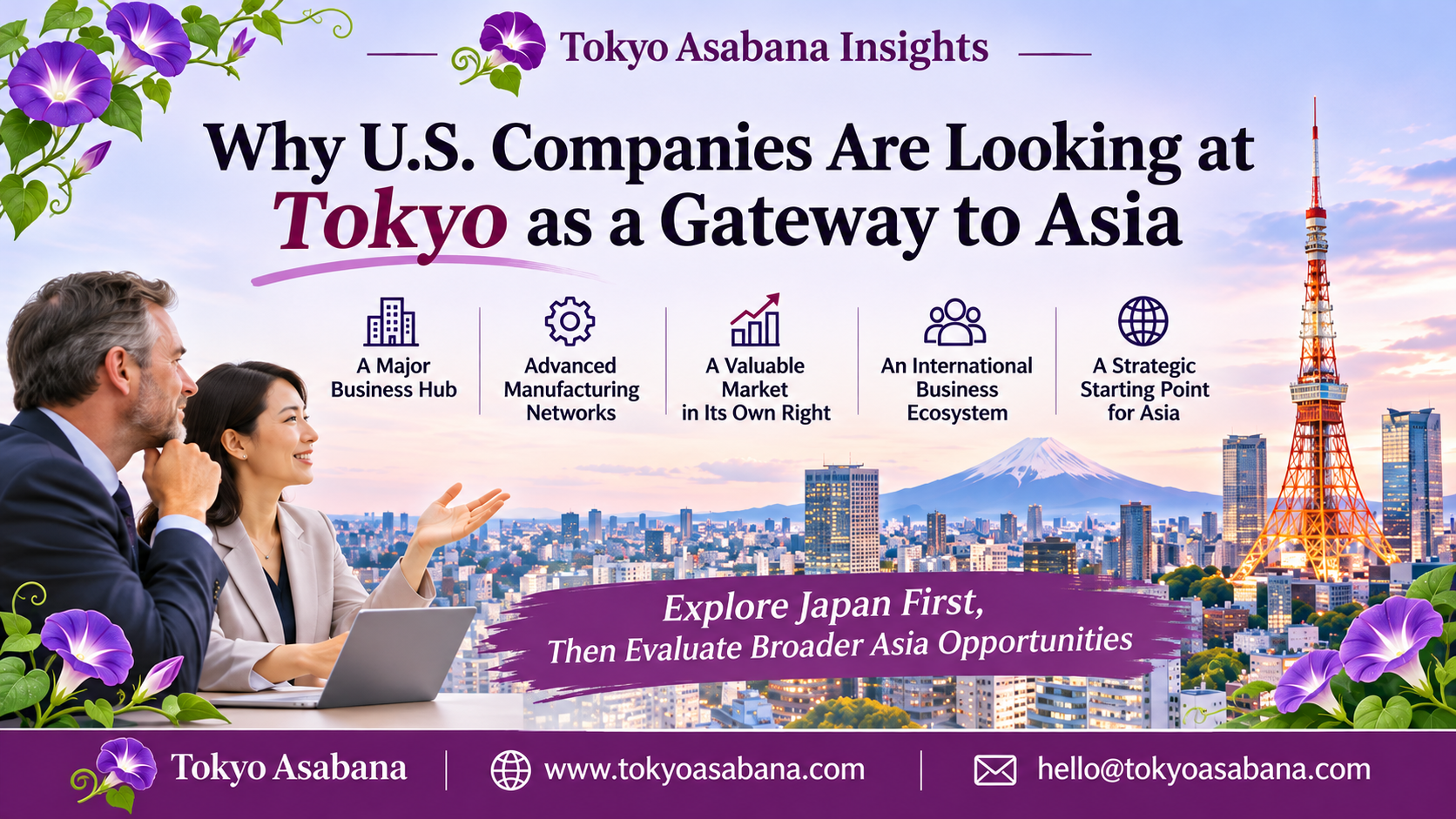
Why Tokyo Could Be a Strategic Starting Point for American SMEs Exploring Japan and Broader Asian Business Opportunities
Introduction: If Your U.S. Company Wants to Expand into Asia, Where Should You Start?
For American companies considering expansion into Asia, the first question is often geographical.
Should we begin in Singapore?
Should we focus on China, South Korea, or Southeast Asia?
Or could Tokyo be a strategic starting point?
There is no universal answer.
Asia is not a single market. Its economies differ significantly in customer behavior, industrial specialization, regulatory requirements, business culture, and commercial opportunities.
However, Tokyo deserves serious consideration, particularly for U.S. companies seeking access to Japanese customers, advanced manufacturing networks, established corporate partners, and a sophisticated business ecosystem.
For smaller American businesses, Tokyo may offer something especially valuable:
An opportunity to develop meaningful business relationships in one major Asian economy before committing to a broader regional expansion strategy.
But does a company need to establish a Tokyo office immediately?
Not necessarily.
Before making a substantial investment, U.S. SMEs can begin by researching Japanese market opportunities, identifying potential partners, and validating commercial demand through focused business development activities.
This article explores why Tokyo can serve as a strategic starting point, which companies may benefit most, where its limitations lie, and how American SMEs can test opportunities before building a permanent local team.
1. Tokyo Is One of Asia’s Major Business Decision-Making Centers
One of Tokyo’s most important advantages is the concentration of businesses and corporate decision-makers.
According to the Tokyo Metropolitan Government’s published investment information, Tokyo is home to approximately 76% of Japan’s foreign-affiliated companies under the source’s statistical definition.
The city also hosts a substantial concentration of major Japanese corporations.
For an American SME, this business environment can create opportunities to approach organizations involved in:
- Manufacturing and industrial supply chains
- Information technology and digital services
- Financial and professional services
- Education and training
- Business consulting
- Distribution and commercial partnerships
- Research and innovation
This does not mean that every relevant Japanese company is headquartered in Tokyo.
Many outstanding manufacturers operate in regional industrial areas throughout Japan.
However, Tokyo can provide a practical starting point for initial meetings, corporate introductions, and partner research.
An American company may begin its business development activities in Tokyo before arranging more specialized visits elsewhere in Japan.
Tokyo’s value is not simply its size. It is the concentration of business relationships and decision-making functions.
For companies without an established Japanese network, this concentration can be strategically useful.
2. Japan Is a Valuable Market — Not Just a Gateway to Somewhere Else
When discussing Tokyo as a gateway to Asia, it is important not to overlook Japan itself.
Japan is a major advanced economy with substantial business opportunities across multiple sectors.
For some American companies, success in the Japanese market may be a sufficient strategic objective without expanding into additional Asian countries.
Consider three hypothetical examples.
A U.S. Software Company
An American software provider may identify Japanese corporate customers that need its products.
Its main challenge may involve understanding local purchasing processes, communicating its value proposition, and establishing appropriate sales channels.
The immediate objective is not to enter every Asian market.
It is to determine whether Japanese customers will buy the software.
A U.S. Manufacturing Company
An American industrial business may want to establish relationships with Japanese manufacturers or specialized suppliers.
The company may be seeking manufacturing capabilities, technical cooperation, or supply chain diversification.
In this case, Japan’s industrial ecosystem is the primary commercial attraction.
A U.S. Education Company
An American education provider may want to develop relationships with Japanese educational institutions, training organizations, or commercial partners.
Its objective may involve international education services, corporate programs, or other educational partnerships.
Again, the Japanese market may be valuable in its own right.
A successful Japan market strategy does not need to be justified by immediate expansion into the rest of Asia.
For many U.S. SMEs, building one commercially viable international market is already a meaningful achievement.
3. Japan’s Advanced Manufacturing Ecosystem Can Be Attractive to U.S. Companies
Japan is particularly relevant to American businesses interested in industrial capabilities, manufacturing partnerships, and specialized suppliers.
Japanese companies operate across a wide range of manufacturing activities, including:
- Precision machining
- Industrial machinery
- Automotive components
- Electronics
- Production equipment
- Materials and industrial technologies
- Specialized manufacturing processes
For American manufacturers, these capabilities may create opportunities for sourcing, joint development, specialized production, or long-term commercial cooperation.
However, identifying suitable manufacturers can be more complicated than conducting an online search.
A Japanese company may have relevant capabilities but limited international sales resources.
Another manufacturer may primarily serve established domestic customers.
Some companies may be open to discussions with American buyers, while others may not have the capacity or commercial interest to accept additional overseas projects.
Why Local Communication Matters
A U.S. company may identify promising manufacturers but struggle to establish meaningful communication.
Potential challenges include:
- Finding the correct business contact
- Explaining technical or commercial requirements
- Presenting the proposed cooperation clearly
- Confirming whether the supplier is interested
- Arranging introductory meetings
- Coordinating visits to relevant facilities
- Maintaining communication after initial discussions
These are practical business development challenges.
They do not necessarily require an immediate Japanese subsidiary.
Depending on the circumstances, selected research, communication, and coordination activities may be handled through a local support provider.
For American manufacturers, Tokyo can serve as an initial business coordination base while relevant suppliers may be located throughout Japan.
4. International Companies Already Recognize Japan’s Regional Importance
Tokyo’s position in international business is not based solely on its domestic market.
Some multinational organizations also use Japan as a regional management or operational base.
JETRO’s 2023 survey of foreign-affiliated companies, published in 2024, reported that 22.2% of its respondents identified Japan as the location of their Asian headquarters.
Among respondents with North American parent companies, the figure was 26.7%.
These results reflect the companies surveyed and should not be interpreted as the proportion of all U.S. companies operating in Asia.
Nevertheless, they demonstrate that Japan is an established regional headquarters option for certain foreign businesses.
More recent research also highlights Japan’s continuing significance.
In February 2026, JETRO published its 2025 Survey on Business Operations of Foreign-affiliated Companies in Japan.
Among the surveyed businesses:
- 61.6% expected an operating profit for the current fiscal year.
- Approximately 60% intended to strengthen or expand their operations in Japan.
- Social, economic, and geopolitical stability received particularly strong evaluations.
- The perceived importance of Japan in light of geopolitical risks increased among European and North American respondents.
These findings do not prove that Tokyo is the best Asian headquarters for every American company.
They do, however, suggest that Japan continues to play an important strategic role for many international businesses already operating there.
For American SMEs considering overseas expansion, this raises a useful question:
Could an initial Japanese commercial presence support broader regional opportunities in the future?
The answer depends on the company’s industry, business model, and target countries.
5. Tokyo Offers Access to an Established International Business Ecosystem
A foreign company entering a new market needs more than potential customers.
It may also require professional services, research resources, business partners, communication support, and reliable local coordination.
Tokyo has an established ecosystem of organizations supporting international business activity.
These include:
Business and Professional Services
Accounting, legal, consulting, recruitment, and other professional service providers are present in the Tokyo metropolitan area.
International Business Organizations
Trade organizations, business associations, and international commercial networks can provide relevant information and potential connections.
Research and Innovation
Universities, research institutions, technology businesses, and industrial research organizations contribute to the region’s innovation environment.
Government-Supported Investment Services
The Tokyo Metropolitan Government operates initiatives intended to support foreign companies considering expansion into Tokyo.
JETRO also provides information and assistance relating to investment and business establishment in Japan.
These organizations can be useful resources for overseas companies evaluating their options.
However, public investment support and independent commercial execution services serve different purposes.
A company may obtain general information about entering Japan but still require practical assistance with targeted company research, business outreach, meeting arrangements, and follow-up.
Understanding the market is one challenge. Turning that understanding into organized commercial activity is another.
6. Tokyo or Singapore? The Right Gateway Depends on Your Business
Tokyo is not the only possible starting point for U.S. companies expanding into Asia.
Singapore is another major international business hub, particularly for companies targeting Southeast Asian markets.
The two cities may serve different strategic purposes.
| Business Consideration | Tokyo | Singapore |
| Primary Market Access | Japan | Singapore and many Southeast Asian regional networks |
| Business Environment | Strong concentration of Japanese corporations and industrial relationships | Strong international business and regional management ecosystem |
| Language | Japanese often important for domestic B2B engagement | English widely used in business |
| Manufacturing Opportunities | Access to Japan’s industrial and supplier networks | Access to regional supply chain and business networks |
| Potential Strategic Role | Japanese market entry and selected regional business functions | Regional management and ASEAN-oriented activities |
| Important Considerations | Localization, relationship development, hiring, and local operating requirements | Regional market differences, operating costs, and country-specific execution needs |
This is a qualitative comparison, not a ranking of the cities.
For a company focused on Southeast Asian markets, Singapore may be a better operational base.
For an American manufacturer whose immediate objective is to develop Japanese supplier relationships, Tokyo may be a more relevant starting point.
For an education or technology company, the decision may depend primarily on where its target customers are located.
The best gateway is not necessarily the most internationally famous city. It is the location that offers the strongest fit with your commercial objectives.
7. The Biggest Mistake: Assuming Japan Represents All of Asia
Although Tokyo can be a strategic gateway, American companies should avoid treating Japan as a substitute for understanding other Asian markets.
Success in Japan does not guarantee success in South Korea, China, Taiwan, Singapore, or Southeast Asia.
These markets differ in:
- Customer expectations
- Pricing structures
- Distribution systems
- Regulatory requirements
- Local languages
- Sales processes
- Competitive environments
- Business development channels
A value proposition that works for Japanese corporate customers may require substantial adaptation elsewhere.
Similarly, a Japanese distributor does not automatically provide commercial access to neighboring countries.
A Better Approach
An American company can use Japan to establish a strong local business relationship or gain experience operating in an Asian market.
But expansion into additional countries should be evaluated separately.
For example:
Stage 1: Validate demand in Japan.
Stage 2: Develop relevant Japanese business relationships.
Stage 3: Establish appropriate local commercial processes.
Stage 4: Assess whether any products, partnerships, or capabilities can support expansion into other Asian markets.
Stage 5: Conduct country-specific validation before further investment.
In this framework, Tokyo is a strategic starting point, not a shortcut around the complexities of Asia.
8. What Challenges Should U.S. SMEs Expect in Tokyo?
Tokyo offers substantial advantages, but entering the Japanese market is not effortless.
JETRO’s research highlights challenges facing foreign-affiliated companies, including exchange-rate volatility, hiring difficulties, and communication barriers.
For smaller American companies, additional considerations may include:
Language and Localization
An English-language website or sales presentation may not be sufficient for every Japanese customer segment.
Customer Acquisition
Overseas companies may need to identify relevant decision-makers and adapt their commercial approach.
Business Relationships
Initial introductions do not automatically become sales opportunities.
Recruitment and Operating Costs
Building an internal team creates recurring employment, management, and compliance responsibilities.
Market Competition
Japanese customers may already have established suppliers or alternative solutions.
Compliance Requirements
Depending on the industry, certain business activities may require registrations, licenses, or other specialized review.
None of these challenges automatically means an American company should avoid Japan.
Instead, they suggest that a market entry decision should be based on research and practical validation.
Tokyo’s business opportunities are real, but so are the costs of entering the market without sufficient preparation.
9. A Practical Strategy for U.S. SMEs: Start Small Before Building a Japan Team
For large corporations, establishing overseas offices may be part of a long-term international operating strategy.
For smaller American businesses, a more focused approach may be appropriate.
Rather than immediately hiring employees or establishing a local subsidiary, a company can consider a defined Japan market validation project.
Phase 1: Understand the Market
Begin with preliminary research.
Identify:
- Relevant Japanese customer groups
- Potential competitors
- Commercial requirements
- Possible business partners
- Market entry barriers
- Communication and localization needs
Phase 2: Test the Business Proposition
Prepare appropriate business materials and conduct targeted outreach.
The objective is to understand whether relevant Japanese organizations show genuine interest.
Useful questions include:
- Do potential customers understand the offer?
- Which segments respond?
- What objections appear?
- Are there practical barriers to cooperation?
- Which channels seem most promising?
Phase 3: Arrange Meaningful Discussions
Where mutual interest exists, coordinate appropriate business meetings.
These may take place online or in person.
For American executives traveling to Japan, local meeting and visit coordination can help organize the trip around confirmed activities.
Phase 4: Evaluate the Results
Review the information gathered.
Did the project identify qualified prospects?
Were meaningful conversations established?
What further information is required?
Does the business case justify additional investment?
Phase 5: Decide Whether to Expand
Possible next steps may include:
- Continuing targeted outreach
- Developing local partnerships
- Launching a larger market validation project
- Recruiting Japanese employees
- Establishing a local entity
- Postponing expansion until conditions improve
The objective is not to guarantee commercial success within a particular period.
It is to make the next investment decision using better evidence.
10. Which American SMEs May Benefit Most From a Tokyo-First Strategy?
A Tokyo-first approach may be worth considering for several types of American businesses.
U.S. Manufacturing SMEs
Companies seeking Japanese industrial partners, specialized suppliers, or manufacturing-related business relationships.
Tokyo may provide an initial coordination point for business discussions, while technical evaluations and supplier visits may take place elsewhere in Japan.
U.S. Technology Companies
Software, IT services, and digital solution providers exploring Japanese enterprise customers, implementation partners, or market validation opportunities.
U.S. Education Companies
Education service providers, training organizations, and international education businesses interested in Japanese institutional or commercial partnerships.
U.S. Professional Services Firms
Consulting, business services, and other specialized providers seeking Japanese clients or local cooperation partners.
For these companies, the critical question is whether Japan offers a strong match with their products, customer segments, and commercial strategy.
Tokyo can be especially relevant when the business opportunity requires relationships with Japanese organizations rather than simply geographic proximity to Asia.
11. How Tokyo Asabana Supports U.S. Companies Exploring Japan
Tokyo Asabana is an independent Japan-side business consulting and coordination service based in Tokyo.
We support overseas companies exploring Japanese market opportunities without necessarily establishing a permanent local team at the earliest stage.
Our experience includes paid Japan-related business advisory engagements with U.S.-based companies in the manufacturing and education sectors.
These engagements have provided experience in discussing overseas companies’ Japan-related objectives, assessing preliminary business opportunities, and identifying potential local support requirements.
Client-identifying details and confidential business information are not disclosed.
Depending on the agreed project scope, Tokyo Asabana offers the following services.
Japan Market Research and Preliminary Assessment
Research into Japanese market conditions, potential customer segments, competitors, and relevant business opportunities.
Market Validation Support
Helping overseas businesses structure limited research and outreach activities to test preliminary commercial assumptions.
Japanese Business Partner Research
Identifying potentially relevant Japanese companies, suppliers, customers, distributors, or other cooperation partners based on agreed criteria.
Japanese-Language Business Outreach
Preparing and coordinating approved inquiries, business introductions, and appropriate follow-up communication.
Business Meeting Coordination
Assisting with meeting requests, scheduling, communication arrangements, and practical local coordination.
On-Site Business Accompaniment
Tokyo Asabana can accompany overseas clients to Japanese companies, suppliers, business meetings, and other professional engagements in Japan.
Support may include business communication, meeting assistance, and local coordination.
Trilingual Business Communication
Tokyo Asabana provides business communication support in:
English | Japanese | Chinese
This helps overseas companies coordinate appropriate communication with Japanese organizations and international stakeholders.
Post-Meeting Follow-Up
Supporting agreed communication and coordination activities after business discussions.
Professional Network Coordination
Where specialized expertise is necessary, Tokyo Asabana may assist in identifying, contacting, and coordinating with relevant Japanese professionals.
Legal, tax, accounting, immigration, and other regulated professional services remain with appropriately qualified specialists.
Tokyo Asabana’s core services focus on Japan-side business activities. Expansion into other Asian countries would require separate country-specific assessment and appropriate local arrangements.
12. Do You Need a Tokyo Office Immediately?
For many U.S. SMEs, the first phase of Japan market exploration may not require a full-time local team.
A company may initially need only:
- Market research
- Business partner identification
- Japanese-language outreach
- Preliminary customer feedback
- Business meeting arrangements
- Local visit coordination
As business activity grows, a permanent local presence may become more appropriate.
Other companies may need employees, facilities, or registrations earlier because of their operating models or regulatory requirements.
The correct approach depends on the business.
A Tokyo office should be a response to a defined commercial and operational need — not simply the first item on an international expansion checklist.
This is the thinking behind Tokyo Asabana’s approach:
Your Japan Team — Before You Build a Japan Team.
13. Start With a Paid Corporate Consultation
If your U.S. company is considering Tokyo as a starting point for Japanese or broader Asian market opportunities, an initial consultation can help clarify your objectives.
Corporate Pre-Consultation — Online, 30 Minutes
JPY 4,400
An introductory consultation to discuss your company’s Japan-related business objectives and potential support requirements.
Corporate Advisory Consultation — Online, 60 Minutes
JPY 44,000
A more detailed advisory discussion covering Japanese market entry, potential customers and partners, research requirements, business development, and local coordination options.
The preliminary consultation fee may be credited toward a qualifying subsequent corporate service within 14 calendar days, subject to applicable terms.
Additional research, outreach, meeting coordination, and on-site accompaniment services are quoted separately according to the agreed project scope.
Tokyo Asabana does not guarantee customer responses, confirmed meetings, partnerships, commercial agreements, or specific market entry results.
Conclusion: Tokyo Can Be a Strategic Starting Point — If the Business Case Makes Sense
For American companies exploring Asia, Tokyo offers a combination of advantages.
It is a major business center, home to Japanese corporations and international companies, with access to sophisticated customers, industrial relationships, professional services, and research resources.
Japan also has commercial value as a market in its own right.
For U.S. manufacturing, technology, education, and professional services companies, Tokyo may provide a practical starting point for exploring Japanese customers and business partners.
However, Japan should not be mistaken for a universal gateway to every Asian market.
The best expansion strategy depends on the company’s commercial objectives, industry, target customers, budget, and operating requirements.
For smaller American businesses, the first step should not automatically be establishing a subsidiary or hiring a local sales team.
It may be more useful to begin with targeted research, a limited business development pilot, and appropriate Japan-side coordination.
Tokyo can be more than a destination. It can become a strategic starting point — when the opportunity is validated first.
At Tokyo Asabana, we help overseas companies explore Japanese business opportunities through professional research, trilingual communication, business outreach, meeting coordination, and on-site support.
Your Japan Team — Before You Build a Japan Team.
Considering Tokyo as Your First Step into Japan?
Whether your U.S. company is looking for Japanese manufacturing partners, enterprise customers, education-related partnerships, or practical local business support, Tokyo Asabana can help you clarify your next steps.
Start with a paid corporate consultation and explore whether a focused Japan market validation project is appropriate for your business.
Website: https://www.tokyoasabana.com
Services & Transparent Pricing: https://tokyoasabana.stores.jp/
Email: hello@tokyoasabana.com
References and Further Reading
JETRO — 2025 Survey on Business Operations of Foreign-affiliated Companies in Japan (Published February 26, 2026)
https://www.jetro.go.jp/en/news/releases/2026/4e5eb959d969f9fd.html
JETRO — 2023 Survey on Business Operations of Foreign-affiliated Companies in Japan (Published March 2024)
https://www.jetro.go.jp/en/news/releases/2024/49fdc5bc4c61f322.html
Tokyo Metropolitan Government — Tokyo’s Urban Strength
https://www.investtokyo.metro.tokyo.lg.jp/en/whytokyo/tokyos-urban-strength.html
Tokyo Metropolitan Government — Invest Tokyo
https://www.investtokyo.metro.tokyo.lg.jp/en/about/index.html
Disclaimer: This article provides general strategic business information rather than a guarantee of market performance or professional legal, tax, immigration, or financial advice. Survey statistics reflect their respective reporting periods, respondents, and definitions. Japan market entry does not automatically provide access to other Asian markets, and individual country requirements should be evaluated separately.
Related Reading
Tokyo Asabana Services|Before Committing JPY 42–46 Million, Validate the Market First