
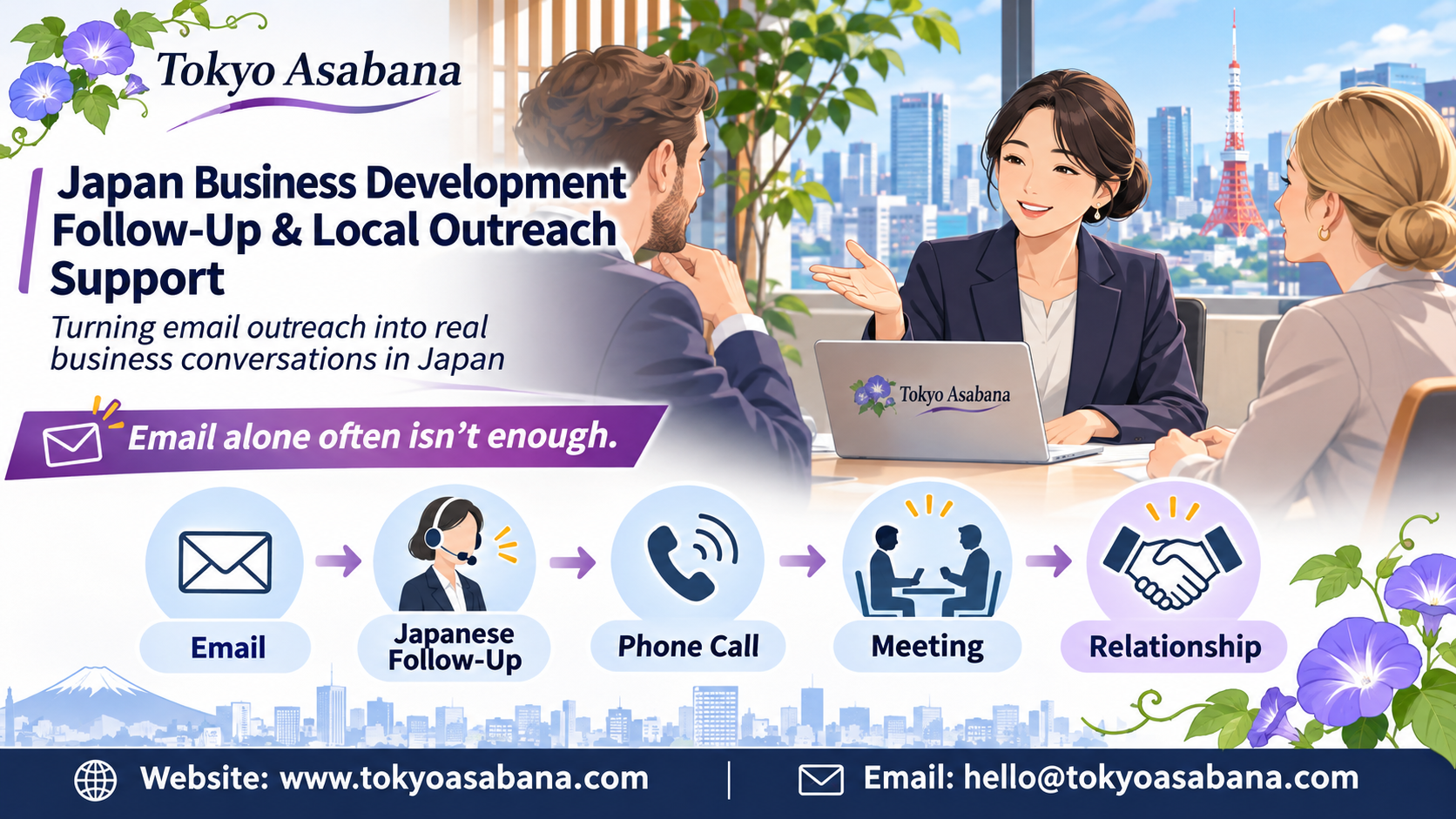
For overseas companies trying to develop business in Japan, sending emails is often only the first step.
A well-written English email may still receive no reply.
The problem is not always the quality of your company, product, or proposal.
Sometimes the real problem is simpler:
Your message never reaches the right person.
It may be filtered as spam.
It may be ignored because it arrives in English.
It may reach a general inbox that nobody actively monitors.
Or the Japanese side may simply hesitate to respond because there is no local contact person behind the message.
This is why Tokyo Asabana provides Japan-side business development follow-up and local outreach support for overseas companies.
Our role is not simply to send another email.
Our role is to help turn a cold overseas message into a real business conversation.
Why Email Alone Often Does Not Work in Japan
Email is useful.
But for business development in Japan, email alone is often not enough.
There are several common reasons.
1. English Emails May Be Filtered or Ignored
Japanese companies receive many unsolicited messages.
An unexpected English email from overseas may be:
- filtered into spam
- treated as a mass sales message
- overlooked by a general contact desk
- forwarded internally without action
- ignored because the recipient is uncomfortable replying in English
This means a potentially valuable business opportunity may disappear before anyone seriously evaluates it.
2. Email-Only Outreach Can Feel Too Distant
If an overseas company sends only one email and waits, the Japanese side may not know:
- whether the sender is serious
- whether the company really understands Japan
- whether someone will be available locally
- whether communication will become difficult later
- whether this is simply another mass outreach campaign
A short, professional Japanese follow-up can change that impression.
It shows:
There is a real company behind the message.
There is someone who can communicate locally.
The project is serious enough to follow up properly.
That difference matters.
3. Japanese Phone Follow-Up Can Build Trust Faster
A short phone call in Japanese can sometimes solve problems that several emails cannot.
The purpose is not aggressive sales.
The purpose is to reduce uncertainty.
A local follow-up call can help confirm:
- whether the email was received
- whether it reached the right department
- who the correct contact person is
- whether the company is interested
- whether more information is required
- whether a meeting may be possible
- whether the timing is simply not right
Even when the answer is “not now,” this information is useful.
It turns silence into market feedback.
Tokyo Asabana’s Approach
Our approach is simple:
Email → Japanese Follow-Up → Phone Call → Meeting → Relationship
Rather than repeatedly sending unanswered emails, Tokyo Asabana can help overseas companies create a more human and locally credible outreach process.
Depending on the project, support can include:
- reviewing the initial outreach message
- adapting messaging for Japanese business context
- identifying the appropriate contact point
- Japanese-language follow-up
- phone confirmation
- clarifying the purpose of the inquiry
- checking whether the company is open to discussion
- coordinating meetings
- supporting follow-up after the meeting
The goal is not to pressure Japanese companies.
The goal is to help your message reach a real person and create the conditions for a meaningful business conversation.
What Tokyo Asabana Can Do
1. Outreach Review
Before contacting Japanese companies, Tokyo Asabana can review the proposed message and help improve:
- clarity
- business purpose
- positioning
- relevance to the Japanese target
- next-step request
A message that is too broad, too long, or too generic may reduce response rates.
The Japanese side should quickly understand:
Who are you?
Why are you contacting us?
Why is this relevant to our company?
What would you like us to do next?
2. Japanese-Language Follow-Up
If the initial outreach is sent in English, Tokyo Asabana can provide Japan-side follow-up in Japanese.
This may include:
- confirming receipt
- introducing the overseas company again
- explaining the purpose of the inquiry
- checking internal routing
- clarifying the requested next step
This can be particularly useful when the original recipient is unsure how to respond in English.
3. Phone Follow-Up
Where appropriate, Tokyo Asabana can contact the Japanese company by phone.
The purpose may be to:
- confirm whether the email was received
- identify the correct department
- confirm the correct person in charge
- explain the business purpose
- ask whether the company is open to further discussion
- request a meeting
- understand whether additional materials are needed
This is not telemarketing.
It is business-development follow-up for a defined B2B target.
4. Contact Point Identification
One of the most common problems in Japan market development is contacting the wrong person.
The official website may list only:
- a general inquiry form
- a representative phone number
- a generic email address
- a department unrelated to your project
Tokyo Asabana can help identify the most appropriate contact route based on the business objective.
For example:
- Business Development
- Overseas Business
- Procurement
- Sales
- Partnerships
- Corporate Planning
- International Relations
- R&D
- University administration
- Industry collaboration teams
The correct contact point can make a significant difference.
5. Meeting Coordination
When interest is confirmed, Tokyo Asabana can help coordinate the next step.
This may include:
- arranging the meeting
- confirming attendees
- clarifying the meeting purpose
- confirming language requirements
- sharing necessary materials
- coordinating online or in-person meetings
For visiting overseas executives, Tokyo Asabana can also provide Japan-side meeting and on-site business support depending on the project.
When Is This Service Useful?
This service may be useful when your company is:
- entering the Japanese market for the first time
- testing demand before building a local team
- contacting Japanese manufacturers
- searching for suppliers
- looking for distributors or partners
- approaching Japanese universities
- developing education partnerships
- contacting corporate clients
- preparing a Japan business visit
- following up after an exhibition or conference
- receiving no response from Japanese targets
It is particularly relevant for overseas SMEs that do not yet have a full-time Japan sales or business development team.
Why Local Follow-Up Matters
The value of local follow-up is not simply language.
It is context.
A Japanese-language phone call signals that the overseas company has invested effort into the relationship.
It reduces the psychological distance between both sides.
It also gives the Japanese company a simpler way to ask questions.
Instead of wondering:
“Who is this overseas company?”
they can speak with someone locally and understand:
“This is what they want. This is why they contacted us. This is what the next step would be.”
That can make the conversation much easier.
From Silence to Information
One of the biggest problems in overseas business development is silence.
Silence gives you no data.
You do not know whether:
- the email was ignored
- the company is uninterested
- the contact person changed
- the message went to spam
- the timing is wrong
- the company wants more information
- the proposal is not relevant
- nobody understood the request
Follow-up helps turn silence into information.
Even a rejection can be valuable.
Why?
Because now you know.
You can refine your target list, change your message, adjust your offer, or focus on companies with stronger interest.
Business development is not only about getting “yes.”
It is also about reducing uncertainty.
Not Every Company Should Be Chased
Tokyo Asabana does not recommend endlessly contacting companies that have clearly declined.
Professional follow-up should respect the other party.
A reasonable process may include:
- initial outreach
- one or more appropriate follow-ups
- phone confirmation where suitable
- final status check
- close or pause the lead if there is no fit
The objective is not to pressure the target.
The objective is to determine whether there is a real business opportunity.
A Typical Workflow
A Japan BD follow-up project may look like this:
Step 1 — Define the Target
Confirm which Japanese companies should be contacted and why.
Step 2 — Review the Message
Make sure the outreach is specific and understandable.
Step 3 — Send Initial Outreach
The overseas company or Tokyo Asabana sends the initial message according to the agreed project scope.
Step 4 — Japanese Follow-Up
Tokyo Asabana follows up in Japanese where appropriate.
Step 5 — Phone Confirmation
If email alone does not generate a clear response, a phone call may be used to confirm status.
Step 6 — Record Feedback
Responses, objections, interest level, and required next actions are organized.
Step 7 — Arrange Meetings
Qualified opportunities move to online or in-person discussion.
Step 8 — Follow Through
Tokyo Asabana can continue supporting communication, coordination, meetings, and follow-up depending on the project.
What We Can Learn From Outreach
A good outreach project should produce more than appointments.
It should also generate market intelligence.
For example:
- Which types of Japanese companies respond?
- Which messages generate interest?
- Which objections appear repeatedly?
- Is the product understood?
- Is the pricing model acceptable?
- Which industries appear most promising?
- Who is the real decision-maker?
- Is the overseas company targeting the right segment?
This is why outreach can also function as a form of market validation.
For Overseas SMEs: You May Not Need a Japan Team Yet
An overseas company exploring Japan may not immediately need:
- a Japanese subsidiary
- a Tokyo office
- a full-time salesperson
- a local country manager
But you may still need someone who can:
send the right message
call the right person
speak Japanese
follow up locally
coordinate the meeting
help keep the conversation alive
That is where Tokyo Asabana fits.
Our approach is:
Your Japan Team — Before You Build a Japan Team.
Related Japan Business Support
Tokyo Asabana can also support overseas companies with:
- Japan market research
- target company research
- supplier research
- partner search
- business development support
- Japanese-language outreach
- meeting coordination
- factory visit coordination
- on-site business accompaniment
- hotel-to-hotel executive support
- post-meeting debrief
- follow-up coordination
- Japan market-entry advisory
Services are structured according to the actual project requirements.
Frequently Asked Questions
Can you guarantee a response from a Japanese company?
No.
No business-development provider can guarantee that a target company will respond or agree to a meeting.
Tokyo Asabana helps improve the outreach process, identify the correct contact route, follow up locally, and reduce communication friction.
Can you call Japanese companies on our behalf?
Yes, depending on the project scope.
Phone outreach should have a clear business purpose and defined target list.
Can you communicate in Japanese and English?
Yes.
Tokyo Asabana supports Japanese and English business communication. Chinese support is also available.
Can you attend the meeting after arranging it?
Yes, depending on the project.
Tokyo Asabana can provide meeting accompaniment, on-site business support, and post-meeting debrief.
Can you contact companies that have never heard of us before?
Depending on the scope, Tokyo Asabana can support targeted B2B outreach.
The approach should be specific and relevant rather than mass unsolicited messaging.
Do you provide telemarketing services?
Tokyo Asabana is not positioned as a mass call center or high-volume telemarketing provider.
Our focus is targeted Japan-side B2B business development, communication, and coordination for overseas companies.
Conclusion
For overseas companies entering Japan, sending an email is easy.
Getting the right person to read it, understand it, trust it, and respond is much harder.
That is why Japan business development often requires more than:
Send → Wait → Follow Up by Email → Wait Again
A more effective process may be:
Email → Japanese Follow-Up → Phone Call → Meeting → Relationship
Sometimes your product is not the problem.
Sometimes your message simply needs help reaching a human being.
Tokyo Asabana supports overseas companies by providing that local connection.
Tokyo Asabana — Japan Business Development Support
If your company is exploring the Japanese market and needs local support with outreach, follow-up, meetings, or business coordination, please contact Tokyo Asabana.
Your Japan Team — Before You Build a Japan Team.
Website: https://www.tokyoasabana.com
Services & Transparent Pricing: https://tokyoasabana.stores.jp/
Email: hello@tokyoasabana.com
Related Reading
Tokyo Asabana Services|How U.S. SMEs Can Arrange Business Meetings and On-Site Support in Japan
Tokyo Asabana Services|How U.S. Companies Can Find and Visit Japanese Suppliers