
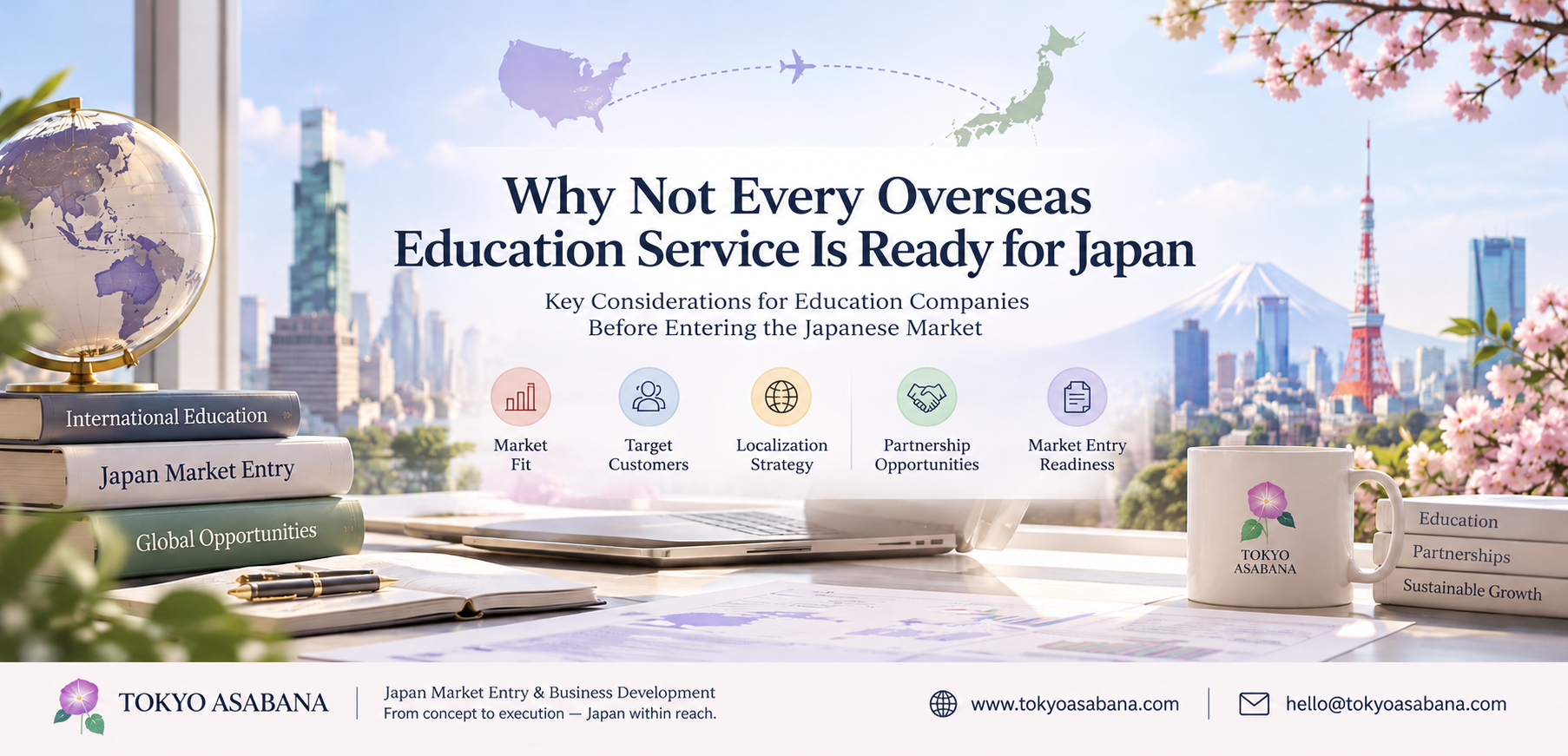
Japan is an attractive market for overseas education companies. It has established educational institutions, families willing to invest in education, and students interested in international opportunities.
However, having a successful education business overseas does not automatically mean that the same service will succeed in Japan.
Before asking how to enter Japan, overseas education companies should first ask whether their services are ready for the Japanese market.
This distinction can save considerable time, money, and effort.
1. A Successful Overseas Business Model May Not Fit Japan
Education is closely connected to local institutions, career pathways, qualifications, and family expectations.
A service that is highly valuable in one country may address a much smaller customer segment in another.
For example, some overseas education services are designed around specific university admission systems or professional career pathways. These systems may differ significantly from those in Japan.
If students intend to build their careers in Japan, the advantages of an overseas education pathway may need to be considered alongside local qualification requirements, employment opportunities, and financial commitments.
Market entry begins with understanding whether the service solves a meaningful problem for customers in Japan.
2. The Target Customer Must Be Clearly Defined
“Japanese students” is not a single customer segment.
Potential customers may include families considering overseas education, students attending international schools, university students exploring graduate study abroad, or professionals seeking further qualifications.
Their needs, budgets, language abilities, and decision-making processes can be very different.
A company may have an attractive service but struggle to identify the right customers.
For overseas education businesses, defining a realistic target segment is often more useful than attempting to reach the entire Japanese market.
The key question is not simply whether Japanese customers might be interested.
It is which customers have a specific need, sufficient motivation, and the ability to purchase the service.
3. Language Is Only One Part of Market Readiness
Japanese-language marketing can help an overseas company communicate with local customers.
However, translation alone is not a complete localization strategy.
Education services often require clear explanations of their value, expected outcomes, application processes, service limitations, and pricing.
Families may also expect information about the provider’s experience, communication arrangements, and how support will be delivered across borders.
An overseas company should consider whether its service can be explained and delivered effectively to customers in Japan.
Localization is not just about changing the language. It is about making the service understandable, relevant, and practical in a different market.
4. Market Interest Does Not Automatically Become Sales
A potential customer may express interest in studying overseas without being ready to purchase a consulting service.
Similarly, an educational institution may be open to learning about an overseas provider without being prepared to establish a commercial partnership.
These differences matter.
Initial interest, qualified demand, and actual purchasing decisions are separate stages.
Overseas companies should avoid assuming that positive conversations will automatically lead to paying customers or institutional agreements.
Before committing to large-scale business development, it is important to evaluate whether there is a realistic route from market interest to commercial results.
5. Local Partnerships Require a Clear Value Proposition
Partnership development can be an important part of entering Japan, but simply contacting schools, universities, or other organizations is not enough.
A potential Japanese partner needs to understand why the proposed collaboration is relevant to its students, customers, or business objectives.
The overseas provider should also be clear about its responsibilities, expected contributions, commercial structure, and available resources.
Without a practical value proposition, even a well-introduced partnership opportunity may not progress.
Effective business development requires more than access to contacts. It requires a reason for both sides to work together.
6. Market Entry Requires Resources and Realistic Expectations
Some overseas companies hope to enter Japan primarily through referrals or commission-based partnerships.
Occasional referrals may create opportunities, but they are not necessarily a reliable substitute for structured market development.
Market research, localization, partner identification, outreach, follow-up, and coordination all require time and professional resources.
Companies should consider their objectives, budget, internal capacity, and expected timeline before beginning active market development.
A limited initial assessment may be appropriate for companies still exploring Japan. Others may be ready for a defined research project or a longer-term business development engagement.
The right approach depends on the company’s stage of readiness.
7. Sometimes the Best Advice Is to Wait
Not every overseas education company needs to enter Japan immediately.
In some cases, a company may benefit from refining its service offering, identifying a more specific customer segment, or strengthening its international delivery capabilities before investing in a new market.
In other cases, a focused market test may be more appropriate than a large-scale expansion plan.
A professional market entry assessment should be able to identify both opportunities and limitations.
The purpose of good advisory work is not to sell expansion at any cost. It is to support better business decisions.
How Tokyo Asabana Supports Overseas Education Companies
Tokyo Asabana provides Japan market entry advisory and business development support for overseas organizations, including companies in the education sector.
Our services can be structured in three stages:
Stage 1 — Japan Market Entry Assessment
An initial evaluation of business objectives, market suitability, potential customers, and possible directions.
Stage 2 — Market Validation & Research
More detailed research into market conditions, customer segments, competitors, positioning, and potential business channels.
Stage 3 — Japan-side Business Development
Practical support for local partner development, outreach, follow-up, multilingual communication, and project coordination.
Each stage is arranged according to the company’s needs and an agreed scope of work. Active research and business development services are fee-based, and commercial outcomes cannot be guaranteed.
Is Your Education Service Ready for Japan?
Japan may offer valuable opportunities for overseas education companies, but the right strategy begins with understanding the market rather than assuming demand.
Before investing in expansion, consider whether your service has a clearly defined customer, a compelling local value proposition, and the resources needed to develop the market.
Tokyo Asabana helps overseas companies evaluate these questions and explore practical approaches to Japan market entry.
From concept to execution — Japan within reach.
Tokyo Asabana | Japan Market Entry & Business Development
Website: https://www.tokyoasabana.com
Services & Transparent Pricing: https://tokyoasabana.stores.jp/
Email: hello@tokyoasabana.com
Related Reading
Tokyo Asabana B2B Case Study |A Paid Japan Market Entry Consultation with a U.S. Education Company