
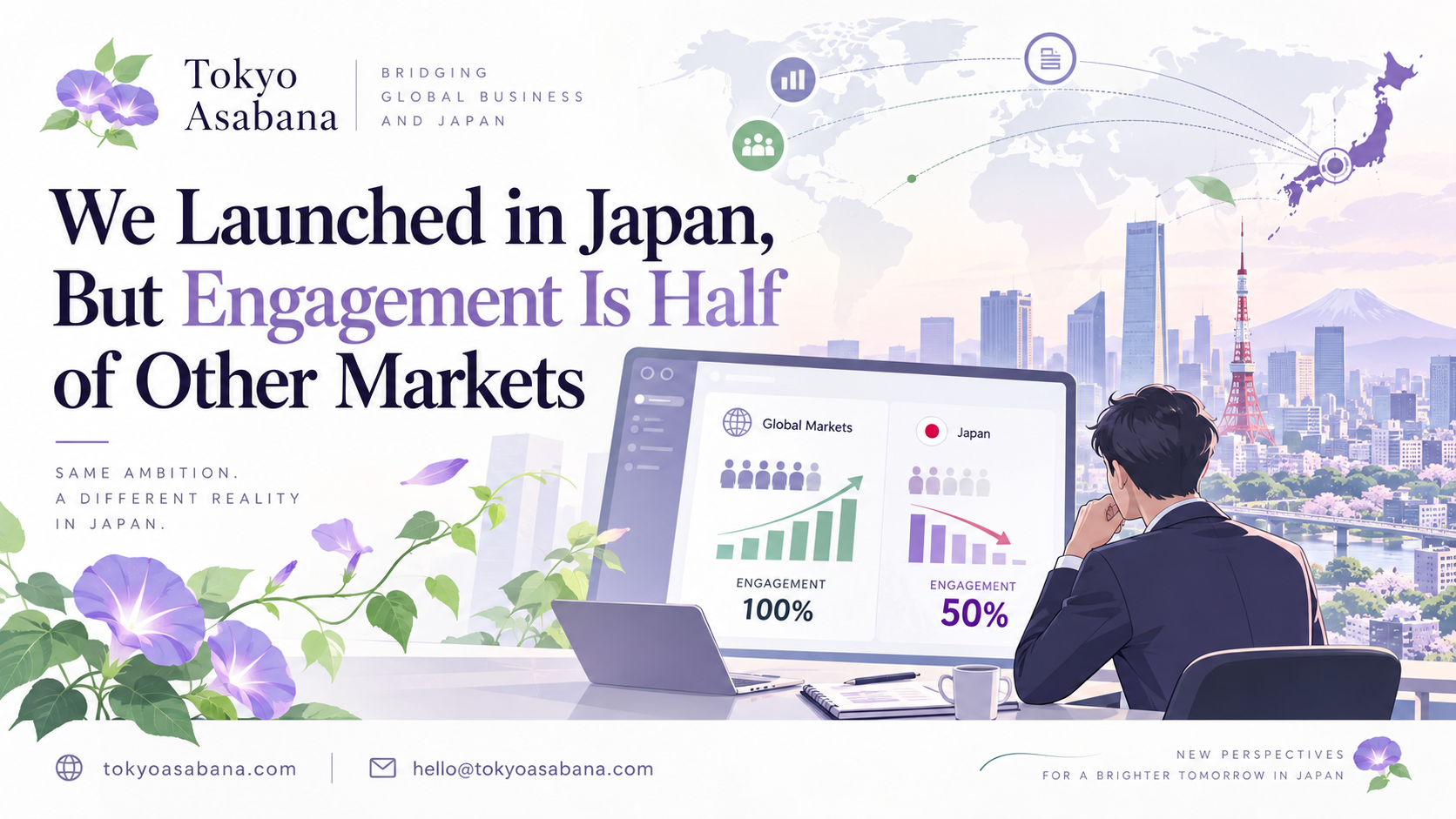
Entering Japan can be an exciting opportunity for an overseas company.
The market is large, consumers have substantial purchasing power, and many Japanese businesses are open to international products and services.
However, some overseas companies encounter a frustrating problem after launching:
“We launched in Japan, but customer engagement is only half of what we see in other markets. What went wrong?”
Their websites are accessible in Japan. Their products are available. Their marketing campaigns are running.
Yet Japanese visitors are less likely to submit inquiries, book meetings, register for services, or become paying customers.
Does this mean Japan is not a suitable market?
Not necessarily.
Low engagement may indicate that a company’s existing approach does not match Japanese customer expectations.
For overseas small and medium-sized enterprises (SMEs), identifying the reasons before investing further can prevent unnecessary costs.
1. Market Entry Does Not Automatically Mean Market Fit
A business model that performs well in Singapore, Australia, the United States, or Europe may not produce the same results in Japan.
Even when the underlying product or service is identical, customers may differ in how they evaluate unfamiliar companies, compare alternatives, and make purchasing decisions.
For example, an overseas B2B company may receive quick responses to introductory emails in its home market.
In Japan, the same messages may receive little engagement.
Possible explanations include:
- The value proposition is not sufficiently localized.
- The target audience has different priorities.
- The company lacks recognizable local references.
- The communication approach does not match customer expectations.
- Potential customers are interested but need additional information before responding.
A successful launch means the company has entered the market. It does not necessarily mean the market has accepted its offering.
These are two different stages of business development.
2. Language Localization Is More Than Translation
One common mistake is assuming that translating an English website into Japanese is enough.
Translation makes information accessible.
Localization makes information relevant.
Japanese customers may expect clear explanations of service scope, pricing, implementation procedures, customer support, and company credibility.
For example, an overseas company might advertise:
“We provide innovative solutions to accelerate your business growth.”
Although grammatically correct, this statement does not explain what the company actually does.
A more practical presentation would describe:
- Which business problems the service solves
- Who the intended customers are
- How implementation works
- What customers receive
- What happens after an inquiry
For B2B services, industry-specific terminology and examples can also be important.
Companies should review not only the language of their websites but also their proposals, inquiry forms, email templates, and follow-up communications.
3. Customers May Need More Information Before Engaging
Overseas companies sometimes interpret low response rates as a lack of interest.
However, customer hesitation can have several explanations.
A Japanese prospect may be interested in a service but uncertain about the company’s ability to support customers locally.
Typical questions might include:
- Does the company have experience with Japanese customers?
- Is Japanese-language communication available?
- Who will handle problems after purchase?
- Are prices and contractual terms clear?
- Does the company understand Japanese business practices?
If these questions remain unanswered, potential customers may leave without making an inquiry.
For overseas SMEs without an established Japanese office, this can be especially challenging.
The solution is not necessarily to establish a local subsidiary immediately.
A company can first improve its information, communication processes, and local coordination capabilities.
4. The Wrong Customer Acquisition Channel Can Reduce Engagement
Another possibility is that the company is reaching the wrong audience or using an unsuitable channel.
A marketing strategy that works well in one country may not reach decision-makers effectively in Japan.
For example, a company may rely heavily on:
- English-language advertising
- International professional networks
- Cold email campaigns
- Overseas referral partners
- Social media channels
These methods can be useful, but their effectiveness depends on the industry, customer segment, and purchasing process.
An English-language campaign might attract international residents while missing Japanese corporate buyers.
Similarly, a message directed at general company information addresses may never reach the relevant decision-maker.
Before increasing advertising or outreach budgets, overseas companies should examine whether their current activities are reaching the customers they actually want.
More outreach does not automatically produce better market penetration.
5. Pricing and Service Expectations May Be Different
Lower engagement can also reflect uncertainty about pricing or service delivery.
An overseas company may offer competitive prices in its home market but struggle to communicate its value in Japan.
Potential customers may compare the service against local alternatives that offer different support arrangements, contract structures, or payment terms.
For service businesses, customers may also need to understand what is included in the quoted price.
For example:
Does the price include Japanese-language support?
Is implementation assistance included?
Are additional charges expected?
What happens if the customer needs modifications?
Clear answers can reduce uncertainty and make it easier for prospects to evaluate the offering.
Overseas SMEs should avoid assuming that lower prices alone will solve engagement problems.
Sometimes the issue is not the amount being charged, but the way the value and conditions are communicated.
6. Identify Where Customer Engagement Actually Drops
Before changing a Japan market entry strategy, companies should identify the precise point where customer engagement falls.
Consider the following examples:
| Situation | Possible Issue | What to Examine |
| Website traffic is low | Limited market visibility | Search visibility, targeting, acquisition channels |
| Traffic is reasonable, but inquiries are low | Weak conversion or unclear value | Landing pages, language, pricing, trust signals |
| Inquiries arrive, but few meetings are booked | Communication friction | Response times, scheduling, qualification process |
| Meetings happen, but sales do not close | Product-market or commercial mismatch | Proposal quality, pricing, decision process |
| First purchases occur, but repeat business is low | Customer experience or retention issues | Delivery quality, support, expectations |
These are diagnostic possibilities, not universal explanations.
For example, if website traffic from Japan is comparable to other markets but the inquiry conversion rate is significantly lower, the company should examine its Japanese landing pages and inquiry process before simply increasing advertising expenditure.
It is also important to compare equivalent metrics.
A Japanese campaign generating fewer inquiries is not necessarily underperforming if it attracts more qualified prospects or produces higher-value contracts.
Engagement should be evaluated alongside lead quality, conversion rates, acquisition costs, and actual revenue.
7. Do Not Expand Your Budget Before Understanding the Problem
When an overseas company sees disappointing results in Japan, the immediate reaction may be to invest more.
More advertising.
More sales emails.
More translated materials.
More business development activities.
However, additional spending can amplify an ineffective strategy.
A more practical approach is to conduct a focused review.
For example, an overseas SME could:
- Compare customer behavior in Japan with its strongest existing markets.
- Identify where visitors or prospects disengage.
- Review Japanese-language communications and service descriptions.
- Examine local competitors and alternative solutions.
- Reassess customer segments and acquisition channels.
- Test a limited number of improvements before expanding investment.
This process does not require an immediate commitment to a large market entry project.
For smaller companies, a targeted initial assessment may be more appropriate than building a local team before the business opportunity has been validated.
8. How Local Japan-Side Support Can Help
Not every overseas company needs a large consulting firm, local distributor, or Japanese subsidiary at the beginning of its market entry journey.
Depending on the situation, a company may initially benefit from more focused assistance.
This could include:
- Reviewing market entry assumptions
- Researching customer segments and competitors
- Identifying potential local business partners
- Supporting Japanese-language business communication
- Coordinating meetings and stakeholder discussions
- Assisting with selected local business development activities
The appropriate support depends on the company’s industry, objectives, budget, and current progress.
Tokyo Asabana provides Japan-side business advisory and coordination services for overseas companies, including SMEs exploring or developing opportunities in Japan.
Services can begin with a paid consultation to clarify the company’s situation and priorities. Research, outreach, coordination, and other project-based work can be discussed and quoted separately according to the agreed scope.
Conclusion: Low Engagement Is a Signal, Not a Final Verdict
If your company has launched in Japan but customer engagement is significantly lower than in other markets, it may be too early to conclude that Japan is the wrong market.
The issue could involve localization, customer targeting, pricing, communication, trust, or the acquisition process.
Different problems require different solutions.
For overseas SMEs, the priority should be to understand where the gap exists before committing additional resources.
Entering Japan is one challenge. Building a commercially viable presence in Japan is another.
A focused assessment can help determine what should be improved, tested, or reconsidered next.
Exploring the Japanese Market?
Tokyo Asabana supports overseas companies with Japan market entry advisory, local business research, business communication, and coordination services.
If your company is experiencing low engagement in Japan or is considering its next market entry steps, you can start with a paid corporate consultation.
Website: https://www.tokyoasabana.com
Services & Transparent Pricing: https://tokyoasabana.stores.jp/
Email: hello@tokyoasabana.com
Related Reading
Tokyo Asabana Insights|Why Customer Engagement Drops After Entering the Japanese Market
Tokyo Asabana Insights|Why a Successful Business Overseas May Struggle in Japan