
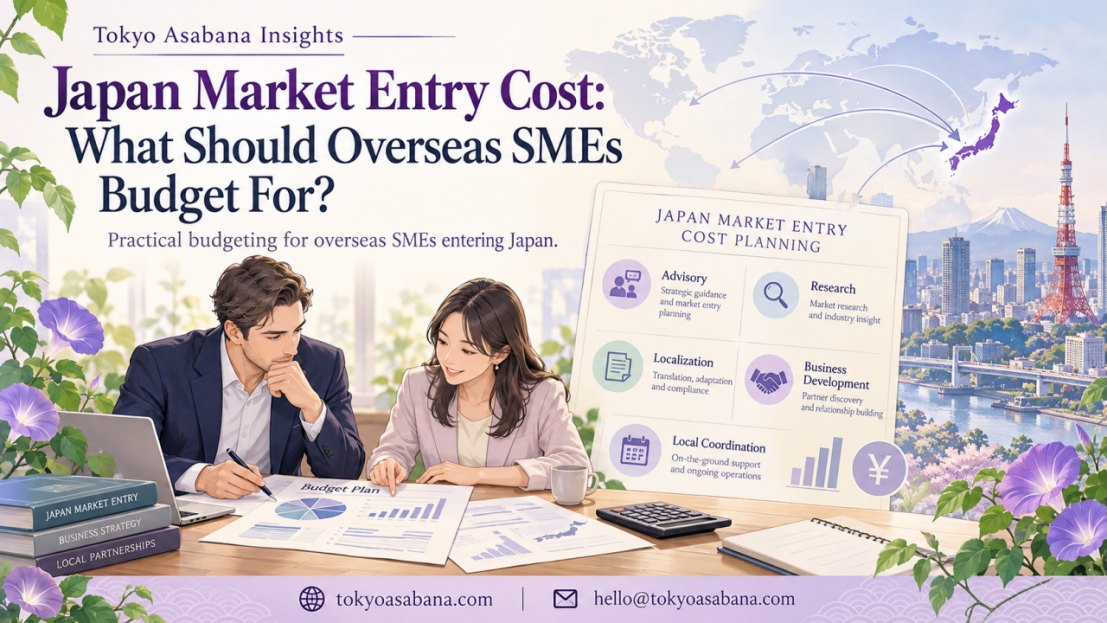
Japan is an attractive market for many overseas companies, but entering it requires more than an appealing product or a translated website.
One of the first questions small and medium-sized enterprises (SMEs) ask is:
How much does it actually cost to enter the Japanese market?
Should a company budget for market research, Japanese-language localization, business development, local partnerships, or even establishing a subsidiary?
The answer depends on what the company is trying to achieve.
For overseas SMEs, Japan market entry does not necessarily require a large upfront investment. However, it does require a realistic understanding of which activities generate costs and which should come first.
Rather than starting with a fixed budget, companies should identify the specific business problems they need to solve.
1. Japan Market Entry Is Not a Single Expense
A common misconception is that entering Japan involves one major investment, such as registering a company or hiring a local representative.
In reality, Japan market entry costs can arise at several different stages.
These may include:
- Initial market advisory and feasibility discussions
- Industry and competitor research
- Customer and partner identification
- Website and business material localization
- Business development and outreach
- Meetings, interpretation, and local coordination
- Legal, accounting, licensing, and company establishment
- Marketing, sales operations, and ongoing customer support
Not every overseas company needs all these services.
For example, an established software company looking for potential Japanese business partners has different requirements from a manufacturer planning to establish a local sales subsidiary.
Similarly, an overseas education provider exploring Japanese customer demand may initially need market positioning and partner research rather than a physical office.
The right budget depends on the market entry model, not simply the size of the Japanese economy.
2. Initial Advisory: A Lower-Commitment Starting Point
Before committing to a major project, many SMEs benefit from an initial professional consultation.
An advisory session can help a company clarify:
- Whether Japan fits its current business objectives
- Which customer segments may be relevant
- What local market information is missing
- Whether a distributor, partner, consultant, or local team may be appropriate
- What should be investigated before further investment
- Which activities are likely to require separate budgets
A consultation is especially useful when a company has several possible directions but has not decided which one to pursue.
However, companies should distinguish between initial advisory and detailed project delivery.
A short consultation is not the same as a completed market research report or an executed business development campaign.
At Tokyo Asabana, our standard corporate consultation options include:
- 30-minute preliminary consultation: JPY 4,400
- 60-minute corporate advisory consultation: JPY 44,000
The JPY 4,400 preliminary consultation fee may be credited toward a further paid consultation for the same agreed scope within 14 calendar days, subject to applicable terms.
These are Tokyo Asabana’s published consultation fees, not general market averages.
Research, outreach, and other project-based services are separately scoped and quoted.
3. Market Research: Budget According to the Questions You Need Answered
Market research is often one of the first substantial expenses for overseas companies considering Japan.
However, research requirements vary considerably.
A company might need a basic competitor overview, while another may require a detailed assessment of a particular industry, customer segment, or partnership landscape.
Typical research activities include:
- Identifying relevant Japanese competitors
- Comparing products, services, and pricing
- Researching customer segments
- Examining industry-specific business practices
- Identifying potential distributors or partners
- Preparing structured target company lists
The cost depends on the depth of research, available information, language requirements, and deliverables.
For example, preparing a limited list of potential Japanese partners is different from conducting a comprehensive market feasibility study.
Overseas SMEs should define their questions before commissioning research.
A useful starting point is:
What decision will this research help us make?
If the company cannot answer that question, the research scope may be too broad.
4. Localization: More Than Translating a Website
Localization is another important component of Japan market entry costs.
Some overseas companies assume that an English-to-Japanese translation is sufficient.
However, effective localization may involve adapting how information is presented, not just changing the language.
Possible expenses include:
- Website translation and content adaptation
- Japanese-language product or service descriptions
- Business presentation localization
- Proposal and marketing material preparation
- Bilingual inquiry forms and customer communication
- Industry-specific terminology review
For example, an overseas B2B service provider may need to explain its scope, pricing, responsibilities, and implementation process more clearly for Japanese corporate customers.
A translated website may attract visitors, but unclear commercial information can still prevent inquiries.
For SMEs, a practical approach is to prioritize the pages and materials most relevant to customer acquisition rather than translating every document immediately.
Localization budgets should be based on customer needs and business priorities, not simply word counts.
5. Business Development: Research and Outreach Require Resources
Business development is frequently underestimated in market entry planning.
After identifying potential customers or partners, companies still need to approach them, explain their offering, and determine whether a commercial opportunity exists.
Japan-side business development support may include:
- Identifying target companies
- Researching relevant decision-makers
- Preparing localized outreach messages
- Contacting prospective partners or customers
- Supporting follow-up communication
- Coordinating introductory meetings
- Organizing information from business discussions
These activities require time and preparation, even when they do not immediately result in sales.
This creates an important distinction between market development and sales referrals.
Referring an existing business opportunity may be suitable for a commission-based arrangement.
However, developing a new market often requires research, localization, and outreach before a qualified opportunity exists.
A commission-only model does not automatically cover the cost of creating a new market opportunity.
Overseas SMEs should clarify whether their budget pays for defined activities, completed deliverables, successful referrals, or a combination of these.
They should also avoid treating the number of emails sent or contacts identified as a guarantee of commercial success.
6. Local Coordination: Budgeting for Activities in Japan
Some overseas companies need practical support in Japan without establishing a local team.
This may involve:
- Arranging business meetings
- Communicating with Japanese organizations
- Coordinating local stakeholders
- Supporting venue inquiries
- Preparing bilingual meeting materials
- Assisting with selected seminars or business events
For example, an overseas company planning a presentation in Tokyo may need assistance contacting local organizations, coordinating a venue inquiry, or communicating logistical requirements.
Costs can depend on the number of organizations involved, project duration, preparation requirements, language needs, and whether on-site support is necessary.
Venue rental, transportation, specialist interpretation, and other third-party expenses may also need to be budgeted separately.
Importantly, local coordination does not guarantee venue availability, institutional approval, or participation by potential business partners.
The service scope and responsibility for third-party expenses should be agreed upon in advance.
7. Establishing a Japanese Company: Is It Necessary Immediately?
Some overseas businesses assume they must establish a Japanese subsidiary before conducting any market research or business development.
That is not always necessary.
Depending on the business model and activities involved, overseas companies may be able to explore opportunities through research, business discussions, local partnerships, or selected project-based support before establishing a permanent presence.
However, company registration, taxation, immigration, licensing, employment, and regulated business activities can introduce additional requirements and costs.
These matters should be assessed with appropriately qualified professionals.
The decision to establish a Japanese company should reflect practical business needs, regulatory requirements, and the company’s longer-term strategy.
Market exploration and permanent business establishment are different investment decisions.
For SMEs, separating these stages may help avoid committing to fixed costs before commercial demand has been adequately assessed.
8. Three Practical Budgeting Approaches for Overseas SMEs
There is no universal Japan market entry budget.
However, overseas SMEs can organize their spending according to their stage of development.
| Approach | Typical Activities | Main Budget Considerations |
| Initial Exploration | Advisory, preliminary competitor review, identifying key market questions | Consultation fees and narrowly defined research |
| Market Validation | Target customer research, localization, partner identification, limited outreach | Research, communication, and business development support |
| Active Market Development | Ongoing outreach, meetings, local coordination, expanded marketing or partnerships | Recurring project costs, third-party expenses, and possible local operations |
These are planning approaches rather than fixed-price packages.
A company may move between stages depending on its results.
For example, if preliminary research reveals significant barriers, it may be reasonable to revise the strategy before investing in outreach.
Conversely, if early discussions generate promising opportunities, the company may choose to expand its business development activities.
The objective is not necessarily to spend as little as possible, but to spend in a way that supports informed decisions.
9. Common Japan Market Entry Budgeting Mistakes
Overseas SMEs should be aware of several common budgeting mistakes.
Mistake 1: Budgeting for marketing but not local communication
Advertising may generate interest, but companies also need processes for responding to Japanese customers and partners.
Mistake 2: Purchasing extensive research without a clear commercial objective
A long report is not necessarily useful if it does not support a specific business decision.
Mistake 3: Expecting business development to operate entirely on commission
Market research, prospect identification, localization, and outreach require work before sales occur.
Mistake 4: Assuming an introductory consultation includes implementation
Advisory, research, outreach, and project coordination are different services and should be scoped accordingly.
Mistake 5: Establishing fixed local operations too early
Hiring staff or opening an office before confirming demand may create ongoing costs that are difficult to justify.
These mistakes do not mean companies should avoid investing in Japan.
They demonstrate why budgets should match the company’s actual stage and objectives.
10. How Tokyo Asabana Helps Overseas SMEs Manage Market Entry Costs
Tokyo Asabana provides Japan-side business advisory, research, business communication, and coordination services for overseas companies.
Our approach is based on clearly defined service scopes and transparent pricing.
For companies beginning to explore Japan, a paid corporate consultation can help clarify priorities before commissioning further work.
Tokyo Asabana’s standard corporate consultation fees are:
- Preliminary Corporate Consultation — 30 minutes: JPY 4,400
- Corporate Advisory Consultation — 60 minutes: JPY 44,000
The preliminary fee may be applied as a credit toward a further qualifying paid consultation within 14 calendar days, according to the applicable terms.
Additional services, such as market research, target company identification, business outreach, bilingual communication, meeting coordination, and local project support, are discussed and quoted separately.
This allows overseas companies to select support according to their objectives rather than automatically purchasing a comprehensive market entry package.
Tokyo Asabana does not guarantee sales, customer acquisition, partnerships, or market entry outcomes.
Where legal, tax, immigration, or other regulated professional services are required, appropriately qualified specialists should be involved.
Our aim is to provide practical Japan-side support with clear responsibilities and realistic expectations.
Conclusion: Build Your Japan Market Entry Budget Around Decisions, Not Assumptions
Japan market entry costs can range from a focused initial consultation to substantial investments in research, business development, staffing, and local operations.
The appropriate level of spending depends on the company’s goals, existing capabilities, and stage of market development.
For overseas SMEs, a practical starting point is to ask:
- What do we already know about the Japanese market?
- What information is still missing?
- Which activities can we handle internally?
- Where do we need Japan-side assistance?
- What decision should each expense help us make?
A good Japan market entry budget is not simply a list of expenses. It is a plan for reducing uncertainty and developing viable commercial opportunities.
Starting with clearly defined questions and expanding investment according to business needs can help overseas SMEs approach Japan more effectively.
Planning Your Japan Market Entry Budget?
Tokyo Asabana provides paid advisory and Japan-side business support for overseas companies, including SMEs considering or developing opportunities in Japan.
Whether you need an initial consultation, targeted research, business development support, or local coordination, services can be discussed according to your specific objectives and project scope.
Website: https://www.tokyoasabana.com
Services & Transparent Pricing: https://tokyoasabana.stores.jp/
Email: hello@tokyoasabana.com
Related Reading
Tokyo Asabana Insights|How to Test the Japanese Market Before Building a Local Team
Tokyo Asabana Insights|What Does Japan Market Entry Support Actually Include?