
Tokyo Asabana Insights|Moving from New York to Tokyo: Does a Lower Salary Mean a Lower Quality of Life?
A senior engineer may earn substantially less in Tokyo than in New York. But salary alone does not tell the whole story.
For many experienced IT professionals, moving from the United States to Japan presents an interesting dilemma.
On one hand, New York offers access to a large international job market, competitive salaries, and opportunities in technology, finance, and professional services.
On the other hand, Tokyo offers a different combination of housing costs, public transportation, everyday convenience, safety, and lifestyle.
The question is not simply which city pays more.
It is:
Does a lower salary in Tokyo necessarily mean a lower quality of life?
Let’s look at a hypothetical senior engineer considering the move.
1. New York vs Tokyo: A Senior Engineer Salary Comparison
Imagine an experienced IT engineer evaluating two opportunities.
One position is based in New York, while the other is based in Tokyo.
For illustration, we will use the following compensation and housing assumptions.
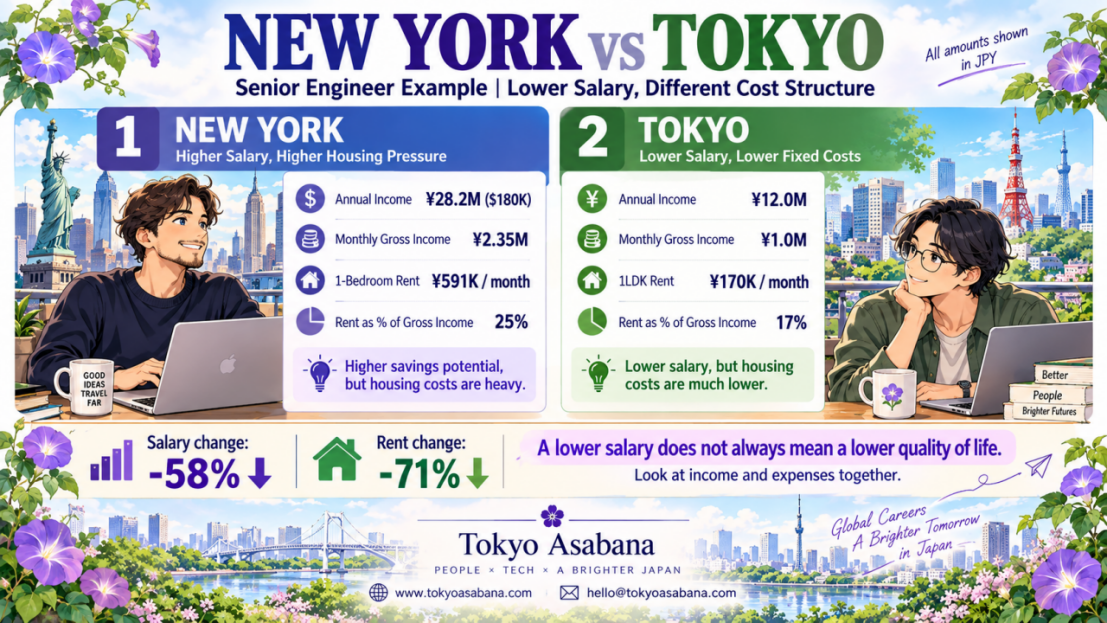
| Category | New York | Tokyo |
| Annual gross salary | ¥28.2 million | ¥12 million |
| Monthly gross salary | ¥2.35 million | ¥1 million |
| Monthly rent | ¥591,000 | ¥170,000 |
| Rent as % of gross income | 25.1% | 17.0% |
All amounts are shown in Japanese yen to simplify the comparison. These figures represent a hypothetical senior engineer scenario, not official average salaries or market-wide median rents. The results depend on exchange rates, apartment location, housing size, compensation structure, and individual circumstances.
At first glance, the difference is enormous.
The Tokyo position offers approximately 57.4% less gross annual salary than the New York position.
For an experienced professional, that is not a small sacrifice.
However, the housing expenses tell another story.
The hypothetical monthly rent falls from ¥591,000 in New York to ¥170,000 in Tokyo — a reduction of approximately 71.2%.
And as a share of gross monthly income, housing costs decrease from approximately 25% to 17%.
This is an important distinction.
A lower salary does not automatically translate into the same percentage reduction in everyday living standards.
2. Housing Costs Can Change the Financial Equation
Housing is often one of the largest fixed expenses for professionals living in major international cities.
New York and Tokyo both contain expensive residential neighborhoods, but their rental markets operate under different conditions.
According to StreetEasy’s September 2026 market report, the median asking rent in Manhattan was approximately $4,995 per month.
Meanwhile, Savills reported that average residential rents across Tokyo’s 23 wards reached approximately ¥4,909 per square meter in the third quarter of 2026.
These figures cannot be compared directly: one measures advertised rent per apartment, while the other measures rent per unit of floor area.
Nevertheless, they illustrate why housing deserves careful attention when evaluating a move.
Tokyo is certainly not universally inexpensive. Premium residences in central neighborhoods can be costly, and housing expenses vary considerably by apartment size, building age, access to transportation, and location.
However, many professionals may find that Tokyo offers a different balance between location, transportation access, and monthly rent.
An IT professional who works remotely or follows a hybrid working schedule may also have more flexibility when choosing residential areas.
The crucial question is not simply:
“Which city has cheaper apartments?”
It is:
“What kind of housing can I realistically afford in each city, and how much of my income will remain after paying for it?”
3. What Happens After Paying the Rent?
Let’s return to our hypothetical engineer.
Before taxes and other expenses, the difference looks like this:
| Monthly calculation | New York | Tokyo |
| Gross monthly salary | ¥2,350,000 | ¥1,000,000 |
| Monthly rent | ¥591,000 | ¥170,000 |
| Gross income minus rent | ¥1,759,000 | ¥830,000 |
The New York professional still has considerably more gross income remaining after paying rent.
This is important.
Lower housing costs do not automatically make Tokyo the financially superior choice.
A simplified comparison based only on salary and rent would overlook several major factors:
- Income taxes and mandatory social insurance contributions
- Healthcare and medical expenses
- Transportation and commuting costs
- Food, utilities, and everyday expenses
- Retirement savings and investments
- Family responsibilities and education costs
- Currency exposure and international financial obligations
In particular, comparing gross income remaining after rent is not the same as comparing disposable income.
An accurate financial assessment should use expected net income and realistic household spending in both locations.
The decision also depends on whether the candidate expects to remain in Japan permanently or return to the United States later.
Someone who plans to retire in Japan may evaluate financial trade-offs differently from someone whose long-term goal is to accumulate assets in US dollars.
4. Quality of Life Is More Than Purchasing Power
For some professionals, the most important motivation for moving to Japan is not financial.
Instead, they may value aspects of daily life that are difficult to express through salary figures.
Transportation and Daily Convenience
Tokyo’s extensive railway network makes it possible for many residents to commute, shop, and enjoy leisure activities without depending on a private car.
For someone accustomed to car ownership or expensive transportation arrangements, this can change their everyday routine.
Personal Safety and Lifestyle
Some international professionals place a high priority on the feeling of personal safety, neighborhood conditions, and convenience of everyday services.
These preferences may influence their decision even when the salary difference is substantial.
Housing Preferences
A professional may prefer a smaller apartment near a convenient railway station over a larger home that requires a longer commute.
Another may prioritize space, privacy, and family accommodation.
Neither preference is inherently better.
Work-Life Balance
Work-life balance can vary dramatically between employers in both countries.
Japan should not automatically be assumed to provide shorter working hours or a less stressful professional environment.
Company culture, workload, role expectations, and management practices matter much more than national stereotypes.
Quality of life is personal. A relocation that improves one professional’s lifestyle may create significant difficulties for another.
5. The Career Opportunity Cost of Moving to Tokyo
For senior IT professionals, compensation is only one part of the decision.
Career progression also matters.
New York offers access to employers across finance, technology, consulting, and other high-value industries.
For professionals pursuing senior technical leadership, specialized roles, or high-equity compensation packages, the US market may provide opportunities that are difficult to replicate in Japan.
Tokyo also has its own employment opportunities, including Japanese technology companies, multinational firms, financial institutions, and international business operations.
But the opportunities are not interchangeable.
A senior engineer considering Japan should evaluate:
Technical specialization: Does the Japanese market offer roles that match their current expertise?
Seniority: Will the position allow them to maintain their professional level, or will they need to accept a less senior role?
Language requirements: Can they work primarily in English, or will Japanese communication become necessary?
Future mobility: Will the experience strengthen their international career, or make a return to their previous market more difficult?
Compensation growth: How realistic are future salary increases, bonuses, or advancement opportunities?
For some candidates, moving to Tokyo can support a long-term international career strategy.
For others, the opportunity cost may outweigh the lifestyle benefits.
This is why career planning and relocation planning should be evaluated together.
6. What If You Are Moving With a Family?
The calculation becomes more complicated when a spouse or children are involved.
A single senior engineer renting a compact Tokyo apartment has very different financial requirements from a family seeking a larger residence and international education.
Important considerations may include:
- Whether the spouse intends and is eligible to work
- The availability and cost of suitable family housing
- Public, private, or international school options
- Children’s language needs and educational transitions
- Healthcare and family-related expenses
- The long-term residence plans of the household
International schooling, in particular, may significantly alter the financial comparison.
A move that appears affordable for one person may become much more expensive for a family with multiple children.
The reverse can also be true: a household that is comfortable using local schools, public transportation, and ordinary Japanese services may have a very different cost structure.
There is no universal household budget that works for every international professional.
7. When Moving from New York to Tokyo May Make Sense
For certain IT professionals, Tokyo may be an attractive destination even with lower compensation.
For example, the move may be worth considering when:
- The candidate already has an appropriate job opportunity in Japan.
- The salary remains sufficient to support their preferred lifestyle.
- The candidate places significant value on living in Japan.
- Professional development opportunities remain acceptable.
- Housing and family expenses have been assessed realistically.
- The move aligns with long-term personal and career goals.
In such cases, the decision may represent a deliberate trade-off between financial compensation and other priorities.
However, other candidates may reasonably decide that remaining in New York is preferable.
A professional with unusually high compensation, significant stock-based rewards, or strong promotion prospects could face substantial financial opportunity costs by relocating.
The objective should not be to prove that Tokyo is better than New York. It should be to determine which environment better supports the individual’s goals.
8. How to Evaluate Your Own New York-to-Tokyo Move
Rather than relying on generic online comparisons, professionals can begin with five practical questions.
Question 1: What Would My Realistic Salary Be in Japan?
Do not compare an existing New York salary with an arbitrary Japanese average.
Consider roles that genuinely match your technical expertise, experience, language skills, and level of seniority.
Question 2: What Would My Net Income Look Like?
Estimate taxes, social insurance contributions, and other deductions in both locations.
If the comparison involves international assets or complicated tax obligations, consult an appropriately qualified tax professional.
Question 3: What Would My Actual Household Expenses Be?
Choose realistic housing locations and estimate expenses based on your own household.
The budget of a single engineer is not comparable to that of a family with children.
Question 4: What Would I Gain or Lose Professionally?
Consider the effect on your career over the next three to five years, not merely the first year’s compensation.
Question 5: What Matters Most to Me?
Some professionals prioritize financial independence.
Others prioritize family life, cultural experience, personal safety, or the opportunity to establish long-term residence in Japan.
Your decision should reflect your priorities, rather than someone else’s definition of success.
9. How Tokyo Asabana Supports International IT Professionals
At Tokyo Asabana, I provide individualized career and life-planning consultations for overseas professionals considering Japan.
As a Japan Nationally Qualified Career Consultant with a background in IT recruitment and international career consulting, I understand that relocation decisions are closely connected with employment prospects, compensation, professional development, and personal circumstances.
For IT professionals considering a move from the United States or another country, consultations may cover:
- Realistic career opportunities and employment direction in Japan
- Japanese and English language requirements
- Job search and recruitment strategies
- Salary expectations and financial trade-offs
- Further study and professional development options
- General visa and relocation considerations
- Family needs and long-term life planning
The objective is not to persuade every client to move to Japan.
It is to help them understand their available options, potential challenges, and the implications of major career decisions.
Tokyo Asabana offers independent, paid consultations. Job placement, employment offers, and immigration approvals are not guaranteed. Regulated legal, immigration, and tax matters should be handled by appropriately qualified professionals.
Conclusion: A Lower Salary Is Not the Same as a Lower Quality of Life
Our hypothetical senior engineer comparison illustrates an interesting point.
Moving from New York to Tokyo could involve a salary reduction of approximately 58%, while the assumed housing expense falls by approximately 71%.
But those percentages alone cannot determine whether the move is worthwhile.
New York may offer substantially greater earning potential, while Tokyo may offer a different combination of housing affordability, transportation convenience, safety, and lifestyle preferences.
And financial outcomes ultimately depend on net income, actual expenses, career progression, and household circumstances.
The real question is not whether Tokyo pays less than New York.
It is whether the career opportunities, financial trade-offs, and lifestyle in Tokyo are right for you.
Before making an international career move, understand the full picture.
Considering an IT Career or Relocation to Japan?
Tokyo Asabana provides personalized career, study, and life-planning consultations for international professionals.
Explore your options before making major decisions about employment, education, or relocation.
Website: https://www.tokyoasabana.com
Services & Transparent Pricing: https://tokyoasabana.stores.jp/
Email: hello@tokyoasabana.com
Tokyo Asabana — Career, Business & Life Planning Guidance in Japan.
Data Sources and Notes
- StreetEasy — September 2026 NYC Housing Market Report — Published October 15, 2026.
- Savills Japan — Tokyo Residential Leasing Q3/2026 — Published October 16, 2026.
The senior engineer salary and housing comparison is hypothetical and intended to illustrate how compensation and living expenses interact. It does not represent a statistically matched comparison of equivalent jobs or apartments. Market data from different sources and measurement methods should not be interpreted as directly comparable. All estimates are subject to individual circumstances and changing market conditions.
Related Reading
Tokyo Asabana Services|Japan Navi for IT Professionals: Career, Study, Visa & Life Planning
Asabana Insight| Can you find a job in Japan if you only speak English?