
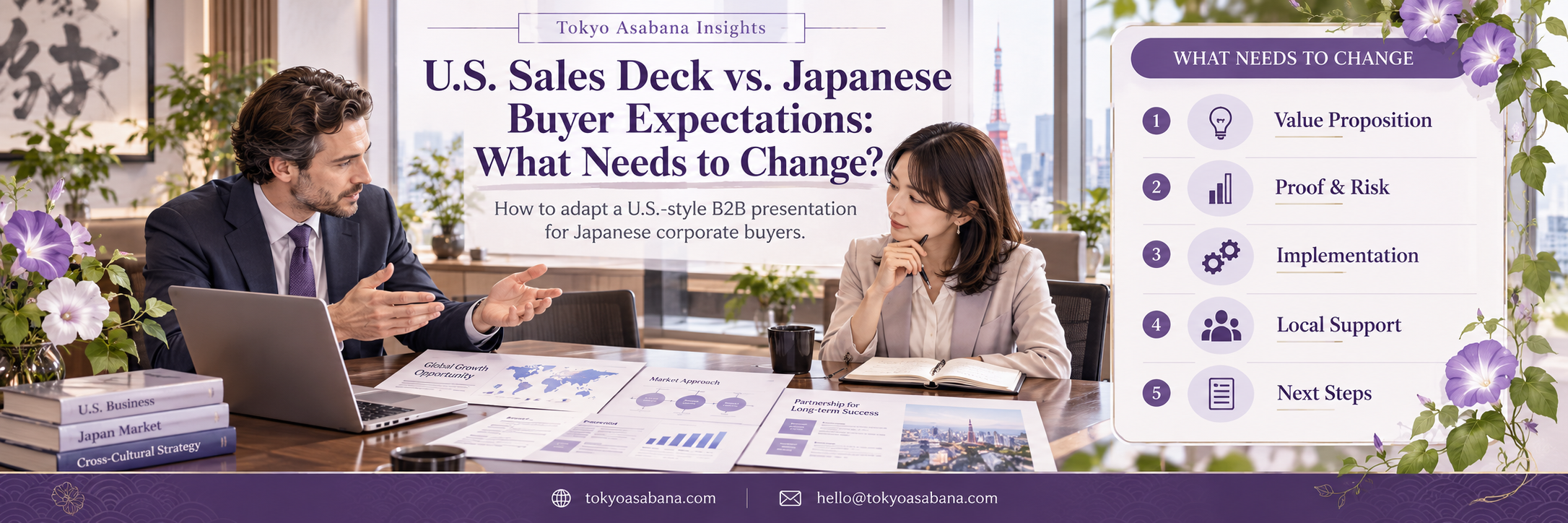
A sales presentation that works well in the United States may not produce the same results in Japan.
An American software company may have a polished pitch deck, impressive customer testimonials, strong growth figures, and a clear value proposition.
The presentation has helped the company win customers in its home market.
However, when the same materials are presented to prospective Japanese business customers, the response may be surprisingly limited.
The meeting appears positive. Participants listen carefully, ask a few questions, and thank the company for its presentation.
Then, nothing happens.
No follow-up meeting. No request for a proposal. No clear purchasing timeline.
For overseas small and medium-sized enterprises (SMEs), this experience raises an important question:
What needs to change when adapting a U.S. sales deck for Japanese B2B buyers?
The answer is not necessarily to redesign the entire presentation or translate every slide into Japanese.
Instead, companies should examine whether their materials provide the information Japanese prospects need to evaluate business value, implementation feasibility, and purchasing risk.
1. A Strong U.S. Sales Deck May Answer the Wrong Questions
Many American B2B sales presentations emphasize:
- Market opportunity and industry disruption
- Revenue growth and business expansion
- Product innovation and competitive advantages
- Customer success stories
- Expected return on investment
- A clear call to action
These elements can also be relevant to Japanese customers.
The problem is not that Japanese companies are uninterested in innovation or growth.
Rather, the importance of individual questions may vary depending on the buyer’s organization, industry, procurement procedures, and decision-making responsibilities.
For example, an American SaaS provider may emphasize that its platform can increase operational efficiency by 30%.
A prospective Japanese corporate customer may also want to know:
- How was the improvement measured?
- Can the solution integrate with existing systems?
- What happens if implementation is delayed?
- Is Japanese-language customer support available?
- Who will handle technical questions?
- What security documentation can be provided?
- What will the total cost of implementation be?
A persuasive sales deck must explain not only why the product is attractive, but also why the customer can adopt it with reasonable confidence.
2. Replace General Claims With Verifiable Evidence
An overseas sales presentation may include statements such as:
“Our platform transforms business productivity.”
“We are the most innovative solution in our industry.”
“Leading international companies trust our technology.”
Such statements may communicate ambition, but they provide limited information for commercial evaluation.
Japanese B2B buyers, particularly those working within formal procurement processes, may need evidence that can be reviewed internally.
Useful supporting information may include:
- Relevant customer case studies
- Measurable performance results
- Product specifications
- Implementation requirements
- Security and compliance documentation
- Customer support arrangements
- Pricing assumptions
- References from comparable organizations
For example:
Original claim:
“Our solution dramatically reduces administrative workload.”
More useful explanation:
“In a pilot involving a 25-person operations team, our software reduced average processing time from 40 minutes to 28 minutes per transaction over an eight-week measurement period.”
The second statement provides context, a measurement period, and a result that can be examined.
Of course, companies should use only genuine, verifiable evidence. They should not invent performance statistics or imply that results achieved elsewhere are guaranteed in Japan.
Evidence makes a business proposition easier to evaluate, compare, and discuss internally.
3. Explain Implementation, Not Just Product Features
An American sales deck may focus heavily on what a product can do.
However, an overseas supplier entering Japan also needs to explain how customers can actually use it.
For example, a U.S. technology company may demonstrate a sophisticated AI platform.
The Japanese prospect understands the potential benefits but remains uncertain about practical implementation.
Questions may include:
- Who is responsible for installation?
- What resources must the customer provide?
- Is training included?
- Can the product support Japanese-language workflows?
- How long will implementation take?
- What happens if the system encounters problems?
- Will support be provided remotely or locally?
These questions are particularly important when the overseas company does not have a Japanese subsidiary or permanent local team.
A localized B2B presentation should therefore include a realistic implementation outline.
For example:
| Topic | Information to Prepare |
| Onboarding | Required steps and responsibilities |
| Timeline | Estimated stages and dependencies |
| Technical Integration | Compatibility and integration requirements |
| Training | Format, language, and availability |
| Customer Support | Contact channels, hours, and escalation procedures |
| Commercial Terms | Pricing, payment, and contract conditions |
| Risk Management | Known limitations and issue-resolution procedures |
Not every sales deck needs a detailed technical appendix.
However, the company should be prepared to provide supporting documents when serious prospects request them.
Implementation clarity can be just as important as product differentiation.
4. Understand the Japanese Buyer’s Internal Decision Process
One common mistake is assuming that a successful introductory meeting means a purchasing decision is close.
In Japan, as elsewhere, B2B purchasing processes can involve several stakeholders.
Depending on the organization, these may include:
- The department requesting the solution
- Operational users
- Technical specialists
- Information security teams
- Procurement departments
- Finance departments
- Legal or compliance personnel
- Senior management
Some Japanese organizations use formal internal approval procedures, including processes often described as ringi.
However, not every company follows the same process, and decision-making practices differ substantially between startups, SMEs, large corporations, and public institutions.
The practical lesson is straightforward.
Your presentation may need to support an internal business discussion, not only persuade the people attending the meeting.
For example, the person receiving your presentation may need to explain your service to colleagues who have never met your company.
A useful deck should therefore be understandable without requiring the salesperson to be present for every explanation.
Consider including:
- A concise statement of the business problem
- A clear explanation of the proposed solution
- Relevant evidence
- Financial implications
- Implementation responsibilities
- Risks and limitations
- A practical next step
For overseas SMEs, this can help reduce repeated clarification requests and make follow-up discussions more productive.
5. Adapt the Value Proposition to the Japanese Customer’s Actual Priorities
A company should not assume that the same selling points will carry equal weight in every country.
For example, an American business software provider may use the following message:
“Scale faster and disrupt your industry.”
However, a particular Japanese customer may be more concerned about:
- Reducing manual processing
- Addressing labor shortages
- Improving service consistency
- Supporting existing employees
- Maintaining business continuity
- Controlling implementation costs
In that situation, a better sales message may be:
“Reduce repetitive administrative work while maintaining existing operational procedures.”
The second proposition does not necessarily describe a different product.
It describes the product in relation to a different customer problem.
This is the difference between translating marketing language and localizing a commercial proposition.
Of course, Japanese companies are not a uniform customer group. A fast-growing Japanese startup may respond positively to aggressive expansion messaging, while an established manufacturer may prioritize operational reliability.
The correct value proposition depends on the target customer’s needs, not nationality alone.
6. Make Pricing and Commercial Conditions Easier to Evaluate
A U.S. sales presentation may focus on the benefits of the product and postpone commercial details until later discussions.
That approach can work in some circumstances.
However, overseas companies should be ready to explain how their pricing model applies to Japanese customers.
Important questions include:
- Is pricing quoted in USD or JPY?
- Is payment made to an overseas entity?
- What costs are excluded?
- Are onboarding or implementation fees required?
- Is there a minimum contract term?
- What happens at renewal?
- Are taxes and other charges handled separately?
- Are local support services included?
For example, a SaaS provider advertising a monthly subscription may also charge for implementation, integration, training, and additional users.
If these expenses are not explained, the prospective customer may have difficulty assessing the total commitment.
Companies should avoid presenting speculative Japanese pricing as confirmed.
Where currency conversion, tax treatment, contract enforceability, or regulated issues are involved, appropriate professional advice may be necessary.
Commercial transparency helps prospective buyers determine whether a proposal is practical within their budgets and approval processes.
7. Localization Is More Than Japanese Translation
A common approach to entering Japan is to translate an existing English sales deck into Japanese.
Translation can improve accessibility, but it may not solve deeper communication problems.
Consider the difference between the following tasks:
Translation
Converting existing English content into Japanese while preserving the original meaning.
Localization
Adapting the structure, terminology, examples, and commercial explanations to the intended Japanese audience.
Commercial Adaptation
Reconsidering which information should be emphasized based on the customer’s industry, purchasing criteria, and business needs.
A properly adapted sales deck may require all three.
For example, overseas customer testimonials may still be useful, but Japanese prospects may need additional information about whether the solution can operate in Japan.
Similarly, an American company may emphasize its global market position while prospective customers ask about local support arrangements.
The company should also review terminology carefully.
Expressions that sound natural in American marketing materials may become vague, excessively promotional, or difficult to interpret when translated literally.
The objective is not to make the presentation sound more Japanese. It is to make the business proposition clearer and more relevant to its audience.
8. Show How Overseas Delivery Will Actually Work
For American SMEs without a Japanese office, local delivery is often an important commercial question.
A prospective customer may be interested in the service but uncertain about how business communication and support will function across borders.
The sales deck should explain the company’s actual delivery model.
This may include:
- Remote service delivery
- English or Japanese communication options
- Meeting coordination across time zones
- Support hours
- Escalation procedures
- Availability of Japan-side coordination
- Responsibilities of external partners
- Contracting and invoicing arrangements
For example, an overseas consulting company may deliver the core professional service remotely while engaging Japan-side support for selected business communications and coordination.
Such an arrangement can be practical, provided the roles and responsibilities are clearly agreed upon.
Companies should not claim to have a Japanese office, local employees, or guaranteed Japanese-language support unless those capabilities genuinely exist.
A credible delivery model is more useful than an exaggerated impression of local presence.
9. Avoid Assuming That a Positive Meeting Means a Qualified Opportunity
American sales organizations often rely on pipeline stages, conversion rates, and defined next actions.
Those practices can be useful in Japan as well.
However, overseas companies should distinguish professional courtesy, exploratory interest, and genuine commercial readiness.
For example, a prospective Japanese company may:
- Attend a presentation
- Ask questions
- Request additional materials
- Express interest in future discussions
These actions may justify follow-up, but they do not automatically establish purchasing intent.
More meaningful commercial signals may include:
- A clearly identified business requirement
- Engagement from relevant decision-makers
- Discussion of implementation feasibility
- Requests for specific commercial terms
- Evidence of an available budget
- A defined decision timeline
- Agreement to evaluate a pilot project
For overseas SMEs, it is important to record what has actually been confirmed.
A CRM entry marked “Interested” should not be treated as a near-certain sale simply because the introductory meeting went smoothly.
A good sales presentation should generate useful commercial information, not merely positive reactions.
10. Replace the Generic Sales Call to Action With a Practical Next Step
Many U.S. sales decks conclude with phrases such as:
“Let’s transform your business together.”
“Book a demo today.”
“Join the future of innovation.”
These messages may be suitable for certain products and audiences, but a Japanese B2B prospect may benefit from a more specific next step.
Depending on the business, this could be:
- A technical evaluation meeting
- A discussion with the relevant department
- A written clarification of pricing and service scope
- A limited pilot proposal
- A product demonstration for operational users
- A review of integration requirements
- An introductory meeting with potential partners
For example:
Generic closing:
“Let’s revolutionize your operations.”
More actionable closing:
“If the solution is relevant to your operations, we can arrange a 30-minute technical discussion to review your existing workflow, implementation requirements, and potential pilot scope.”
The second version gives the prospective customer a clearer understanding of what will happen next.
It also creates a more useful basis for qualifying the opportunity.
The best call to action is not necessarily the most ambitious. It is the one that helps the customer make the next practical decision.
11. U.S. Sales Deck vs. Japanese B2B Buyer Expectations: A Practical Comparison
The following table summarizes common areas worth reviewing.
These are not universal cultural rules. They are practical questions for companies adapting their sales materials to a different market and purchasing environment.
| Presentation Element | Common U.S.-Style Emphasis | Questions to Address for Japanese B2B Buyers |
| Opening | Market disruption and growth | What specific business problem is being solved? |
| Value Proposition | Innovation and competitive advantage | How does the solution fit existing operations? |
| Evidence | Growth metrics and global testimonials | Are the results relevant and verifiable? |
| Product Features | Capabilities and differentiation | How will implementation and integration work? |
| Pricing | Subscription value and ROI | What is the full commercial commitment? |
| Support | Standard customer service | Who handles Japanese customer inquiries and issues? |
| Decision-Making | Persuading the primary buyer | Can multiple internal stakeholders evaluate the proposal? |
| Closing | Immediate conversion or product demo | What practical evaluation step should follow? |
The goal is not to remove creativity, confidence, or persuasive messaging from American presentations.
It is to ensure that buyers receive the information they need to consider an unfamiliar overseas supplier.
12. A Practical Sales Deck Structure for Entering Japan
For an American SME preparing to approach Japanese corporate customers, the following structure can provide a starting point.
Slide 1: Company Introduction
Who you are, what you provide, and which customers you serve.
Slide 2: Target Customer Problem
The specific operational or commercial challenge your solution addresses.
Slide 3: Proposed Solution
How the product or service works, using clear and concrete language.
Slide 4: Business Value
Relevant benefits, supported by evidence where available.
Slide 5: Customer Examples
Verified case studies or relevant implementation experience.
Slide 6: Implementation Approach
Required steps, responsibilities, and expected dependencies.
Slide 7: Japan-Side Delivery and Support
How communication, support, and coordination will operate.
Slide 8: Commercial Structure
Pricing framework, contractual scope, and potential additional costs.
Slide 9: Questions and Evaluation Requirements
Issues the prospective customer may need to clarify internally.
Slide 10: Proposed Next Step
A realistic pilot, technical review, or follow-up discussion.
Not every company needs exactly ten slides.
A short, relevant presentation may be more effective than a longer deck containing unnecessary information.
The objective is to create materials that support actual B2B discussions rather than simply deliver a polished marketing message.
13. How Tokyo Asabana Supports Overseas Companies Approaching Japanese Buyers
Tokyo Asabana provides Japan market entry advisory, business research, trilingual business communication (Chinese, Japanese & English), business development support, and local coordination services for overseas companies.
For American SMEs preparing to introduce products or services to Japanese organizations, project-based support may include:
- Japan market entry advisory
- Target customer and competitor research
- Review of Japan-facing business positioning
- Business material localization and communication support
- Potential customer or partner identification
- Targeted business outreach
- Meeting and stakeholder coordination
- Selected Japan-side project support
For companies already using an English-language sales deck, the first step may be to review whether their existing materials answer the practical questions relevant to their intended Japanese customers.
Depending on the project, additional research or Business material localization and trilingual communication support (Chinese, Japanese & English) may be appropriate.
Tokyo Asabana does not guarantee customer acquisition, meeting acceptance, sales conversion, or purchasing decisions.
Our services are provided under clearly defined scopes and commercial terms.
Corporate Consultation Options
- 30-minute preliminary corporate consultation: JPY 4,400
- 60-minute corporate advisory consultation: JPY 44,000
The preliminary consultation fee may be credited toward a qualifying subsequent consultation within 14 calendar days, subject to applicable terms.
Market research, business material localization, customer identification, outreach, and local coordination are separately scoped and quoted.
Conclusion: Your Product May Not Need to Change, but Your Sales Presentation Might
When an American company’s sales deck receives limited engagement in Japan, the problem is not necessarily the product itself.
The presentation may simply be emphasizing information that does not fully address the prospective customer’s commercial concerns.
Rather than translating an existing deck word for word, overseas SMEs should evaluate whether their materials clearly explain:
- The customer’s specific business problem
- The proposed solution and its limitations
- Relevant evidence
- Implementation requirements
- Commercial terms
- Delivery and support arrangements
- Internal evaluation considerations
- A realistic next step
Japanese businesses differ greatly in their size, industry, international experience, and decision-making practices.
There is no single presentation format that guarantees success across the entire Japanese market.
However, a practical, evidence-based approach can make overseas business proposals easier to understand and evaluate.
A strong sales deck does more than make buyers interested. It helps them understand how a business relationship could actually work.
For overseas SMEs entering Japan, that distinction can make a meaningful difference between an interesting introductory conversation and a commercially useful next step.
Need Help Adapting Your Business Approach for Japan?
Tokyo Asabana supports overseas companies with Japan market entry advisory, market research,Business material localization and trilingual communication support (Chinese, Japanese & English), business development, and local coordination.
If your existing sales materials are not generating meaningful discussions with Japanese prospects, a paid corporate consultation can help you examine your approach and identify practical next steps.
Website: https://www.tokyoasabana.com
Services & Transparent Pricing: https://tokyoasabana.stores.jp/
Email: hello@tokyoasabana.com
Related Reading
Tokyo Asabana Insights|What Does Japan Market Entry Support Actually Include?